Recessed Lighting Problems
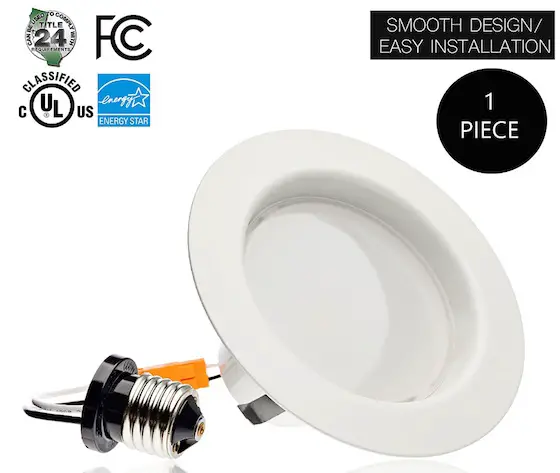
Recessed lighting problems solved with kit | You can solve your recessed light issue in minutes working from inside the room. No repainting, no hassle! CLICK THE IMAGE NOW TO BUY THIS GREAT LIGHT. MULTI-PAKS are available.
"There are several reasons why your recessed lights turn off by themselves."
Recessed Lighting Problems Checklist
- Heat sensor in fixture turning off lights
- Bulb wattage possibly too high
- Insulation trapping excess heat
- Wrong recessed housing leaking air
- CLICK HERE to Get Tim's FREE & FUNNY Newsletter!
DEAR TIM: My husband installed some recessed lights in a family room we just built. I think he goofed something up. Every time I turn the lights on, ten minutes later they automatically turn off.
Also, I feel a draft through these fixtures. Did we make a mistake purchasing recessed lights? T. G.
DEAR T. G.: No. However, your husband very likely made several mistakes during the installation. Some of these are potentially very serious and could result in a fire.
FIRE HAZARD: Do not use the lights again until you have them checked by a professional or by your local electrical inspector. By the way, the electrical inspector DID look at the lights and wiring before they were covered, didn't he? I hope your flashlight batteries are fresh.
CLICK HERE to get FREE & FAST BIDS from local electricians who specialize in recessed lights.
Can Recessed Lights Produce Layers Of Light?
Recessed lighting is a very functional type of lighting. It can be used to create a border of light in a room, flood work areas with light, spotlight pictures or sculptures, and as general purpose lighting.
Personally, I prefer to mix recessed lights with other types of lighting fixtures such as indirect lights and hanging fixtures. This creates layers of light that can be peeled from one another to create different moods.
Is the Thermal Protection Switch the Issue?
There are several reasons why your recessed lights turn off by themselves. All Underwriters Laboratory (UL) approved recessed lighting fixtures produced since the early 1980s must have a thermal protection switch built into the fixture. This device will turn off the light if the temperature inside the fixture gets too hot.
It turns off the light so the excess heat doesn't melt the plastic insulation on the electrical wires. If that insulation melts, arcing can happen and a fire results.
After the light cools down, the sensor resets itself allowing the light to turn back on.
If this is what's happening to you, your lights are telling you there is a problem that must be addressed.
Does Ceiling Insulation Trap Heat?
Your problem may be the ceiling insulation. Some recessed fixtures are allowed to be smothered in insulation. These often are designated IC fixtures.
Fixtures without this designation must have a minimum of 3 inches of clearance between the fixture, its junction box, ballasts and any insulation.
The National Electric Code specifically states that nothing should be installed above these fixtures that will either trap heat or block free air circulation through the fixture.
Is Light Bulb Wattage Important?
The wattage of the light bulbs is important. More wattage means more heat. The fixture is rated for a maximum bulb wattage.
In your case, your husband may have installed a fixture without the IC designation. If insulation is too close or on top of this fixture, the fixture will overheat. The problem may also be as simple as the light bulb within the fixture. If it is too large (too high a wattage), the bulb is creating too much heat.
Where is the Bulb Wattage Label?
Remove the bulb and look inside the recessed light housing. You should see labeling which tells you the maximum wattage of the bulb that you can place in the fixture. Be sure to use the approved light trims for the fixture as well. Intermixing trims between fixtures can cause you to lose your UL rating.
CLICK HERE to get FREE & FAST BIDS from local electricians who specialize in recessed lights.
Am I Supposed to Feel a Cold Draft Through the Light?
The draft you feel is unnecessary. Many manufacturers now make recessed lights that are completely sealed. Using these fixtures can save you money.
A single recessed light fixture that's not airtight can allow up to 2.5 million cubic feet of air to pass through it in one year. This type of air flow could waste up to 1 million BTU's of energy loss per fixture per year!
Are There Great DIY Electric Books?
If you're looking for a great book for installing simple wall lights to running wire in new construction and in existing walls and ceilings, then Wiring a House is the book for you.
I own this book. Rex Cauldwell makes it easy to understand perplexing electric. CLICK THE IMAGE TO ORDER IT NOW.
This book, written by master electrician Rex Cauldwell, is sure to become an indispensable reference for anyone who wants a common sense guide to residential electricity. The photos and illustrations featured in this book are clear, crisp and easy to understand.
If you're looking for a book with invaluable information on tools and materials, detailed instructions for how to repair or replace the wiring in old buildings and bring them up to code then you need a copy of Old Electrical Wiring. This 400-plus-page book tells you everything you could ever imagine about switch layouts, troubleshooting, and design change.
It also has an extensive glossary of old wiring terms and slang. Packed with drawings and illustrations, including pictures of old devices, this practical book will tell you whether an old electrical system should be torn out or repaired. This book will really help you.
If you have an older home, this is a must-have book. CLICK THE PHOTO NOW TO HAVE THIS BOOK DELIVERED TO YOU BY SPECIAL COURIER.
CLICK HERE to get FREE & FAST BIDS from local electricians who specialize in recessed lights.
Column 091

Tim built custom homes and did ultra-custom remodeling for 20+ years before launching his Ask the Builder media presence. He was selected as one of the Big 50 by Remodeling magazine in 1993. This award gave birth to Ask the Builder in October 1993. Tim also operates https://DrawPlumbingPlans.com. His @askthebuilder YouTube channel was the first home improvement channel on YouTube.

Tim,
I recently installed twelve 6" canned lighting units in my home. I purchased 6" LED lights as my light source. All of the LED lights fit perfectly - flush mounted with the ceiling. However, three of the LED lights seem not to fit entirely inside the canned unit. When I attempt to insert the LED light into the can, it either slips/pushes back or seemingly will not fit properly. The tensioners are in working order and both the canned unit and LED lights are 6" in size. I checked to see if I could adjust the inside height of the canned unit socket and determined that was not an option.
Have you any suggestions?
Thank you for your assistance.
One of two recessed lights is going off and on about every 4 minutes. I removed all the insulation that might be a problem. The insulation doesn't appear to be the problem. The light next to it (about 4 ft .away) works perfectly. I have disassembled the problem light and can't identify a "thermal protector" and can only assume that it may be in a metal box near the fixture. There is a flex line running from that box to the small metal cup that holds the ceramic socket. Can you give me a clue as to what to look for?
Can lights worked fine but now only half as bright as when installed. Could this be a switch gone bad?
"Your husband very likely made several mistakes during the installation..." I don't think your target audience of DIYer husbands finds much pleasure in this kind of tone and will likely seek their advice elsewhere.
Chuck, are you serious? Am I supposed to not tell the truth? If her husband made mistakes, shouldn't I acknowledge them? Me thinks you're a bit sensitive. Toughen up buddy.
Tim, I've got 4 recessed lights in the kitchen that operate off the same switch. One light I though blew, so I put a new bulb in, and nothing. Thought that bulb maybe was bad also, so I take one from a working light and put it in it, and still nothing. I put that light back in the working one and it's bad now also!! What the heck is goin on? Any ideas? The lights were installed by a licensed elec. and passed insp. I'm a carpenter, and have zero experience as far as troubleshooting electrical. Thx.
John,
Read my past column about light bulbs burning out. That could be the issue!
Light was crooked I went to straighten it flashed all lights went out took socket holder out put in new bulb reset circuit breaker all lights worked but the one light socket hangs with a white and black wire from top of can with a looks like small chip at top of can have not taken can apart yet ?? This doug
Take it apart. Diagnose what is broken. Fix it. Very simple. This is Tim.
Hi Tim. 2 out of 3 Recessed lights in our bathroom has gone, but getting the fitting out to replace the bulbs seems impossible. The fitting does not twist and cannot be pulled out. It looks like it has been sealed in? Can that be true? Do I really need to start cutting away the white silicon rim around the fitting? Nikoline
I wish I could help you, but without being there to see this thing I'm at a disadvantage. I can tell you this. Think how the light was installed. Almost ALWAYS the electrician puts in a rough housing. Then the drywall or plaster people come and the painter. Then the LAST THING is the electrician putting in the trim that you see to finish it off. Remove the bulb and really inspect the inside of the fixture for springs. Sometimes the trim is held in by a tension clip. Good luck to you!
Thank you for getting back to me so quickly! The problem is that I can't even get to the bulb as the cover seems to be sealed all the way around to the ceiling (basically it looks like it's glued to the ceiling). Is this normal practice in bathrooms. The rest of the lights in our home do not have this seal.
Tim,
I've just installed six rerecessed Philips LED lights and a Leviton dimmer. everything works great, but when the lights are off you can still see a faint glow. What could be the problem? Thank you
phantom electricity. The glow should go away after a few minutes. Does it? Or do they glow for hours at night?
Tim,
Tried 4 different switches with no luck, then I pulled the light from the can and it shut off completely, as soon as I put it back in it came back on. The can is not energized, I checked with my voltmeter. I even put electrical tape on the metal springs that hold the light and that didn't work. Now I'm very confused
Very common actually. Half the dimmers in my home only reduce to a very dim glow. I have had some that have a distinct OFF click and those go off. On the bright side, I don't mind 'cause they act like night lights.
I was told they stay on constantly. My thought is a bad switch?
I thought maybe my bulb blew out in my recessed lighting. Went to replace it and the socket seems loose and spinning. Checked others and no problem with them. Blew the circuit and tried again to tighten the bulb. It blew again. Can not get light to work. How do I tighten the socket inside the recessed lighting. Thanks, Linda
You need to call in an electrician. You have a SERIOUS fire hazard. The socket wiring is shorting out. TURN OFF THE BREAKER NOW and get an electrician out there as soon as possible.
Sorry to burst your "I'm a professional" bubble, but LEDs (Light Emitting Diodes) are DIFFERENT than "conventional" (incandescent) bulbs.
SOME (many) LED bulbs are simply not designed to operate with a dimmer circuit (which, as you SHOULD know, does NOT cut off ALL power to the circuit [unless the cut-off switch is used to remove power to the circuit]).
Replacing the LED bulbs with LED bulbs that are DESIGNED to be used with dimmer switches will resolve the issue.
In other words, it's THE BULB, not the SWITCH/CIRCUIT!
Mark,
Linda wasn't talking about LEDs nor a dimmer switch. You've got everyone here confused with your reply.
I have two recessed lights that keep shitting off and no insulation covering them. I replaced the 75 watt floods with 75 watt equivalent LED floods, same thing happened. So I went a step further down to smaller 49watt equivalent LED floods they still shut off. They've been doing this for years so I want to finally get them taken care of. I'm told there are specific lights I need to use and was curious if you might have more info by chance?
Appreciate and guidance.
Hi Tim, I have a similar problem as Linda from March 22, 2015 except that I am not blowing any circuits. The recessed lighting appears to burn out, but when I reach up to twist the bulb it will turn on again. Within the day, the bulb seems to "burn out" again. All other lights recessed cans remain lit. I reach up, twist, and the seemingly burned out bulb turns on once again. Is this the same serious issue as Linda? Any insight is appreciated... Thanks.
I recently installed a series of 5 recessed lights in a ceiling with no insulation. The LED Lights work fine, but one gets very hot, as hot as an incandescent bulb. The bulbs in the other fixtures are fairly cool to the touch. I've tried swapping bulbs and using different kinds of bulbs, and they all get very hot in that one fixture. Could it be a bad fixture?
As Tim mentioned, first be sure you installed proper, IC-designated fixtures. Nothing is perfect and LED lighting is still essentially in its early stage of development. Like any electronic device, LED bulbs generate heat (more than CFL in fact). However, if you have one that is noticeably hotter than the others, it is likely defective. I would try to return it for replacement or contact the manufacturer. In the meantime, I wouldn't use it. Also like any electronic device that is malfunctioning, it can catch fire all by itself.
I have an old recessed lighting fixture over my kitchen sink. It began turning on and off by itself a few weeks ago. On for 7 minutes and off for 1-2 minutes. I replaced the light switch, removed the ceramic light socket and metal cover in the fixture, removed the metal flex to the fixture, and replaced the light fixture with a new LED 18Watt surface mounted fixture. It is tied into the same Romex wiring. AND IT IS STILL GOING ON AND OFF!!!! Where should I look for the thermistor to remove it from the remaining parts of the old fixture?
Anything else on that circuit acting strangely? I just inspected a job where the suspect light was actually the victim of a very lightly loaded GFI outlet. If this circuit is a on a GFI protected circuit, cycle the GFI breaker(s) a few times and see if this helps.
I just had recessed lighting installed in my basemenr. When I turn the lights off there is still a faint glow in the bulbs. What could this be?
Are your lights turned off with an actual switch or a combo dimmer/switch. I find it very common for dimmers to leave the bulbs dimly lit when at their lowest settings. On the other hand, if you have an actual switch, or the dimmer has an actual OFF position (you can feel the click), then I would get an electrician in to inspect the wiring to make sure all is proper (blk on blk, wht on wht, grn on grn, never the twain to meet except in the Main Panel 🙂 ).
Tim: I've seen several questions now that mention this "glowing" effect with canned lights. Is there something about canned lights specifically that might cause this (i.e., luminescent coatings or materials)?
Hi Tim I just had hallo 6 inch high hats installed. The first two turned on the other six will not go on. The wiring is good. Driving me nuts.
Simple. Loose connection between #2 and the other 4.
Hoping you can help, we have 4 dimmable recessed lights in our living room. Our house was built in 2004 and we have lived here for 5 years. During the last year one of the lights has started turning on or off for anywhere from a couple of seconds to a minute. I've tried tightening the bulb and it seems to fix it for a few days and then starts up again. Same when I change the bulb. Now the bulb has burned out completely. Could it be a bad fixture? All the other lights that run off the same switch work fine. We have dimmable LED bulbs from Costco in all the fixtures. And all the lights have 3 way wiring. I'm not sure if we need to replace the fixture or if we might have something else going on? We did rewire the light switches prior to all this starting, but since the other lights work fine I don't know how that could be the problem. Any suggestion on what to look for?? Thanks so much!
Recently moved into new house with recessed lighting with MR16 sockets. One particular area in the basement two lights are connected to the same light switch but one no longer works. Checked behind the switch for loose or frayed wires and they all seemed fine with juice flowing (checked with voltage meter). Took apart the broken light and first checked for bad bulb. Checked it against the one that is working and it worked. Then I check for juice and both lights had juice. What could be the problem? I replaced the M16 on the one that isn't working, checked it for juice and replaced new bulb and it still doesn't work. Thoughts?
We just bought a new home and the can light take a while to brighten up. Is this normal? The family room, hallway and master bedroom do not but they are slso on a dimmer...
Yesterday I installed 4 juno ic22 recessed lights, and wired them today. Before hanging sheetrock, I put 2 light bulbs (not the ones I intended using) at the first and last light in the run, wired up the switch, and they turned on fine. Just got done hanging the last piece of sheetrock on the ceiling and attempted to turn lights on again and a spark emitted where one of the rails on the light fixture was touching the ductwork and tripped the breaker. (???) Ripped the sheetrock off and moved the arm away from the duct, which hangs below the ceiling height, and flipped breaker back on and attempted to test them again. There is a humming noise coming from the lights, which stay on for about 4-5 seconds, then trips the breaker again. Anyone have any info on this??
Hi Tim, we had our recessed can lights installed in our remodeled kitchen and also into a porch area that was closed in and is now part of the house. New wiring in the porch area. when I turn on the recessed lights there I hear a high pitched ringing noise (as if I had ringing in my ears). It doesn't happen in the kitchen. Both sets are on dimmer switches. Is it the lights or the switch?
Several high hats in my 30 year old home have slipped away from the ceiling. Do you know of a way to tighten them upward? Thanks
Wwe have recessed lighting in both our living/Dining room and kitchen. the fixtures all seem the same as do the bulbs (same wattage). However the kitchen lights are much duller brightness and yellowish. Could this be a voltage issue?
No. Bulb color temperature. Read my columns about that topic.
I have two 12v 50w pendant halogen lights over my sink. I switched to 12v 5 w LEDs. Now after being on for about 5-10 minutes, one of the lights goes off while the other stays on. Both are on the same switch. Any thoughts as to how to remedy this issue? After turning them off, they both go on for another short period. Thanks in advance for any help.
I replaced a 65 watt flood light in one of my kitchen can lights and it would not light. The bulb was ok, so I tried a standard 60 watt light bulb which did light. There was a hissing sound before the flood light went out. The lights are about 8 years old. Any ideas? Thanks.
I have an intermittent clicking sound coming from pot light (14 yr old house ,prof installed) took the buld out still getting a clicking sound.
I have exterior can lights in my eaves. One has stopped working, thought it was the bulb, which I changed. Build will blink while screwing it in the socket, but can't find a spot where it will stay lit. Have cleaned socket, but still get nothing other than the blink. Suggestions? Can I simply change out the porcelain socket YF 603, with another socket, or does whole unit have to be replaced?
I have 4 newly installed LED ceiling cans, and all working fine over last couple weeks. Now none come on at all. Checked power with sensor - and power is good going into all lights. Had a spare new LED bulb and plugged it in and also does not work even though power is good to it. Any thoughts?
Yes. When you take apart the box that contains the 120-volt incoming power lines, what happens when the switch is on and you put your voltmeter leads across the hot and neutral? Are you getting 120 volts to the fixtures???? Problem could be a wire nut that's come undone in the first fixture in the chain.
Hi Tim,
I have 6 recessed lights in my kitchen. All turn on with the switch except 1. This one will turn on after I wiggle it, tighten, or loosen the bulb. If the bulb isn't in "the sweet spot" this light will not turn on. I have replaced the bulb, and the issue remained. What is the next step in troubleshooting the issue? Thanks in advance!
Read my past column about light bulbs burning out too fast. The issue is with the brass tab at the bottom of the socket.
I have recessed lighting in my kitchen. 1 bulb burnt out, and after replacing it, the new bulb turns on like 1 second after all other bulbs. what would cause this?
How about an led retrofit that lights after a Short delay. sometimes nothing, 2-3 seconds partial bright, then 2-3 seconds full bright?
Tim, I live in a 2 story house built 2004 we are first owners. Have recessed lighting throughout house and have been very happy with it. My son who live upstairs recently saw one of our fixtures protruding from the ceiling about 2 inches. The fixture is easy to get too from above since it is an accessible attic and it it close to access ladder.
We cannot push it up from below or pull it back up from above. Are there some brackets that hold it up that may be hidden with the insulation that we are not seeing? We have cleared most of the insulation from around fixture!!!
Any idea you may provide would be helpful.
Light still operates.
Remove the trim and look for screws on the inner adjustable metal housing. They are made to adjust up and down to account for different ceiling material thicknesses.
I have 8 pot lights in my basement rec room four of them in a row just went out
What could the problem be
They are on the same dimmer switch
Four are still working
We have 4 canned recessed lights in our kitchen. We have used regular and LED bulbs in them for years. We are updating and I purchased
HALO 5 inch and 6 inch Recessed LED Can Light – Retrofit Ceiling & Shower Downlight, Baffle White Trim, Selectable CCT (2700K-5000K), 600 Lumens
We set them to 2700.
3 of them installed great and work great. The fourth will not go on. We checked the Halo unit and it works fine - just not in this can. We put the bulb back in and it works fine...
Any ideas??