Load Bearing Wall Identification
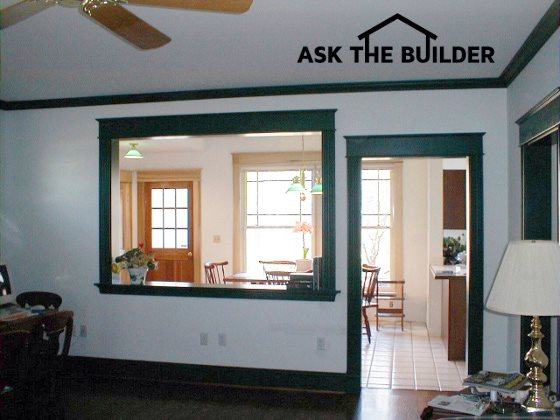
This load bearing wall separates my family room from my breakfast room. You would be shocked to discover the enormous loads concentrated in this wall, even with the doorway and large opening. © 2018 Tim Carter
"All walls tend to look the same. A cleverly placed bearing wall can be as dangerous as a stealth bomber. Remove one without adequate re-support and all sorts of things may drop down on you."
Load Bearing Wall ID TIPS
- Giant openings can be in a load bearing wall!
- Walls parallel to floor joists can be load bearing!
- WATCH my Bearing Wall ID video Below!!
- NEVER GUESS - CLICK HERE to GET FREE BIDS from a residential structural engineer to be SAFE
- CLICK HERE to get Tim's FREE & FUNNY Newsletter!
DEAR TIM: I need to know how to tell if a wall is load bearing. I would like to knock down a short wall between my kitchen and dining room that is just four feet long.
To the best of my knowledge, there are no electrical or plumbing lines in the wall. There is a phone line in this short wall. The wall does run perpendicular to the floor joists above and below the wall. What are my options? Do you think this is a load bearing wall? Tim G., Rochester, NY
DEAR TIM: Bearing walls have a mystic aura all their own. Plaster, drywall and wood paneling finishes that are applied to all interior and exterior walls act as a very effective camouflage in the average residential home.
All walls tend to look the same. A cleverly placed bearing wall can be as dangerous as a stealth bomber. Remove one without adequate re-support and all sorts of things may drop down on you.
CLICK HERE to get FREE & FAST BIDS from structural engineers about your load-bearing wall dilemma.
Related Links
How to Modify a Load Bearing Wall
Cut a Load Bearing Wall Stud - Yes, It Can Be Done!
What is a Load-Bearing Wall?
A bearing wall is a wall that has loads (weight) bearing down on it from above. It is a structural element within a house or home. Floor, ceiling, and roof loads from above are common loads that bear down on a bearing wall.
They typically are carrying and transferring a load from one point to another. In a properly designed home, the loads eventually get transmitted to a foundation, a thickened part of a slab and/or a concrete footer that supports a column or post.
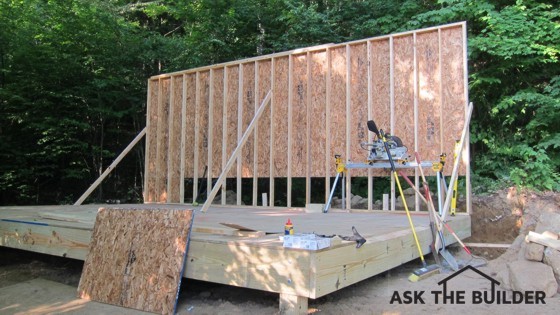
This is a large storage shed under construction. The wall you see will be load bearing and each roof rafter will sit directly on top of each wall stud. ©2018 Tim Carter
Knowing this, you can work up from these elements in the average home and locate many structural elements and bearing walls. But beware, some loads are very well hidden and not all bearing walls are found in the middle of a structure.
Are Exterior Walls Bearing Walls?
The exterior walls on houses that support the roof are primary bearing walls. Not all exterior walls are bearing walls though. There are many houses where just the front and back walls are bearing walls.
My home is different. Because I have a hip roof that slopes towards each exterior wall, each of those walls is carrying some roof weight. To make it even more complicated, the second floor of my home has a smaller footprint than the first floor.
Can an Interior Wall Support a Roof?
Some first-floor interior walls are actually supporting the main roof of my home. This innocent looking wall in the photo below with two openings in it is a bearing wall that supports 20 percent of the roof and 33 percent of the second and third floor loads!
This wall separates my family room from my breakfast room. You would be shocked to discover the enormous loads concentrated in this wall, even with the doorway and large opening. © 2018 Tim Carter
Do Bearing Walls Run Perpendicular to Floor and Ceiling Joists?
Yes, interior walls that run perpendicular to the run of the floor joists above and below are almost always load-bearing walls. But there are many a wall such as this in a home that are not bearing any weight whatsoever.
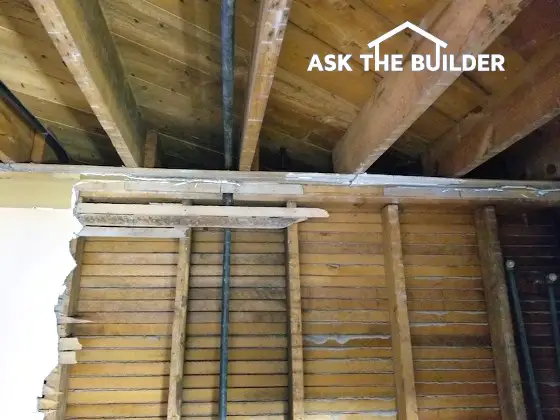
This is a load-bearing wall. Note how the floor joists above are passing over the wall at a 90-degree angle. You can see where the floor joists overlap one another on top of the wall. This is a CLEAR SIGN the wall is load bearing. Copyright 2018 Tim Carter
It's important to realize if you discover a wall or a beam directly below this wall or parallel with the wall within a short distance, then the suspect wall may be a bearing wall. Bearing walls are not always stacked one on top of another. This is why detection and identification is an exact science.
Free & Fast Bids
CLICK HERE to get FREE & FAST BIDS from structural engineers about your load-bearing wall dilemma.
Another key point is don't assume your short wall is free of electrical or plumbing lines. It is not uncommon for cables, wires, and pipes to run horizontally from an adjacent wall to another wall as they run from one location to another.
Trust me, as you begin to strip the drywall or plaster from this wall you could quickly run into a plumbing vent pipe or an electrical wire. I have on occasion discovered abandoned gas lines, heating ducts, return air ducts and even clothes chute pipes in very innocent looking walls. The absence of utility lines and pipes below a wall does not mean they are not present above.
Are Columns in Load Bearing Walls?
Yes, columns that support wood or steel i-beams can be hidden in a load-bearing wall.
The wall itself may not be a bearing wall but it is hiding a crucial support member. Several years ago, I built a light commercial building that has a four-inch steel column buried in an unsuspecting interior wall.
From all outward appearances each and every interior wall in this building appears to be non-load bearing because the roof structure is all modern trusses. But this particular truss roof was different. It had a giant girder truss that was accepting loads from other trusses. This special truss needed extra support mid-span!
Should I Hire a Structural Engineer?
Yes, the best advice is to hire a structural engineer to identify load-bearing walls.
Structural engineers are trained to do this. CLICK HERE to get FREE & FAST BIDS from structural engineers about your load-bearing wall dilemma.
If you don't hire a structural engineer, you can create a problem that could cost you THOUSANDS of dollars to repair. Often you can get the advice you need for several hundred dollars. To keep the fee to the absolute minimum, remove the drywall or plaster from the wall before the engineer arrives. The fee you will pay will be very small compared to cost to repair structural damage that may result from a hasty demolition party.
CLICK HERE to get FREE & FAST BIDS from structural engineers about your load-bearing wall dilemma.
Column 397

Tim built custom homes and did ultra-custom remodeling for 20+ years before launching his Ask the Builder media presence. He was selected as one of the Big 50 by Remodeling magazine in 1993. This award gave birth to Ask the Builder in October 1993. Tim also operates https://DrawPlumbingPlans.com. His @askthebuilder YouTube channel was the first home improvement channel on YouTube.

Hi, I have a question on load bearing walls. I just bought and moved into a townhome and am interested in doing some renovations in the basement. I notice there is a small wall built under an i-beam that runs across the span of the basement to both sides of the house. The wall separates a living room from a large laundry room. I want to make the living room bigger and knock out the wall. Is the i-beam carrying all the weight? Can I remove the wall?
Thank you!
We need to talk. Far too much to type. http://shop.askthebuilder.com/categories/Consult-Tim/
Hi, i had an extension on the back of the house 10 years ago for an extra room but now i would like to knock the 2 rooms into one which i will have to take the back of the original house out, will that be possible and do i need an engineer and how do i get one of them.
Kind Regards
Hi Tim,
I purchased a relatively new home (it is not just about 5 years old) and it came with a 10-year structural warranty. Three weeks ago, I discovered water was seeping down the basement wall and dampened the carpeting. I thought it was a broken pipe (hose bib) but it was not and after removing the drywall they discovered it was a crack in the concrete wall of the basement - the crack is about a foot and a half long and just about a 1/4 inch in width. The warranty defines Structural Defect "as actual physical damage to the designated load-bearing elements of the Home caused by failure of such load-bearing elements which affects their load-bearing functions to the extent that your Home becomes unsafe, unsanitary, or otherwise unlivable." Apparently this warranty only provides coverage for "catastrophic failure of load-bearing elements of your Home." The designated load-bearing elements that are covered under this Structural Defect warranty are:
1. Footings and Foundation systems;
2. Beams;
3. Girders;
4. Lintels;
5. Masonry arches;
6. Columns;
7. Load-bearing walls and partitions;
8. Roof framing systems; and
9. Floor systems
Examples of elements not covered by this Structural Defect warranty which are deemed NOT to have Structural Defect potential are:
1. Non-load-bearing partitions and walls;
2. Wall tile or paper, etc.;
3. Drywall and plaster;
4. Flooring and sub-flooring material;
5. Stucco, brick and stone veneer;
6. Any type of exterior siding;
7. Roof shingles, roof tiles, sheathing, and tar paper;
8. Heating, cooling, ventilating, plumbing, electrical and mechanical systems;
9. Appliances, fixtures or items of equipment;
10. Doors, trim, cabinets, hardware, insulation, paint and stain.
I have not submitted a claim in writing yet but was discussing this on the phone with the warranty company and they indicated that it is likely my claim would be denied since a crack in the basement wall does not constitute a structural defect and not a load-bearing wall. I am wondering why a crack in the basement wall supporting a 4 story townhouse would not be considered a structural defect. What can I say to help further support my claim? What is the point of having a new house with a warranty that does not cover repairs for what I believe was a defect in the foundation and now causing me all of these problems. I appreciate your help!
April
April,
Your comment is exactly why I created my 15-Minute Consult product. You should order one!
I realize that this is an old post, however I figured I should post an answer in case anyone else has a similar problem and seeks advice. Vertical cracks in poured concrete foundation walls are known as "shrinkage cracks", and they are, what we call, "through and through", meaning that they extend from top to bottom, all the way through the wall. Technically, the insurance in this case is correct, in the fact that shrinkage cracks in poured concrete foundation walls are not structural defects. These cracks are extremely common, and will occur in most poured concrete walls during the initial curing stage, during construction. See, as concrete cures, it dries and loses moisture. As it does so, it shrinks. If the wall is of significant length, a vertical crack will tend to snap somewhere along the midpoint of the wall. This crack is not structural, and will not affect the structural integrity of the foundation. That being said, the crack should be repaired, particularly if the crack is 3 mils or more in thickness. The reason is exactly what occured in this case, moisture permeation. If the crack is wide enough (3 mils rule-of-thumb), moisture can permeate through due to hydrostatic and geostatic forces below grade level. The normal repair procedure is injection repair. Some contractors will perform epoxy injection (the crack is filled with epoxy resin), or urethane foam injection (the crack is filled with urethane foam). Either method will seal the crack all the way through, thus preventing any future moisture from permeating through. On another note though, the foundation wall is considered a structural component and a load-bearing wall.
I came acrosse something I haven't seen before. I have a simple single story bungalow, (1930's built), and it has one main load bearing all dividing the house. It also has a non load bearing wall that i want to remove, (running with beams, and no other support above or below) but i see that that there is a metal plate in the under the floor joist and on top of the ceiling rafters that have a steel cable connecting the two. Is this Cable something structural, I wouldn't call it load bearing since it doesn't hold anything from saging it more creates tension from the joist going up.
Do you think walls that cover up the back opening of your basement staircase can ever be load bearing? Not the sides of the stairs, where the studs are, but a wall across the open space where, if there was another stair below it, you'd walk through to keep going down.
I'd like to access the space for storage, but when my basement was finished (may have been with the house's construction) the area was walled in. I've seen this area open in other houses I've been in, but here the opening does (or would) open to the middle of the basement, and while the wall's span isn't lengthy, it does run parallel to the I-beam in my basement (although probably 2 feet in front of it). There is a wall underneath the I-beam that forms the bathroom to which the stair's wall is connected, but that wall only runs for about a 1/3 of the basement (unfinished area to one side has no wall under I-beam, other side of basement in finished area is open). However, there could be a steel support pole within the stair's wall--there's one in the unfinished portion, so I assume there's one mirroring it about where the corner of the stairs/finished area is.
I'd have to see the stairway and what's going on. Don't forget, you need solid bearing at the BASE of any bearing wall situation. This means the load needs to be transferred, at some point, to the Earth.
Can you give me an idea whether the wall dividing the Great Room from Jr. Master Bedroom in my townhome is load bearing? That wall does NOT continue to the 2nd floor. On the floor above, the wall dividing Bedroom 3 from Bedroom 2 (measured 130 inches) is nearly 1 foot away from the wall below (141 inches) it in question. Just want an idea. Thanks. I tried copying sketch to message but didn't work
This is why I developed my 15-Minute Phone consult.....
Hi tim can you plz tell me if old war pre fab houses have load bearing walls ? As we want to move one thank u
Any house that has a roof on it has load-bearing walls.
I have a split level house and wanted to remove the wall between the kitchen/ living room/ dining room. There is an attic above and a crawl space below. Was wondering if this wall is load bearing ?
Well, I'd have to come over and inspect your place to give you solid advice.
Tim, I have a two story home in So CA. At the kitchen on the first floor there is a span of 14' with a wrapped beam and 6x6 oak ply veneer wrapped post in the center. This span is separating the kitchen from the family room. Upon opening the ceiling on the kitchen side which has a fur-down ceiling to accommodate a recessed light well, I discover what appears to be a 6x10 beam running over the post (the top of the beam has no joints which would indicate a laminated 2x construction, the exposed side of the beam is also wrapped in oak ply veneer). On the kitchen side of the beam it is supporting the floor of the bedroom/master bath above as well as the 2x6 fur-down ceiling in the kitchen, on the family room side of the beam, the floor joists run parallel to the beam, so it is not load bearing for the family room floor joists. The beam continues over an adjacent wall for 3'6" serving as the stairs landing. The floor/ceiling joists in the family room continue past this beam for an additional 3'6" cantilever for a landing overlook extension above. We're getting ready to renovate the kitchen and I'd like to remove the post in the center of the kitchen span to accommodate a new island. Based on this description would the 6x10 beam need to be resized?
Probably..... Read ALL of my columns in my Structural category before you COLLAPSE your home on your heads!
Greetings,
We've got this plan to put built-in shelves into a wall in our boy's room. This involves cutting out a couple of studs next to the closet door. I took a look in the crawl space and the floor joists run perpendicular to the wall. Now, we're on the ground floor of a 100 year-old triplex and I wonder if the joists above the wall would run in the same direction--I'd take this to mean that the wall isn't load-bearing. Short of tearing into the ceiling above the wall, any advice?
Thanks very much,
Ivan
Ivan, I solve structural bearing wall problems on the phone each week for folks like you. It's impossible to do in comments. You can order a phone consult by clicking here.
I have an old 2 story 1890 Brick Construction House. It is a typical shotgun style house where it is 15feet wide and 60 feet long (with a brick wall somewhere in the middle). All of the joists on the first and second floor run from side to side. The roof has a slight slant starting at the front and then drops at the back.
The front two rooms have an old plaster wall (with the 2x4s front facing for the lathing. I would like to remove the wall so I can reconfigure the room. This wall can't possibly be load bearing, can it? Since it runs parallel to the joists, I can't imagine that it provides any support.
Let me know your thoughts. Kevin
Based on your description, and I've worked and remodeled MANY of those shotgun places, I'd say it's not a load-bearing wall. Be SURE to sign up for my FREE and funny newsletter!
Come back and reply once you've got the wall gone. Let us know what you discovered.
Hey Tim,
I have a split entry home the basement has a large family room with the load bearing wall replaced with the proper sized beam. I would like to open the front room kitchen area above it. Can you take out two load bearing walls right on top of each other or does that create a problem?
Yes you can! You just need to be sure the BEARING points of the two new openings are resting on things that can handle the load without failure.
A women is looking to knock down a brick wall in her kitchen through to the living room in her flat. If the ceiling above is concrete would this wall be Supporting can't be can it !
Graham,
YES! It sure could be a bearing wall!!!! Time to call in a structural engineer unless you love rolling the dice.
My husband and I are looking at buying a church to covert into a family dwelling. The ceiling of the sanctuary has support cables crisscrossed and seem to be supporting the north facing wall. This building closed a few years ago and the current owner has limited history on the renovations done in the past. Is it normal to have steel cables supporting a large wall like this? We have no plans to remove them but wonder if we should be worried about their existence! Additionally, should we be considered re-enforcements on that wall? We don't want to go into this massive project blind. It is a 113 year old building made of limestone. Everything else looks in order but this is our one factor holding back from purchasing. Thanks!
Hire a structural engineer NOW to inspect the building. The last thing you want to buy is a structural NIGHTMARE.
HI,
I have a open archway leading into the living room, It has in the middle some railings and two stained posts leading into the archway, im wondering if these posts can be removed or not.
I can send an image if this helps paint a better picture.
The posts and railings are stained timber, looks decorative to me.
Thoughts?
Hi Tim,
I have a "rancher" with a full walk-out basement. I have a hip roof.
The floor joists run from the front to the back of the house and there is a metal beam running from left to right, about midway of the floor joists, with mollie columns supporting the beam.
I have a kitchen wall that runs from the back of the house to about midway (where the metal beam is) (dividing kitchen from family room) and am trying to determine what other bearing walls there may be based on the roof structure. No 2nd floor.
What else should I look at to determine if there are any other load bearing walls?
thank you so much.
Jennie
Hebrew translation is
Live free or die.
We are looking to buy a manufactured double wide home and in the purchase agreement they have written that the zoning inspector advised that non-load bearing foundation is not present. What does this mean? Could you please advise.
there is a small wall separating a living room and dining room that i want to knock out but do not know if it is load bearing. there is a basement then the floor where i want to knock the wall out , an upstairs and then an attic. the house is a half double and the other side has the same wall but both walls are located on the outer wall of the house. what are your thoughts. we were going to have a contractor look at it before we knock anything down but just trying to plan what furniture to buy
Hi Tim,
I've been a contractor for about 30 years and had a client ask me a structural question last year I could not answer for her. She lives in an old log cabin that has been added onto in creative ways a couple of times over the years. One of the gable end walls has an opening about half the width of the cabin that opens into an addition and in the middle of the opening is a small post. The owner asked if there was a way to remove the post. I looked and looked and could not decide if the post was load bearing and if so how much of the structure was being supported. So I started calling around to find an engineer that would come and evaluate it for us, but no one would. Have you ever had the experience of no one wanting to take on a job of determining the loads in an old building/cabin? Have you found that there are there certain engineers that specialize in old structures? Just wondering. Thanks.
Why don't you take a few photos of this situation and submit them via my Ask Tim page? Be sure to look for any HIDDEN CONCENTRATED loads like I describe in the above column.
I'll look at your photos and give you a long-distance opinion.
Can you drill vertical holes in a load bearing beam? We need to move some electrical down to it while opening up an adjacent wall.
Generally, the answer is NO. The wood you remove may weaken the beam.
Only one person can give you the correct answer: a structural engineer.
I have a single story hip roofed home with a cathedral ceiling great room at the center. I'm not sure if it's a design flaw or not, as the house was definitely not built to code. But the roof rafters run in both directions. Which ones bear the load?
All roof rafters bear load.
Tim, I have a wall I’m looking to remove and want your opinion on whether it’s load bearing or not. I have a photo. can you email me and I will send. Thank you!!!
Madeline,
I offer a consult service to handle situations like this. Far cheaper than calling in a structural engineer. Purchase this product and then send me your photo.
https://shop.askthebuilder.com/products/15-Minute-Phone-Conversation-with-Tim.html
My home was built in 1965. All walls, exterior and interior, are constructed of Concrete an Pumice. The roof is a truss roof. I need to find out if the interior walls are load bearing. I need to carve out a new doorway.