Hot Water Recirculating Pumps
To add a comment visit the Article Page.
Comments
paul
04 Dec 2007, 19:49
04 Dec 2007, 19:49
I have an instantaneous water heater in the basement. Hot water takes up
to a minute to make it to the shower and to the kitchen sink. what is the
best recirculating pump or system to use in this situation. thanks!
AsktheBuilder
05 Dec 2007, 07:10
05 Dec 2007, 07:10
I name the pump in a sister column on the website. Clue: it begins with the
letter g.
Bob Scanlon
07 Dec 2007, 16:17
07 Dec 2007, 16:17
So where is this sister column on the website that names what you think is
the best recirculating pump. I can't find it. Thanks.
AsktheBuilder
07 Dec 2007, 16:53
07 Dec 2007, 16:53
Bob,
I just went to the top of this page and typed "recirculating pump" into the search engine and Ta Da!!!! Look at the results. Behold the power of the AsktheBuilder search engine! :->
Victor Roces
19 Dec 2007, 13:40
19 Dec 2007, 13:40
I have a recirculting pump with a timer attached to a water heater. The
pump is attached to the drain outlet of the tank. This was installed when
the house was built Oct. 2006. After a few weeks liveing in the house we
began hearing a sound of steam releasing just like a steam iron. At time it
loud and at times it is faint. Do you have any suggestions? Thank you
AsktheBuilder
19 Dec 2007, 14:02
19 Dec 2007, 14:02
Victor,
I have no suggestions other than to contact the manufacturer and see if they say it is normal.
Laurie Frame
27 Dec 2007, 20:21
27 Dec 2007, 20:21
Help!! I've been having a disagreement with our builder for the year that
we've lived in the house. We have a walk-in shower with 10 foot ceilings.
Problem is when the weather cools of in South Texas, it feels like we have
about two minutes to shower if we plan to not freeze to death while
showering. We have a TACO pump but it doesn't seem to be enough to correct
the problem. We have tried adjusting the thermostat on the electric water
heater but for obvious reasons that's not the best alternative. I'm
guessing the pipe run from heater to shower head is about 50feet. Can you
give me any suggestions?
AsktheBuilder
28 Dec 2007, 07:08
28 Dec 2007, 07:08
Laurie,
Your comment leaves me shaking my head. What is the relationship between the ceiling height and running out of hot water? If you are saying that hot water only flows for two minutes and then turns cold, then I say you have a defective dip tube. Read all about those in another column of mine.
Richard Meyer
29 Dec 2007, 11:36
29 Dec 2007, 11:36
I have been thinking about the efficiency of the circulating loop. My son
just moved into a new home with a unit. His cold water is no longer cold,
but rather warm. His hot water is hot immediately. My concern is the
amount of energy that is lost with the hot water continually running
through the pipes. Has anyone conducted a study as to the relationship of
wasted water to wasted energy?
Thank you
Richard
Thank you
Richard
Susan P
08 Jan 2008, 20:38
08 Jan 2008, 20:38
I am on my 4th recirc pump (3 TACOs) in 1 year (new construction with
warranty coverage). We have hard water and are now being told that the
constant hot water increases sediment (which we see and have replaced 3
showerheads as well) and this will be a recurrent problem. We also get
only lukewarm water to our master/kitchen downstairs but great hot water to
the upstairs baths and 1 downstairs bath. Any ideas on decreasing sediment
and is true about the hot water causing it? (We've flushed both heaters
twice this year already.) Also what problems could be causing the
imbalance in our system? Our plumber just cannot seem to fix it (30+
visits/1 year...) All plumbed out...
AsktheBuilder
09 Jan 2008, 07:41
09 Jan 2008, 07:41
Susan,
My high school chemistry class notes show that heat can accelerate reactions, so maybe it can increase the rate of precipitation.....
It sounds like you have an inferior piping design. You need to bring in a mechanical engineer who designs hot water systems for hotels and hospitals.
My high school chemistry class notes show that heat can accelerate reactions, so maybe it can increase the rate of precipitation.....
It sounds like you have an inferior piping design. You need to bring in a mechanical engineer who designs hot water systems for hotels and hospitals.
Brad Playford
11 Jan 2008, 13:02
11 Jan 2008, 13:02
There is a pump available at my local Home Depot that claims to work on any
hot water system. My house does not have a hot water return going back to
the hot water heater so I'm thinking this might be the way to go. It's
only $200 and all the reviews that have been left claim that it is
EXTREMELY easy as a do-it-yourself project. Could you please check it out
and let me know if it is a good system to use?
http://www.homedepot.com/catalog/pdfImage/e339de60-c9f8-4d36-b9ec-131386f77 441.pdf
Thanks,
Brad
http://www.homedepot.com/catalog/pdfImage/e339de60-c9f8-4d36-b9ec-131386f77 441.pdf
Thanks,
Brad
AsktheBuilder
11 Jan 2008, 16:39
11 Jan 2008, 16:39
Brad,
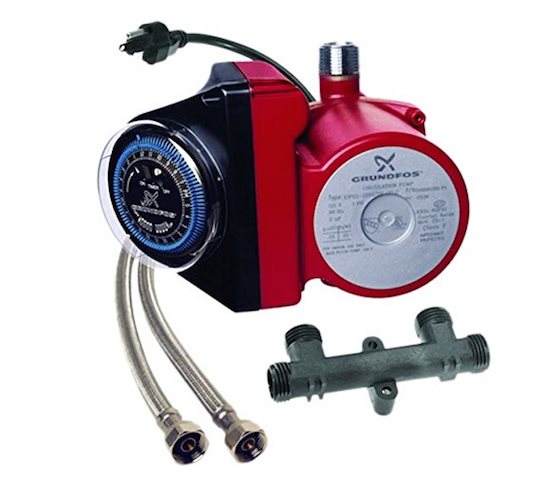
Why not look at the pump that is in the photo to this column? It is a Grundfos one. There is very little I have ever seen at HD that I would put in my own hme for what that is worth.
Gary G
15 Jan 2008, 10:34
15 Jan 2008, 10:34
I have a taco recirc pump. My shower is about 125 ft from the heater. My
HWH tank rust out and leaks about every 18 months to 2 years. I have a
large water softner before the heater. Rumor has it recirc systems will
promote decay of the tank. Any news on this subject ??
I theorize the recirc has entrapped air. Air with water will accelerate corrosion. Maybe the line needs a air strainer prior to the tank or something to keep the air out of the tank while circulating. OTHER COMMENTS: 1)10 ft ceilings in the showers will be cold, large areas in the shower allow air to convect -the hot water force causes a natural current, (large showers are taboo, dont build them), 2)Over rate your water softner by 30 to 50 % and make sure it is prior to Ur HWH. 3)Install a good size filter from ur water 'in' prior to the water softner for sediment removal. Change the filter about once a year -depending.
AsktheBuilder
15 Jan 2008, 10:54
15 Jan 2008, 10:54
Gary,
You need to contact the water-heater local factory rep. Air would *never* stay in the tank, it would bubble / float to the highest part of the system and spurt out when you opened valves.
Lynn
20 Jan 2008, 04:58
20 Jan 2008, 04:58
I had a circulating loop installed and a new water heater about 6 months
ago, a timer was not installed, the plumber installed a drain spout that
empties into my wash basin (located next to water heater); is it normal for
water to drain from they system for 20 - 30 minutes?
AsktheBuilder
20 Jan 2008, 08:48
20 Jan 2008, 08:48
Lynn,
No. Maybe I am not understanding you, but a loop should be a closed system.
Gynelle
08 Feb 2008, 15:18
08 Feb 2008, 15:18
I have a recirculating hot water pump and when we set the breakers (due to
a disposal issue) something happened and now the hot water takes forever as
before it was instant. ?And the water pressure in the furthest room has
changed as well. Do you have any suggestions as to what might be wrong?
AsktheBuilder
09 Feb 2008, 07:14
09 Feb 2008, 07:14
Gynelle,
It sounds like two issues. Electrical for the heater and a sediment issue for the far-away fixture.
CPD
25 Feb 2008, 10:29
25 Feb 2008, 10:29
Tim, whenever i turn my hot water handles my pipes bang very loud,i made
sure i got all the air out of the lines ,but it just keeps on getting
worse.any suggestions would be helpful. thankyou
AsktheBuilder
01 Mar 2008, 16:22
01 Mar 2008, 16:22
CPD,
Read all of my columns about Water Hammer.
Jim F
05 Mar 2008, 21:49
05 Mar 2008, 21:49
I saw that you recommended the Grundfos from the picture. It looks real
easy to install. I already have a power outlet in the attic where my 2 hot
water heaters are located. The Master bath is on the far side of the house
on 1st floor. Do you believe it to be better than the Laing AutoCirc that
goes under the farthest sink? They both seem to be comparably priced, but
I'd have to install an outlet under the sink for the Laing. What are your
thoughts?
Tom L.
06 Mar 2008, 17:27
06 Mar 2008, 17:27
I own a Watts Premier hot water recirculating system and it has worked
great for me and my family for many years. I have saved a ton of money on
my water bill!!! They also carry water filtration systems that I am looking
into purchasing.
AsktheBuilder
09 Mar 2008, 10:39
09 Mar 2008, 10:39
Jim,
I think my thoughts are in the column above. :->
Eric
19 Mar 2008, 09:11
19 Mar 2008, 09:11
We have a new home with a recirc pump connected to the bottom of the water
heater. The home was built with an insulated loop line, not a retrofit.
The instant hot water aspect works fine. However, our cold water is now
luke warm. The house is under warranty still, and we had the plumber out.
He said that the pump was back pressurizing the cold line. I thought about
that, and it doesn't make any sense. I don't see how there should be any
connection between hot and cold sides unless they somehow buggered the
plumbing and are using a cold line for return somewhere instead of the
insulated loop line that we paid for. Is warm water from the cold tap
common in recirc systems? I'd love to hear any explanations for this
effect. Thanks -- Eric
AsktheBuilder
21 Mar 2008, 08:23
21 Mar 2008, 08:23
Eric,
You are correct. There might be a cross connection someplace. If the recirculation loop is only feeding the hot-water supply lines, how could water get back into the cold water system other than to flow back up through the cold-water inlet at the heater. To prevent this, there is supposed to be a check valve at the cold-water side of the heater.
Kay Speake
28 Mar 2008, 11:36
28 Mar 2008, 11:36
Our house is about 12 years old. Last week we had 2 slab leeks at the same
time. We have had that fixed. Right after these repairs our water in our
shower will run for about 4-5 min and then turn cold. After about 4-5 mins
it's hot again. This goes on all day. I had the same plumbers out that
did the slab leek and they checked the water heater and all elements and
nothing was wrong. The water heater is about two years old. There is
something wrong but they are not looking past the water heater. What else
could be causing this problem. These are very reputable plumbers.
Thanks,
Kay
Thanks,
Kay
AsktheBuilder
29 Mar 2008, 15:46
29 Mar 2008, 15:46
Kay,
Maybe at the same time the dip tube in the heater went bad...... Install a new one.
Scott Cantrell
02 Apr 2008, 22:20
02 Apr 2008, 22:20
I read 2 different comments that mentioned luke warm water coming from the
cold supply with the recirculating systems that use the cold supply for
return lines. Is this true? If so, now you have to wait for cold water?
Thankyou,
Scott
Thankyou,
Scott
AsktheBuilder
05 Apr 2008, 17:55
05 Apr 2008, 17:55
Scott,
There is a problem in the setup when that happens.
Raynette
12 May 2008, 21:22
12 May 2008, 21:22
I want to disconect my recirculating pump since it has quit working. Can I
just disconnect it or do I need to consider or need to do something other
than just unplug it!
kim
13 Jun 2008, 07:59
13 Jun 2008, 07:59
Approximately 3 weeks ago I was hearing water running in the pipe by my
shower, there is no evidence of water leakage in the ceiling and it is not
heard anywhere else. Then the water was not so hot anymore. My neighbor
came over and said your water heater is going. Ok, so I put on a new water
heater and we notice that the circulation pump, the outside of it was quite
hot, there is no timer on it, we shut it off at the breaker. I still hear
the water running in the lines and the water is only warm with the new
heater, not hot, in fact you cannot use any cold or the water is cold.
Plumber's answer is get a larger water heater, I don't think so, the water
never ran thru the lines like that before.. Any help?
Jim Keithley
18 Jun 2008, 12:46
18 Jun 2008, 12:46
I am installing a Watts hot water recirc pump in a five bedroom rancher.
How often should I set the recirc timer?
Candy
27 Jun 2008, 20:14
27 Jun 2008, 20:14
Hi,
I am a single woman first time homeowner. I own a two-family brownstone in NYC. In the basement I have two hot water heaters. They seem to be hooked in parallel and not one heater per apartment (I don't know this for a fact). The brownstone has four floors: the first floor has a shower, bath, kitchen; second floor has a half bath and kitchen, third floor has a shower, bath, and washer/dryer; and the fourth floor has a shower, jacuzzi bath and double sink. The problem is the fourth floor. I takes a bit more than 10 minutes to get hot water to the shower and a few minutes to get hot water to the sink.
Would a recirculating pump help this and would I have to purchase the comfort valve for all the different shower/baths/washers/kitchens on the other floors as well? Or is something else wrong with my plumbing?
I am a single woman first time homeowner. I own a two-family brownstone in NYC. In the basement I have two hot water heaters. They seem to be hooked in parallel and not one heater per apartment (I don't know this for a fact). The brownstone has four floors: the first floor has a shower, bath, kitchen; second floor has a half bath and kitchen, third floor has a shower, bath, and washer/dryer; and the fourth floor has a shower, jacuzzi bath and double sink. The problem is the fourth floor. I takes a bit more than 10 minutes to get hot water to the shower and a few minutes to get hot water to the sink.
Would a recirculating pump help this and would I have to purchase the comfort valve for all the different shower/baths/washers/kitchens on the other floors as well? Or is something else wrong with my plumbing?
Darrell G
03 Jul 2008, 19:32
03 Jul 2008, 19:32
I had a separate water line installed for circulating the hot water when we
had our house built and it has works ok. Our systems has the return line
connected into the supply line at the top of the tank. I have observed
other systems similar to ours but they connect in at the drain valve on the
bottom. Connecting at the bottom seems the better way. If I changed ours
would it work better?
Judy Pettitt
07 Jul 2008, 19:53
07 Jul 2008, 19:53
I live in an apartment building where very often, mostly early morning, the
water coming out of the "cold" tap comes out scalding hot. The "hot" tap is
hot water as well. I can't seem to get a clear explanation why this is
happening. It did start happening shortly after work was done in the
building and in my bathroom. Also can only have baths because I can't
regulate the water in the shower other than scalding hot.
Marci
21 Jul 2008, 09:23
21 Jul 2008, 09:23
We have a recirculating hot water system in our 7.5-year-old home to our
master bath which is the furthest room from the hot water heater. We are
now on our 4th or 5th leak in the copper pipe for this. All leaks but one
was closest to the hot water heater and the recirc. system. The other leak
was in our finished basement ceiling - and ruined dry wall, etc. Is this
going to be a recurring event with this system? Some folks we have spoke
with have had this problem. Should we take out this luxury system to avoid
any further leaks? Or do you know what could be causing this? They seem to
be pin-hole leaks. Thanks for your assistance!
Mark S
27 Jul 2008, 15:47
27 Jul 2008, 15:47
A water softener is the only way I know to eliminate hard water. As for
the circulator problem I try the redytemp system. We chose them to avoid
the hard water problems your experiencing. It cost a bit more but we
wanted the calcium proof features as well as the adjustable temperature
function. We've had ours for over four years without any problems.
Nike
11 Aug 2008, 01:01
11 Aug 2008, 01:01
Install water treatment equipment for water softening like something on
this site http://www.waterking.com/
Do not heat water above 120F because scaling is progressive after that temperature.
What type of water-tap you have in kitchen?
If you ever had normally hot water in master/kitchen and you only recently don't have hot water, then it could be because of sediments or bad water-tap. Try to change water-tap.
If you never had warm water there, then instalation is not properly done.
Do not heat water above 120F because scaling is progressive after that temperature.
What type of water-tap you have in kitchen?
If you ever had normally hot water in master/kitchen and you only recently don't have hot water, then it could be because of sediments or bad water-tap. Try to change water-tap.
If you never had warm water there, then instalation is not properly done.
frank
08 Oct 2008, 05:46
08 Oct 2008, 05:46
please help! I work in a 5 story bldg that has HW circulating problems. You
have to run the HW for several minutes to get HW. The water on the Hot side
of the faucet is ice cold at times. Where can the cold water be migrating
into the hot side?? There is a common HW return line in the bldg.
Thanks
Thanks
mike
08 Oct 2008, 21:15
08 Oct 2008, 21:15
Can a recirculating pump be used in conjunction with a tankless gas water
heater?
thanks!
thanks!
Mike in Va
11 Nov 2008, 18:36
11 Nov 2008, 18:36
Hey Bob, any idea how much noise these under the counter recirc pumps make?
I am remodeling my masterbath and want to be Greener by not wasting so
much water waiting on the hot to make it up. Since I am in the shower by
5:30am it would be unfortunate if these pumps were noisy. Thanks
Dave Rivera
20 Nov 2008, 16:10
20 Nov 2008, 16:10
I have problems with my recir pump casuing my pipes to break down and pin
size hole in the pipes keep occuring after 4 to 5 years. Is this normal?
Jim
20 Nov 2008, 23:29
20 Nov 2008, 23:29
I have a 100 gallon gas hot water heater for 19 apartments with a timer on
the recirculating pump that can be set for two times. I want to reduce wear
and tear on the hot water system. What time periods should the timer be set
to turn the reciculating pump on and off to provide reasonable hot water
service to the tenants but reasonably limit the wear and tear on the hot
water pipes caused by the recirculating pump?
Ted
24 Nov 2008, 10:02
24 Nov 2008, 10:02
We just moved into a home a few months ago. The home is fairly new - built
in 2004 and has a recirculating valve on the water heater. Recently, the
water service to our house was interrupted because of a broken water main.
We didn't know about it until we used all the water in the water heater.
The recirculating valve was make a funny noice (almost like an alarm).
After water service was returned to our house, we no longer have instant
hot water. Was the recirculating valve damaged or so I have to do
something to make it work again, like prime it or something? I've looked
at it and don't see anything that looks like a reset switch or anything.
Any advice?
Charles Kapp
25 Nov 2008, 15:10
25 Nov 2008, 15:10
I had a circulator pump installed in our closed loop hot water system when
our house was built in 2001. I have two switches controlling the pump; one
by the pump and one in our master bath which I can turn off at bed time or
when traveling.
Would it be benefical to add a 15 minute on-off timer so that the pump doesn't run all day? Right now I can hardly tell the difference in the daily gas usage whether the pump is on or off.
Dean Warren
30 Nov 2008, 10:47
30 Nov 2008, 10:47
HI there it seems like we wait for ever to get hot water inour show and our
sinks, I have read about and concidered installing a hot water
recirculating pump. most that are on the market today us the cold water
line as a return line. how exactly does that work, there should be presure
there for the cold water. how can you force hot water back through it?
where does it go if does go through the cold water lines? I'm not a plumber
but I'm pretty sure that my cold water line does not go back to my hot
water tank. can you explain how this all works? if it does use the cold
water line, is the cold water still COLD???
thanks
thanks
MF
30 Nov 2008, 20:40
30 Nov 2008, 20:40
I agree with the energy issue. What about a local electric heater. I've
seen products that fit into the wall cavity space for single appliances. i
am unaware of how they compare with circulating pumps in terms of
efficiency but i think its worth looking into.
Gerry Coorsen
02 Dec 2008, 17:19
02 Dec 2008, 17:19
How high does the hot water line pressure go when the pump is on before the
tap is opened? Or, how much above house pressure does the pump provide?
Shawn Damkroger
16 Dec 2008, 10:28
16 Dec 2008, 10:28
To the gentleman named "Richard Meyer" who was interested in the the
difference between wasted water and wasted energy... I don't think the main
reason people install these pumps (I am one of them) has to do with wasted
water. Of course, none of us wants to waste water or energy, but that isn't
the primary motivation for installing such a pump. Speaking for myself and
friends who have one, we installed it because we wanted hot water to be
instantly available at every sink and shower.
However, I believe I can say that relatively little energy is wasted for several reasons:
1. How often does one really want cold water at a tap? Isn't warm or hot water usually what we turn the faucet or shower on for? The only time we really want cold water is for a drink, and ice cubes solve that instantly (if the water is warm), and many people don't drink tap water anyway.
2. In a system without a pump, you have to draw the hot water the distance of the heater to the sink/shower/tub you are using, but energy is still wasted. After you are done with the hot water, it sits in the line losing heat until it is the temperature of the environment it is in (the ground, a wall, whatever). How different is that from a system with a pump?
As our resident "AsktheBuilder" said, the best pump has a timer on the pump and a valve at the farthest sink/shower/tub. This means that you can run the pump just a few hours a day if you like, and it stops pumping when the valve cuts the flow. If you have a pump with a timer and the cut-off valve, you drastically reduce the energy loss.
3. Radiant water heating (with pipes running under the floor) is an optional install in higher-end production homes and custom homes. A recirculating pump produces a kind of "unintentional" radiant heating, which is useful in the winter. In other words, in the winter there is no energy waste, the heat (to a very small extent) warms the home, reducing the amount your furnace runs. In the summer of course, this would not be advantageous. However, if you live in an area of the world/country where it is cold/cool a good deal of the year, the energy loss is probably nil because it actually (again, in a very minuscule amount) reduces the energy usage of your furnace.
When you factor in all these points, not only do you realize that the energy loss is very minor, but you have even more reason to want this device. Warm water is always available (which is the kind you most often would want), water waste is basically eliminated and (most importantly) there is no waiting for hot water... ever.
I've had this installed in my home for two years. I put it in when I installed our new water heater. I did all the work myself, it was easy (but then, I am a carpenter and a "handy" person). My family *loves* it. We liked the idea of it before I put it in, but we loved it after we began using it. I can't really communicate how pleasant it is. Perhaps it is simply my family's personal taste, but friends and family who have spent the night (or a few days) at our home love it as well. It is one of those things that you just don't realize how nice it is until you have it. It's a big time saver too. You turn on the shower when you're in it, as opposed to turning it on a few minutes before you get in. Every time you wash your hands the water is warm. It's just a really nice touch in a home.
I, like you, was concerned about wasting energy, but I have seen no (discernable) difference in my energy usage/cost. I am conservative with the timer, but it's not complicated. Everyone is out of the house by 8:30 am on weekdays, and no one is using hot water until after 5pm. So, I simply have the pump kick on about 30 minutes before we get up, and kick off about 30 minutes before we leave in the morning. I have it turn back on again about 5pm, and off again at 8pm. We all shower in the morning, it's not planned that way, I just realized one day that we all showered in the morning.
So, it's really simple to set the timer with our habits/schedule. Although it's set up to run for five hours per day (combined) it doesn't run that long at all because of the cut-off valve. Once the water reaches 98 degrees (Fahrenheit) at the farthest sink, the valve shuts off and the pump shuts off. I work out in the garage a good deal and I hear it turning on and off and it runs very little, you get a lot of bang for your buck.
If you have to run the hot water for minutes at your shower (any one of them), trust me, you want this device. Your kids and your wife will love you and think you're a magician especially if you install it yourself. If you have a modicum of "do it yourself" (DIY) skills, you can install this pump. If you live in a relatively new home, it couldn't be any easier, because most of the connection are screw-on flex tubing. The pump installs directly on top of the hot water heater, all you do is unscrew the line from the water heater, put the pump in and reconnect. If it's hard-plumbed then you have some work, but with compression fittings and flex line it would be easy. At the farthest sink, you simply disconnect the lines under the sink from the cut-off valves and put the valve in between. My pump had the flex lines — to go from the valve to the hot and cold on the sink — included in the box. If you have screw-on flex tubing, it's a snap. If it's hard plumbed (which is rare) you have some work to do. I can't go into detail, but even if it's hard-plumbed there is an easy work-around for that (which involves unscrewing the lines from the sink). Point being, in most cases, installing this pump is very easy for someone with even rudimentary DIY skills.
Whew, I really wrote a little tome there didn't I? Haha. I guess you can tell I like this device and I had a little free time today. Anyway, I hope that answered some questions for any folks that ended up here on this wonderful site. ;-)
However, I believe I can say that relatively little energy is wasted for several reasons:
1. How often does one really want cold water at a tap? Isn't warm or hot water usually what we turn the faucet or shower on for? The only time we really want cold water is for a drink, and ice cubes solve that instantly (if the water is warm), and many people don't drink tap water anyway.
2. In a system without a pump, you have to draw the hot water the distance of the heater to the sink/shower/tub you are using, but energy is still wasted. After you are done with the hot water, it sits in the line losing heat until it is the temperature of the environment it is in (the ground, a wall, whatever). How different is that from a system with a pump?
As our resident "AsktheBuilder" said, the best pump has a timer on the pump and a valve at the farthest sink/shower/tub. This means that you can run the pump just a few hours a day if you like, and it stops pumping when the valve cuts the flow. If you have a pump with a timer and the cut-off valve, you drastically reduce the energy loss.
3. Radiant water heating (with pipes running under the floor) is an optional install in higher-end production homes and custom homes. A recirculating pump produces a kind of "unintentional" radiant heating, which is useful in the winter. In other words, in the winter there is no energy waste, the heat (to a very small extent) warms the home, reducing the amount your furnace runs. In the summer of course, this would not be advantageous. However, if you live in an area of the world/country where it is cold/cool a good deal of the year, the energy loss is probably nil because it actually (again, in a very minuscule amount) reduces the energy usage of your furnace.
When you factor in all these points, not only do you realize that the energy loss is very minor, but you have even more reason to want this device. Warm water is always available (which is the kind you most often would want), water waste is basically eliminated and (most importantly) there is no waiting for hot water... ever.
I've had this installed in my home for two years. I put it in when I installed our new water heater. I did all the work myself, it was easy (but then, I am a carpenter and a "handy" person). My family *loves* it. We liked the idea of it before I put it in, but we loved it after we began using it. I can't really communicate how pleasant it is. Perhaps it is simply my family's personal taste, but friends and family who have spent the night (or a few days) at our home love it as well. It is one of those things that you just don't realize how nice it is until you have it. It's a big time saver too. You turn on the shower when you're in it, as opposed to turning it on a few minutes before you get in. Every time you wash your hands the water is warm. It's just a really nice touch in a home.
I, like you, was concerned about wasting energy, but I have seen no (discernable) difference in my energy usage/cost. I am conservative with the timer, but it's not complicated. Everyone is out of the house by 8:30 am on weekdays, and no one is using hot water until after 5pm. So, I simply have the pump kick on about 30 minutes before we get up, and kick off about 30 minutes before we leave in the morning. I have it turn back on again about 5pm, and off again at 8pm. We all shower in the morning, it's not planned that way, I just realized one day that we all showered in the morning.
So, it's really simple to set the timer with our habits/schedule. Although it's set up to run for five hours per day (combined) it doesn't run that long at all because of the cut-off valve. Once the water reaches 98 degrees (Fahrenheit) at the farthest sink, the valve shuts off and the pump shuts off. I work out in the garage a good deal and I hear it turning on and off and it runs very little, you get a lot of bang for your buck.
If you have to run the hot water for minutes at your shower (any one of them), trust me, you want this device. Your kids and your wife will love you and think you're a magician especially if you install it yourself. If you have a modicum of "do it yourself" (DIY) skills, you can install this pump. If you live in a relatively new home, it couldn't be any easier, because most of the connection are screw-on flex tubing. The pump installs directly on top of the hot water heater, all you do is unscrew the line from the water heater, put the pump in and reconnect. If it's hard-plumbed then you have some work, but with compression fittings and flex line it would be easy. At the farthest sink, you simply disconnect the lines under the sink from the cut-off valves and put the valve in between. My pump had the flex lines — to go from the valve to the hot and cold on the sink — included in the box. If you have screw-on flex tubing, it's a snap. If it's hard plumbed (which is rare) you have some work to do. I can't go into detail, but even if it's hard-plumbed there is an easy work-around for that (which involves unscrewing the lines from the sink). Point being, in most cases, installing this pump is very easy for someone with even rudimentary DIY skills.
Whew, I really wrote a little tome there didn't I? Haha. I guess you can tell I like this device and I had a little free time today. Anyway, I hope that answered some questions for any folks that ended up here on this wonderful site. ;-)
prygaard
21 Dec 2008, 18:17
21 Dec 2008, 18:17
A recirculation pump with a dedicated return line and a timer has two
problems:
1) Most of the time the pump is running, it is not needed
2) When Hot water is needed, the pump is often not running.
I solved the problem with a unique "on-demand" control that turns on the pump when the hot water anywhere in the house is turned on. Please see the image at
http://i480.photobucket.com/albums/rr167/PRYGAARD/RecirculationControl.png
1) On the cold water IN on the Hot Water tank, a flow switch is installed that turns on when it detects flow. (Note: This can *not* be anywhere in the circulation loop)
2) A Delay-Off timer turns the pump on immediately when the Flow Switch turns on, but does not turn off the pump for a while after the flow switch is turned off. (The delay time needs to be adjusted for the characteristics of the particular installation. Typical times range from 30-90 seconds)
3) An aquastat is used to turn off the pump when the farthest faucet in the loop reaches temp.
When the hot water is turned on, the pump comes on and hot water arrives fairly quickly (but not instantly). The innovation is this: Turn the hot water on for a second and then turn it back off...and the pump keeps going for a while. Then just wait for a little bit and turn the Hot water back on...it is hot and ready to use. However, after the water is turned off, the pump will run for the delay time and then stops till the next time there is demand.
Flow Switch: Gems 26605 (I got it cheap on ebay).
I used the following parts:
(http://www.gemssensors.com/ApplicationSearchResults.asp?nQuestionID=36 ) Others are available, but be sure to get one that has a fairly low trip point on the flow. (.75 – 1 GPM)
Delay off Timer: MX046 timer kit. (15 second to 6 min delay)
(http://www.bakatronics.com/shop/item.aspx?itemid=466) It is inexpensive but you must build it into a case. There are other delay-off timers and relays available but this seems to be the cheapest option.
Aquastat: Grundfos ½” Clip on.
1) Most of the time the pump is running, it is not needed
2) When Hot water is needed, the pump is often not running.
I solved the problem with a unique "on-demand" control that turns on the pump when the hot water anywhere in the house is turned on. Please see the image at
http://i480.photobucket.com/albums/rr167/PRYGAARD/RecirculationControl.png
1) On the cold water IN on the Hot Water tank, a flow switch is installed that turns on when it detects flow. (Note: This can *not* be anywhere in the circulation loop)
2) A Delay-Off timer turns the pump on immediately when the Flow Switch turns on, but does not turn off the pump for a while after the flow switch is turned off. (The delay time needs to be adjusted for the characteristics of the particular installation. Typical times range from 30-90 seconds)
3) An aquastat is used to turn off the pump when the farthest faucet in the loop reaches temp.
When the hot water is turned on, the pump comes on and hot water arrives fairly quickly (but not instantly). The innovation is this: Turn the hot water on for a second and then turn it back off...and the pump keeps going for a while. Then just wait for a little bit and turn the Hot water back on...it is hot and ready to use. However, after the water is turned off, the pump will run for the delay time and then stops till the next time there is demand.
Flow Switch: Gems 26605 (I got it cheap on ebay).
I used the following parts:
(http://www.gemssensors.com/ApplicationSearchResults.asp?nQuestionID=36 ) Others are available, but be sure to get one that has a fairly low trip point on the flow. (.75 – 1 GPM)
Delay off Timer: MX046 timer kit. (15 second to 6 min delay)
(http://www.bakatronics.com/shop/item.aspx?itemid=466) It is inexpensive but you must build it into a case. There are other delay-off timers and relays available but this seems to be the cheapest option.
Aquastat: Grundfos ½” Clip on.
To add a comment visit the Article Page.