Poured Concrete vs. Block Walls
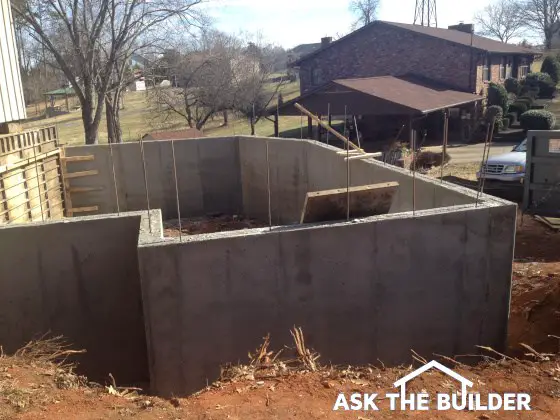
The entire hollow spot created by the foundation addition needs to be filled with something so the concrete slab to be poured on it will not settle. Photo credit: Dave Lich
Poured Concrete vs. Block Walls TIPS
- Block is hollow
- Poured concrete is not
- Block can be filled
- Reinforcing steel is a must
- CLICK HERE to Get Tim's FREE & FUNNY Newsletter!
- This article was featured in the April 19, 2020 AsktheBuilder Newsletter
DEAR TIM: What's the difference between concrete block and poured concrete foundation walls? Which one is better? The lot I'm going to build upon has a seasonably high water table. Which of the wall systems would ensure a dry basement? Diane J., Redwood Falls, MN
DEAR DIANE: I think it might have been easier to answer a question such as: Is a glorious sunrise more beautiful than a magnificent sunset? The truth of the matter is that both building materials - concrete block and poured concrete - can yield superior foundation walls so long as they are installed correctly.
All too often builders and sub-contractors fail to realize the limitations of certain masonry materials. When this happens, foundation failures are a common occurrence.
Related Content
Precast Concrete Foundations Deserve Your Attention
Waterproof ALL Foundations - No Matter Which One You Do
Free & Fast Bids
CLICK HERE to get FREE & FAST BIDS from local foundation contractors.
Concrete Block Is Concrete!
The first thing to realize is that concrete block is made from poured concrete. The primary ingredients in concrete block happen to be: Portland cement, gravel aggregate, and sand. These are the same ingredients you'd find in a poured, or cast, concrete foundation.
The only difference between the two finished products s the size of the gravel. Typically you'll see gravel stones as large as big juicy grapes in a poured concrete foundation. A concrete block may have gravel no larger than the size of a standard green pea or a dried raisin.
CLICK HERE to get FREE & FAST BIDS on a concrete BLOCK foundation.

Poured or Cast Concrete
Poured concrete foundations are solid through and through. This happens by default as the plastic concrete flows from the ready-mix trucks into the foundation forms. Poor workmanship can yield hollow spots in poured foundations. The contractors use special vibrating tools to prevent this.
The typical concrete block foundation is not solid. The concrete blocks that are used to build block foundations, by their very nature, are hollow.
CLICK HERE to get FREE & FAST BIDS on a POURED concrete foundation.
Make Block Walls Solid
When concrete blocks are stacked on top of one another, you can look down through the center of the foundation. After the concrete blocks are laid, the voids can be filled with a cement-based mortar or poured concrete that contains small pea gravel.
The concrete used to fill the block voids must have small gravel so it can flow readily into all the narrow voids. To maximize strength, the voids need to have 1/2-inch steel rods centered in the voids from the bottom of the block walls to the top. Put this steel every 2-feet on center.
If the builder does this, then the filled concrete block walls are nearly identical to poured concrete walls.
CLICK HERE to get FREE & FAST BIDS from local foundation contractors.
Both Weak If Bent
But simply doing this is not enough to satisfy me, code officials and structural engineers. Concrete and things made of concrete or cement tend to have fantastic compressive strength.
This means when you squeeze concrete it's very strong. Often it is measured in the thousands of pounds-per-square-inch range.
But the same material typically has only one-tenth the strength when you apply a tension to it. Tension is a bending or stretching force.
You can easily picture this. Imagine pouring a 4-inch thick slab that's 10 feet wide and 40 feet long that's up three feet in the air and just supported on each end.
It would bend in the center under its own weight and crack long before it would if you tried to drive across it!
Massive Soil Pressure
Backfilled soil against a wall produces tension as the soil pushes against the wall. Poor quality soil creates tension on a foundation as more and more weight is added to the foundation as the house is built.
Poor drainage around a house creates pressure as tons of water collects in the soil.
This is why roof water should NEVER be allowed to run on the ground near a foundation.
The use of splash blocks at the base of a full basement is comical. Roof water needs to be piped far away from the house to the lowest spot on the lot or into an approved storm sewer.
Steel = Strength
You can strengthen poured concrete and concrete block walls by including reinforcing steel. Often you will see horizontal steel bars placed in the lower and upper sections of poured foundation walls.
This steel is usually found about one foot up from the bottom of the foundation wall and a foot down from the top.
There are usually two rows of the steel and it's continuous around the entire foundation. When the steel bars overlap, it should be no less than 16 inches.
This steel often has a tensile strength of 40,000 pounds per square inch. This horizontal steel helps prevent vertical cracks should the foundation drop or heave.
Horizontal wire fabric can also be placed in the mortar joints between layers of concrete block to achieve the same result in a concrete block wall.
Vertical Steel
Vertical reinforcing steel is also very important. This steel can be put in both a poured concrete foundation and a concrete block wall that will have the hollow voids filled with cement grout or pea gravel concrete.
The reinforcing steel should be one-half inch in diameter and these rods should be connected to the poured concrete footer that the foundation rests upon. This steel should be placed every two feet on center.
Not Waterproof
Neither wall system will be waterproof. If you want a dry basement or crawlspace you must apply a foundation waterproofing system to the exterior of the foundation walls after they are built.
There are many different systems, but my favorite when I was building was a rubberized asphalt called Tuff-n-Dry. Once the material was sprayed on the walls it was about 1/8-inch thick. If the foundation did crack, this material could stretch and bridge a crack up to 1/4-inch I believe. The specifications may be different today.
Liquid asphalt is often sprayed on a new foundation wall. It's like a coat of paint and very thin. This is NOT waterproofing. It's just a vapor barrier.
Drain Tile
In addition, a drain piping system needs to be at the base of the wall adjacent to the footer.
This pipe is covered with two or three feet of washed gravel. The gravel is then covered with six inches of straw or a sheet of tar paper before dirt is placed over it. The straw and tar paper prevent silt from the fluffed up backfill dirt from clogging the gravel. The water that flows through the soil and makes it to the pipe is then drained to daylight if the house is built on a sloping lot. If the house is built on a level lot, the drain pipe often empties into a sump pit.
CLICK HERE to get FREE & FAST BIDS from local foundation contractors.
Column 439

Tim built custom homes and did ultra-custom remodeling for 20+ years before launching his Ask the Builder media presence. He was selected as one of the Big 50 by Remodeling magazine in 1993. This award gave birth to Ask the Builder in October 1993. Tim also operates https://DrawPlumbingPlans.com. His @askthebuilder YouTube channel was the first home improvement channel on YouTube.
If your foundation has the drain piping system on the perimeter, does it still need the outside of the wall coated with a tar mixture?
Yes!
You always want exterior water proofing, even if interior drainage is good, because any water will bring mold, algea and in cold climates, frost and cracking.
Is it common for the sand to migrate out of a pored foundation wall? In one area, I have a light tan "dust" on the wall (top to bottom). I vacuum / brush it off and it re-appears.
Curtis, you need to schedule a 15-Minute call with me.
HEY I HAVE THE SAME THING GOING ON IN MY DOUBLE WALLED STONE BASEMENT. BROWN SILT IS COMING OUT OF MY LEAKING WALLS... WHATS HAPPENING?
WORRIED IN WISCONSIN!
Is a stick house on a concrete ribbon foundation asking for trouble?
Not if it's all built the way I would do it!
I am moving a house in on a lot. This is Texas and the lot is sandy. What kind of foundation is recommended?
One with reinforcing steel.
I was recently looking to buy a house with a block built foundation/ basement. It appears that someone has installed some sort of piller supports on all walls except one. The wall that has none is a little bowed, and has a nice sized angled crack that leaks water. I just witnessed the sump pump running you could hear the water going out of the house overhead and 3 minutes later the water would literally pour back in the crack! Besides getting the water away from the house how could you fix this?
Matt, time for a 15-Minute phone consult. Much to discuss!
On a poured concrete or block wall, when furring strips are used to attach drywall, How do you obtain the depth to install electrical boxes? We. Are building a home in southwest florida.
Chip out the masonry or attach 2x material.
Hello, I want to buy a house that has block foundation. The house has a plastic that covers the blocks and you can see white pots on the block. What is your advise?
My advice is to read all my past columns on efflorescence.
Looking to add 120sf to on grade garage foundation. What is the best way to connect footer slab to existing foundation?
Pin the new footer to the existing with 5/8-inch rods that penetrate into the old at least 6 inches.
I have a seasonal home built with concrete block foundation on sandy soil. Last time I was there I noticed on one corner of the wall the blocks had filled with water, about 25 of them. I did not have the time to empty them out.
Do you think the water entered from the outside water line or from under the cove joint and worked its way up.
I guess they had about 9 inches of rain the week before.
Furthermore I noted a horizontal crack in the front facing wall but I did not detect any bowing in that wall
The water seeps through the mortar joints - usually the vertical ones. You NEED my Linear French Drain DVD!!!! If you install one as I show in the DVD, you'll NEVER have water in the block again.
whats your take on my comment about the horizontal crack ?
I'm going to replace one of the block walls in my basement thanksgiving weekend. All four walls are bowed in and they are bad at the cornets too. How do you tie in a new straight wall to a bowed at the corner? Lots of mortor?
You cut the block to fit.
I want to build a tornado shelter because I live in tornado alley. There are lot size construction so it has to be aboveground essentially. I'm concerned that CMU blocks or just strong as a poured wall, even if I backfill it and reinforce it with rebar. I am using FEMA's drawings.there will be a solid poured top and a solid poured foundation with the rebar tight end at least every 16 inches on center. Am I mistaken that it won't be as strong as a solid wall?
The block MUST be filled with pea-gravel concrete. Hollow block can be EASILY penetrated with a flying 2x4. Then, imagine a car or pickup truck flying through the air that RAMS your shelter!
I want to build a 30x60 single story building with a 12 ft ceiling and a pitched roof. I live southern Indiana. And the building site will most likely be in a cleared out space in a wooded lot. Not terribly sloped but not exactly level either. What sort of foundation would you recommend?
Thanks
Jeremy
Poured concrete.
Thank you! How thick a poured concrete foundation?
I'm looking at purchasing a house with a stone foundation/basement in the Midwest (Kansas City). I would like to add a two car garage with a suspended floor with space underneath that could be finished and connected to the existing basement. Can this be done?
Yes, it can be done.
I live in the Kansas City area. I have a basement that is referred to as a Michigan basement. The basement is rectangular with a 7' ceiling. Half of the basement wall is a full 7' tall. The other half has been dug out, leaving a 2' knee wall on a 5' tall dirt ledge. A poorly formed sister wall was put in some time in the past to hold the dirt ledge in place. that sister wall was not reinforced and is starting to fail.
My question is:
Is there anyway to fix this wall? Replacing the wall exceeds the value of the house. Many engineers have told me that the sister wall is not load bearing and therefore does not need a footing under it. I have been monitoring the sister wall and it has not sunk any in 10 years, but it is bulging in to the basement. the result is the knee wall is starting to sink.
Is it possible to hand-stack concrete and fix this wall?
Yes, the wall can be fixed. We can discuss options on the phone if you want. It's far too detailed to do in comments here.
My builder is installing foundation blocks 6x8x16. He places the steel from the base of the trench within the core of the blocks. But as he lay more blocks and the foundation gets higher the steel is no longer visible. Was this done right?
It's like 4 rows height of foundation blocks. He argues that bringing up the steel is not necessary because of the height. Please help.
Noel,
I've got questions. I don't go back and forth in comments. If you want me to guide you, consider this:
http://shop.askthebuilder.com/products/15-Minute-Phone-Conversation-with-Tim.html
Hi, I'm renting a house that I also have the option to purchase in 5 months in Winnipeg Manitoba Canada. It has a block foundation and a fully finished basement so it's hard to tell the shape of the foundation. The reason why I suspect there to be a foundation problem is throughout the house (only on main floor not second story) there are cracks in the walls almost around every door frame . I was told that's signs of stress and I could be looking at foundation problems . The furnice room is the only room in the basement that isnt finished and there is a small horizontal crack right across the middle of the walls , the crack isn't big, can't fit a dime in it. Also underneath the stair case is another little closet with bare foundation showing and I looked and there is a large crack that seems to have some sort of filler in it but the filler is loose I can wiggle it with my finger.
Please tell me your thoughts on this and if you think I'll be looking at some hefty repairs on the foundation in the near future if I choose to purchase this property.
Thanks !
It's really hard for me to speculate without being there, but based on your description, I'd NEVER buy this house. READ all my columns here in my Structural category. Just type that word into my search engine to get to it. I have a column about the EXACT cracks you see at each doorway!
Tim
I recently had a soil engineer out on a piece of vacant land in which will require a mound type septic system. Everything is a go for that. I do however have one concern we talked about. The land has some very shallow areas toward the back in which he called shale rock. My concern is building a forever home with a basement as well as having a backyard for the kids to play in and not a swamp. Is there things that can be done to drain/remove some of this excess water that sits back there. Any expert advise would be appreciated. Thank you so much. Also want to keep a dry basement. Have a great day.
Tim, no question, just wanted to thank you for all your info. I have been debatting on which way to build (block vs poured) I live in a house with a block basement now that I did not build and it was not build corretly and it has been nothing but trouble. (Water, cracks, mold, etc. I'm selling and starting over. I am looking to start building a house with a full basement and the info you have supplied is a great help.
Tim,
I have a question I live in the Philippines, i would like to build a basement, I was told every 2-3 years the area I live in if the drainage is clogged then I might get about 2ft of water outside. Now I could raise my house but I was wondering if I went along with building the basement, had an outer and inside wall 1ft apart and then poured concrete in the middle and then treated the outer wall with a concrete sealer, would that be ok? Maybe I'm over thinking it I'm not sure. I would just hate to build a basement and then have to worry about it flooding. I did intend to put a sump in the room as well. Your advice would be appreciated.
Hi, I just constructed a small "wall" 18" high x 32" long x 8" thick to support 4 x 4 8ft posts for a lean-to roof over an existing basement door. It extends down 12" below adjacent grade. It is formed with wood boards. How soon can the form be removed? I know that the concrete needs light wetting while curing. The roof is eager to be built.
Gary Jenkins
[email protected]
We are having a concrete retaining wall for a fence footing built by a sub-contractor of the Fencing company. The contractor is preparing to pour concrete. My concern is that per my request the metal fence posts were seated in PVC and then concreted. Because there has been delay due to weather (rain) there is now dirt that has built up over the concrete seating for the posts. I'm questioning if there is a concern over pouring the concrete over the dirt (which will cause a layering effect of concrete/dirt/concrete). It's my thinking that if the dirt then washes out (from natural drainage) between the layers that there will then be space and will the weight of the fence then lead to cracking in the will. The subcontractor says no, but since he has been less than knowledgeable up to this point, I'm reluctant to trust him. Your thoughts would certainly be appreciated!
We have a walk out basement. The earth around it is clay. The basement is 12 inch block. My husband is good about keeping gutters and downspouts clear and directing water away from the house. The basement wall is 9 or 10 feet tall. We recently noticed, after living there eight years (house is 12 years old) that the wall into the hill leans forward one inch at the top. We removed the Sheetrock to see if the wall had damage. It is perfect, no cracks, very dry. One structural engineer told us the wall had moved and was compromised. Should we get a second opinion? The whole basement is tiled. Not one cracked groutlines, no cracks, not even hairline, in Sheetrock, glass shower doors close perfectly, doors and windows close perfectly. The interior walls lean by same amount, but doors are square. We think the wall always leaned, was constructed that way. Decks are flush, concrete patio is not cracked and is flush, stacked stone on exterior is perfect. We also believe the previous home owner, who finished the basement himself, came off the back wall. In our minds, if the walls were pushed, things would not just be slightly tilted in but also off square. Look forward to your opinion on our second opinion. Also, if we do brace the wall, what would you recommend? He recommended steel h beams from footing to floor joists. Upper level is log.
We are planning to raise the Ground Floor by 10Ft height and construct G+2 Floors. i.e ground floor + 2 additional floors.
Can we have the Large rock based foundatation for this 10Ft wall on all 4 side or just concrete with Steel road + bricks for 10Ft.
Pl. suggest for cheap and best solution
I have a question that I've been unable to find an answer for; but then, it may just be a stupid question.
I'm thinking of building a shed, with a "basement"
I've researched all what I think I need to understand how to do the concrete floor and I want to use cement blocks for the walls, with rebar reinforcement.
I would then build supports to pour the "basement ceiling/shed floor" on top of.
My question is this:
After having the basement hole excavated, I'm going to end up with a large amount of dirt.
What would happen if I used this dirt, to fill in the gaps in the concrete block?
I could do it two ways.
One is to fill it in as each layer is cemented in place and tamp it down solid.
The other way is to wait until the walls are finished and then fill them in, tamping them down by building 2 different kind of tampers.
One made with a solid bottom for the holes with no rebar and one build with a hole in the middle for the ones with rebar.
Please don't laugh to loudly.
The dirt may cause a wide range of problems. The dirt may draw moisture and freeze at points above the frost line causing block failure.
Your project would require a building permit and full plans submitted to the municipality. Since this is not an excepted building practice it wouldn't get through inspection.
We're a fourth generation family owned and operated design-build firm with nearly 70 years experience in building homes. Our background is in masonry and we've been doing block foundations going back to my great grand father. It wasn't until recently, some prospective clients brought to our attention concerns of block foundations that we discovered articles saying block foundations are hollow and not reinforced with steel. Since the age of 4 years old, walking around the job sites with my father and uncle, it was common knowledge to me that block foundations were reinforced with vertical and horizontal steel and filled with concrete. Reading up online and finding where builders are not doing this just blew all of our minds. Prior to reading online, we were really struggling to understand these clients admit concerns of block foundations. Now I see where they're coming from. Thank you for the article!
I'm in the desert with 6' tall block fences around my whole property. The fences have stucco applied on the outside, looking away from my yard. My property is 38 inches above the grade of the surrounding area and four rows of the fence block retain dirt. The ground pitches rapidly down just outside my fence. When it rains, water soaks the soil and eventually loosens the stucco on the outside. I'm tired of paying to have it replaced every 5 years. What can I do to eliminate this problem.
I want to build a story building that is 11.8m by 6.5m in a water logged area. The plot of land is flat . I want my foundation to be 2.5m high because the plot is on the lowest part of the road. Is it possible to have a 1.2m raft with extended colums at 3.5m intervals . then have 1m block wall filled with concrete and 300mm beam before casting the ground floor slab. I cannot afford to have a raft of 2.5m
Hello we are looking at building a metal shed into a small house (576 sq ft) in Northern Missouri and we are way out in the country, I was wondering if we could do a cement block foundation for our slab foundation rather then poured concert due to being so far out. Would this being done with the rebar and the holes filled with the gravel and pour cement be strong enough or are we asking for trouble and should just figure out a way to get a cement truck out there? Thank you
It's a great idea. I've built sheds the exact same way with a block foundation. Just read ALL OF MY columns about building with concrete block.
Read all my concrete slab columns too so you do that right.
I live in central PA. I had a poured foundation with 10’ walls. I had to move a doorway in the basement and cut the concrete out to find no horizontal or vertical rebar in it. I also have a crack in one corner that looks to be growing. Should I be worried about building on this foundation?
If the soil is strong and the footing was installed correctly, I think you'll be fine.
Many many old cast concrete foundations exist all over the USA that have no steel. The steel compensates for bad things that happen when you build on the crappy soil.
I'm looking at building a 3'-4' wall around my lot as a fence/flood barrier. I'll be using floodplanks to cover gateways and driveways during any flooding.
Would this application be better suited for poured concrete or a filled block Wall?
I'm not a floodwall expert. Better research it online. Water's damn heavy so you better get an engineering stamp on your flood plank plans at the driveway!
Being the planner I am 15 years out from building my home to enjoy in my retirement. We just purchase 10 acres of land, (2 @ 5.3 Acres, side by side. Each approximately 300 feet across the south perimeter with gravel road access. My current vision is rambler style, 30' X 80', and hoping to have a greenhouse built along the south of the house, with solar panels on the single sloped south facing roof. I want to do the foundation correctly. I've had several ideas about most effective system for drainage, keeping basement walls dry. Any links or knowledge you can share would be greatly appreciated.
Kyle,
Simple. Use the search engine at my website here.
Start with these keyword phrases and READ all the results:
drain tile
foundation waterproofing
precast foundation walls
If you need one-on-one help, I offer that service:
http://shop.askthebuilder.com/products/15-Minute-Phone-Conversation-with-Tim.html
Hi Tim,
We are about to build a side extension, a double story back extension and a summerhouse on grounds that are mostly clay. This winter the water table has risen more than expected and we are now worried that the block and beam concrete floor we were advised to use for the foundation (due to a big tree next to the house) might intermittently sit in water during the winter (with the risk of steel rusting with time). What foundation would you recommend, please?
Ari,
I'd do a concrete block foundation that's filled with pea-gravel concrete and reinforcing steel rods.
A strong footing is mandatory.
I was considering having a house all poured concrete with 3 rooms 2 on bottom(kitchen, living room) and one on top (bedroom) with deck. Is the cost of block vs poured going to be excessive? Also, I don't know where to go to have this done and any ideas would be welcome.
I am looking at building a workshop with a basement in Las Vegas, Nv. Given that it will be load supporting should the foundation and walls be tied together?
Corie,
You're not at all clear on what's going to be load supporting. The workshop?
The only way for me to give you an accurate answer is on the phone.
http://shop.askthebuilder.com/products/15-Minute-Phone-Conversation-with-Tim.html
new house-36 inch wide footing- 4,000psi concrete- 1 foot thick with 3-5/8 inch rebar longitudinal, 1/2 inch rebar transverse every 24 inches under 5/8 inch rebar. Step foundation(2 steps). 1/2 inch vertical rebar 24 inches apart with 12" L in footing. All blocks below grade and 2 rows above grade filled with concrete. vertical rebar tied into bond beam horizontal rebar at top of block foundation by drilling blocks. Hot dipped galvanized ladder type block reinforcement every other layer of block.
coated block, asphalt type, waterproof membrane added with french drains down all sides and garage draining to daylight, gutters draining away from house, ground sloped away from house. Reason-high water table and sloping to flat ground. Comment
Is it possible to build a combination poured/block foundation? We're building a 52x40 home with a full basement located on a sloped lot with 2 sides of the basement/lower floor completely in the hill. The debate is over building double retaining wall and a foundation wall on the filled dirt sides vs two poured walls and 2 cinderblock. We have great "Chirt" filled dirt for back fill. This home should be in the family for years - we don't want the basement floor caving in.
Yes, it's possible.
New builder contract states "block and fill foundation with #4 rebar matt 24" o.c. over 6 mil visqueen. Footers will be 24"×15" with 4 #4 rebar reinforcement." Is this a solid foundation? Want the best. Southern state
Amy,
I'm not quite certain by his terminology. You also need a high-performance vapor retarder. I HIGHLY recommend that you jump on one of my quick consult phone calls to go over this if you want THE BEST possible foundation that I'd build for you.
Here's how to set up the call:
https://shop.askthebuilder.com/products/15-Minute-Phone-Conversation-with-Tim.html
Never had a poured basement before. Always been block. New home has a LOT of water coming out of walls and pooling on floor everywhere. I would attribute some to cold walls in high humidity causing condensation, but house envelope has been sealed a couple of weeks now and we have had a few weeks of low humidity, still getting big moist areas. Does water normally leach out of a new pour? if so how long? (this wall is 2 months old)
The answer is No.
Brand new poured concrete walls for a crawl space foundation have large gaping cracks on the outside. One crack even goes through to become a hole. Inspector passed it and says there is rebar support so it's ok. Is it OK? I have photos.
Rick,
I already know this is going to require a phone conversation. There are multiple moving parts to the issue:
The call is FREE if you get no value from it: https://shop.askthebuilder.com/15-minute-phone-or-video-conversation-with-tim/