Blacktop Driveways Over Concrete
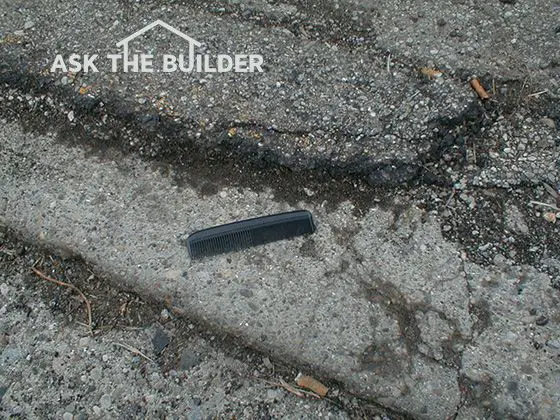
Blacktop over concrete is what you see. Here's a 2-inch layer of blacktop on top of concrete. It's falling apart and I don't see any asphalt binder on the concrete. I'm not a big fan of putting asphalt on top of concrete. © Copyright 2018 Tim Carter
"But keep in mind that you may have crack problems at a later date with your blacktop. My guess is your current concrete drive has control or expansion joints at 10 - 15-foot intervals."
Blacktop Driveways Over Concrete Checklist
- Blacktop over concrete is not a good idea
- Added height could cause big problems
- Cracks in new blacktop will happen over existing concrete cracks
- Concrete overlay may be a better choice
- CLICK HERE to Get Tim's FREE & FUNNY Newsletter
Related Links
Tar and Chip - The Ultimate Blacktop - SECRET INFORMATION - Please Don't Share
Blacktop Facts - The Real Truth
DEAR TIM: The surface of my concrete driveway is eroding after years of wear and tear. I'm thinking about resurfacing my existing concrete driveway with blacktop. It's my intention to add two inches of blacktop to the existing concrete after all of the loose debris is removed.
Is this a good idea? Do you see any problems?
Are there other alternatives? Patrick O., Lexington, KY
DEAR PATRICK: What you plan to do is done on hundreds of thousands of miles of roadways and driveways each year in the USA.
Can Blacktop Be Put Over Concrete?
Blacktop can be successfully installed over concrete. But there are issues as you might expect. In addition, you do have an alternative paving method that may surprise you.
Does Concrete Provide a Solid Base?
One positive aspect of installing blacktop over concrete is the concrete provides a firm base for the flexible asphalt paving. Experts who work each day in the blacktop industry, refer to blacktop as flexible pavement.
It doesn't have near the strength of concrete when you measure them inch for inch. The asphalt cement that bonds the pieces of sand and gravel in the blacktop can and does move over time.
What is Asphalt Cement?
Asphalt cement, the binder that holds together the sand and gravel in blacktop, is a unique material in that it possesses qualities of both a solid and a liquid.
Any chemist will tell you that asphalt is much like glass. Both will succumb to the pull of gravity, albeit it takes years to see it happen. Window panes in old homes that have survived the test of time are almost always thicker at the bottom of the pane than the top.
Blacktop Drive Installation Video
Here's a great video showing lots of things you need to know about installing blacktop.
How is Concrete Similar to Blacktop?
Concrete is very similar to blacktop in that it also contains sand and gravel pieces. But the Portland cement ingredient that crystallizes and bonds tenaciously to the sand and gravel is as hard as rock.
In fact, and geologist will tell you that regular concrete looks and feels exactly like a sedimentary rock called conglomerate.
Where Does Blacktop Get Its Strength?
Blacktop derives its strength from the base beneath it. New blacktop driveways are routinely installed over a compacted crushed-gravel base.
This base stone is often eight to ten inches thick and when installed on firm compacted soil, it makes a superb foundation for the blacktop.
But if your concrete driveway is crack-free and the individual slabs are not tilted, the blacktop covering will perform as well or better on it than the gravel.
Can You Have Crack Problems in the New Blacktop?
But keep in mind that you may have crack problems at a later date with your blacktop. My guess is your current concrete drive has control or expansion joints at 10 - 15-foot intervals.
Or perhaps there are a few random cracks and some slight displacement between the cracked pieces of concrete. If this is the case, these cracks will eventually telegraph through the new blacktop covering.
Your blacktop contractor can saw cut in crisp lines in the blacktop directly over the concrete control and expansion joints if you like. These thin lines can be filled with a special epoxy crack filler and the small stones that are in the blacktop mix.
IMPORTANT TIP: CLICK HERE to read about the magic method and secret epoxy I use to fill blacktop cracks.
Can The New Blacktop Be Too High?
The new blacktop on top of the concrete can be too high. This can cause water puddling and tripping issues where the blacktop touches other paving.
The added two inches of blacktop might cause safety issues where the driveway abuts stairs and sidewalks. The added thickness of the blacktop can reduce the riser height at stairs.
A tapered two-inch lip can create a stumbling hazard when people walk from adjacent paved surfaces onto the driveway.
Does The Blacktop Require Future Maintenance?
Keep in mind that your blacktop driveway may become a maintenance item every three to five years.
This is a name-brand blacktop sealer. Apply it when there's no chance of rain for 24 hours. CLICK THE IMAGE NOW TO BUY IT.
To keep blacktop from degrading due to exposure to the elements and liquids such as gasoline, oil and hydraulic fluids, it's not a bad idea to keep a coat of premium sealer on it at all times.
Sealers aren't necessary because public roads are never sealed. The car traffic would wear off the film in a short time. Low-traffic driveways will not be an issue.
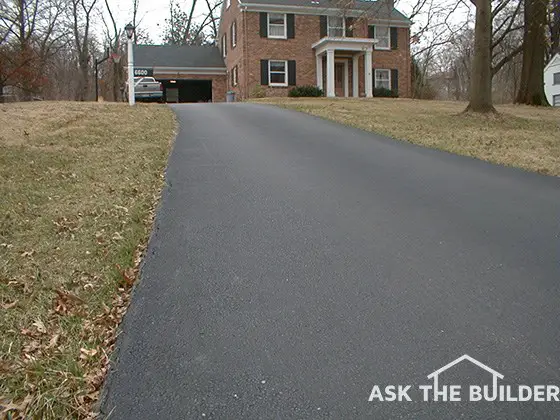
This is a blacktop driveway near my last home. it's in great shape and you know it's got a solid gravel base under it. © Copyright 2017 Tim Carter
What is a Better Option Over the Concrete?
If I were you, I'd seriously consider installing a thin concrete overlay on your driveway. You can apply a layer of cement stucco as thin as 3/8 inch that will last for another 40 or more years.
It's possible to add an even thicker layer of concrete with small stones in it, but then you have the same safety issues I have already discussed.
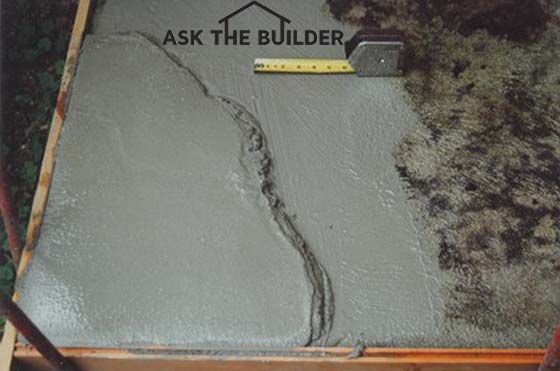
This is an example of a concrete overlay. The thin overlay is in the lower left corner. You can see a coat of cement paint on the old concrete. Look at the paint under the tape measure. Copyright 2018 Tim Carter
Can I Do a Stamped Concrete Overlay?
There are professional companies that can stamp and colorize the thin overlays if you want a truly distinctive driveway. Stamped concrete is not a do-it-yourself (DIY) project unless you have lots of experience and many friends who can assist you.
Is Concrete Overlay DIY Friendly?
The concrete overlay project is very DIY friendly as you don't have to do the entire driveway on one day or even a weekend. You can apply the overlay to one or two sections of driveway at a time.
The trick to making sure the driveway looks the same once complete lies in getting all of the materials you need at the same time. You must buy all the sand at one time and the bags of cement must be from the same manufacturer and batch.
Can I Trust Blacktop Contractors?
Beware of blacktop contractors that speak with a forked tongue. Some might say all will be well if they install blacktop over broken and crumbling concrete.
It will look fine for awhile, but wait until you start to drive on it or heavy trucks pull into your drive. If you live in a cold climate, all sorts of cracks will appear half-way through the coldest part of the winter when the soil freezes and heaves the driveway.
How Does the Concrete Overlay Bond to the Old Concrete?
If you decide to install the concrete overlay, you must make sure all loose material is removed and the concrete is slightly damp. Immediately before applying the overlay mix, paint on a thin coat of cement paint.
Cement paint is made by mixing Portland cement powder with clear water. CLICK HERE for a step-by-step guide for doing a concrete overlay.
Column 508

Tim built custom homes and did ultra-custom remodeling for 20+ years before launching his Ask the Builder media presence. He was selected as one of the Big 50 by Remodeling magazine in 1993. This award gave birth to Ask the Builder in October 1993. Tim also operates https://DrawPlumbingPlans.com. His @askthebuilder YouTube channel was the first home improvement channel on YouTube.

I have a terribly broken up concrete driveway; 1600 sqft....that is 75% gravel-exposed...the balance , though smoothly covered , is mostly thin layered concrete... ready to break up anytime.
So ugly! And when I say thin layer , I mean THIN.
Would you still recommend an overlay of concrete method, or just get it completely dug out, and "re-surfaced" ?
Appreciate your reponses to others. Just don't know what I should do.
Estimate (zip code : 29609) was $5,000 six yrs. ago.
Bill, your question requires lots of typing, plus I have some questions for you so I can give you the correct answer(s). I only do pithy answers here in the comment section. If you want to protect the investment you have in your house and not waste time or money *hoping* you make the right decision, you should talk to me on the phone for just 15 minutes. It'll be the best investment you've ever made in your home!
I would like to "Blacktop" over my existing concrete driveway in North Carolina. My house is situated somewhat at the end of my community, and kind of on a slope (which catches alot of weather/rainwater from the other houses above mine).
Would it be feasible and is it possible to "Blacktop" my driveway.
Please advise.
C. A. Lewis
Yes. Why don't you spend a few minutes and read all my Asphalt and Blacktop Drive columns?
i have a small concrete patio approximately 12' X 24' with only real crack; however, that crack created a sloping 3' X 6' triangular section of concrete that is level at the crack but has sunk 2 or 3 inches at the far point where it meets the house cinder block foundation (it cracked because of excessive rain water from broken gutters which have since been fixed).
My Questions:
- could this sloping section be a problem if "blacktopped"?
- we also have porch steps (3' X 3' X 7'); can it too be "blacktopped"?
- and finally, is such a thing a DIY project (we're pretty clever about most DIY stuff)?
(i'm just investigating things at this point in time so general advice is fine.)
thanks in advance for anything you can tell me, i truly appreciate it.
Remove the broken part. Drill 1/2-inch holes into center of remaining slab 16 inches on center. Drill them 5 inches deep. Get 14-inch-long pieces of 1/2-inch rebar. Pound them into holes. COMPACT soil at location where new concrete will be poured. Pour new concrete and place steel bars in the new triangle for extra strength.
Hello I have an old asphalt driveway that half of it is cracking into pieces. Can I paved over it
Met with Oneil Asphalt guy who said even though our 30 year old concrete drive with cracks is in bad shape that he with tack coat application and 2 inches finished of black top, that life of drive will be extended by 25 years. Your thoughts? Sam
Sam,
I've got questions. I don't go back and forth in comments. If you want me to guide you to the best decision, consider this:
http://shop.askthebuilder.com/products/15-Minute-Phone-Conversation-with-Tim.html
Some situations can be solved by an experienced "mud-jacking" contractor. If slabs of a concrete driveway are tipping down, holes can be drilled in the concrete and a quick drying material will be pumped into the holes until the concrete slab is level with the surrounding concrete. If this is still not exactly what you want the finished driveway to look like, mud-jacking can produce a level surface for either a thin concrete overlay or finishing with a blacktop surface on a flat, solid base. I don't know the formula for mud-jacking, but I do know there are contractors using an inferior liquid, so get references from customers whose driveways have remained level for several years after being lifted.
Question: New concrete driveway is flaking and saw cuts are crumbling. Contractor will remove and replace, but that is a headache I prefer to avoid. You mentioned an overlay what is the material and how durable will it be over the next 20 years? my driveway is about 2600 sq feet of concrete so if i can avoid a tear out I'd prefer. what would you do if presented both options?
An overlay can last decades if done right.
Use my search engine on this page and go read ALL of my Concrete Overlay columns.
I also do phone consulting if you need an extra level of confidence:
http://shop.askthebuilder.com/products/15-Minute-Phone-Conversation-with-Tim.html
We have a concrete exposed aggregate driveway. The prior residents did not seal it properly. The aggregate is starting to slough off in a few places and after every hard winter and inches of snow the cancerous places have become worse and worse. We live in central Washington where the winters are very cold and snowy and the summers are extremely hot. Do you think resurfacing our concrete aggregate driveway with asphalt is an option? Thank you in advance for any advice you might be able to give us!
Margie,
This is an excellent topic for my podcast. I'd be happy to call you and tell you exactly how to fix this so it lasts for a long time. I'd need to see three really good photos of the situation. Go to this page and fill out the form. Be sure to say you want me to call you for the podcast:
https://www.askthebuilder.com/ask-tim/
Gawd. I dug a trench for a client to install drainage. I put in two screens to prevent blockage, one coarse at the storm drain, one fine at the parking lot level.
Guy cut out the fine drains and then put ready-mix ashphault overtop of the concrete (we had to do the pour in sheeting rain, a long story I wont bore you).
Now complaining that the concrete cracked, but concrete is mostly white colored, and this material is dark (ie. ashphault). AFAIK, ashphault will not bind to fresh concrete as it is oil based, and the concrete is water based. It's Canada in the winter, I told him to leave the plastic sheeting over the top as long as he could so it could cure properly.
I'm just frustrated. Wouldn't mind talking to a fellow pro.
You can vent all day on the phone with me. I'm glad to share tips to make you more $$$ or minimize complaints. Do this:
http://shop.askthebuilder.com/products/15-Minute-Phone-Conversation-with-Tim.html