Gas Grills
DEAR TIM: My husband and I moved into a new condo that has a balcony. We are allowed to install a gas grill, but don't know which type to buy. On the wall immediately adjacent to the balcony is our mechanical and laundry room. Both our water heater and clothes dryer that are in this room are fueled with natural gas. Is it possible to extend the gas line through the exterior wall for a grill? Or would it make better sense to purchase a gas grill that has a tank of its own? Gina B., Chicago, IL
DEAR GINA: Who can resist the tantalizing aroma of steaming vegetables and seared meat wafting from an outdoor grill on a relaxing afternoon or evening? Evidently millions of people can't as barbecuing is a very popular pastime. It is easy to become addicted to this relaxing cooking technique.
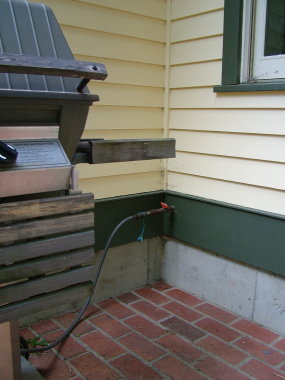
The gas grill is fueled with natural gas. The gas line extends into the house and connects to the main house line. This grill never runs out of fuel. PHOTO CREDIT: Tim Carter
I'll bet you and your husband will enjoy the flavorful food so much, you will find yourselves outdoors this winter cooking while snowflakes are swirling about you. I have my own natural gas grill and have barbequed outdoors for many years. It is an enjoyable time and it is one of the few cooking tasks I can do with a degree of confidence.
But before you go and buy a grill be absolutely certain a gas grill is permitted in your apartment or condominium complex. Recent changes in the fire code have placed certain conditions on the use of gas grills in multi-family housing. It may be illegal to use one where you live. It is always best to contact the fire prevention officer at your local fire department to get a definitive answer.
Your decision over which grill to buy is not easy. There are quite a few things you need to consider. The actual price of comparable propane vs. natural gas grills is nearly identical in most markets, so the cost of the grill should not weigh heavily in your decision. In your case, you need to obtain a quote from a plumber to see what it will cost to extend a one-half inch approved gas line branch out to the balcony.
Be sure the plumber quotes two small shutoff valves for this branch line. One valve should be inside and the other one out on the balcony. The end of the line should also have a quick-connect adapter which will automatically shut off the flow of gas when the flexible gas line that connects to the grill is disconnected. Be sure all local fire codes are followed to the letter.
The cost difference of the fuel for either grill is so small it also doesn't matter as far as I am concerned. A standard propane cylinder holds just about 18 pounds of liquid propane and can fuel a grill with a total output of 36,000 Btus for well over 12 hours if you have the burners set on medium. If you grill for say 30 minutes or more each meal and cook outdoors 3 times a week, you may discover you need a propane cylinder refill every two months.
A typical refill for a propane cylinder often costs less than $15.00. I know it costs me very little to operate my natural gas grill each month. I estimate I spend less than 15 cents each time I grill for my family. Neither option is very expensive.
What you need to consider is how much you value your time and how convenient it is to get a propane tank refilled. Will it be a struggle for you to lug a filled propane cylinder on the train or bus back to your condo if you don't have a car?
How long will it take to get one filled or exchanged if you visit a large store that just sells propane as a sideline business? Will you run out of propane in the middle of a cooking task? You can buy an extra propane cylinder to have on hand for just this occasion, but if you are a procrastinator, you will end up with two empty cylinders for sure at some future time.
I really feel the actual deciding factor will be the convenience factor of getting propane refills. If it becomes a problem, you will regret not having spent the money to cover the one-time cost to get the natural gas line extended out onto the balcony. It probably is very attractive to buy the propane grill now and have it working within an hour of arriving home. But try to imagine how long you might stand in line to get that tank filled or how unhappy you might be if you have to travel to different locations to find a dealer that has filled propane cylinders that are in stock.
Not all natural gas lines can be extended. The plumber you hire needs to make sure the line feeding the new branch has enough capacity. If the gas line feeding the existing appliance near the balcony is only one-half inch diameter or less, you may not have enough gas to feed both the grill, the water heater and the clothes dryer.
It would be ideal if the gas service line feeding both the water heater and clothes dryer was a pipe that had a one-inch inner diameter. The plumber could then install a tee fitting off of this line that connects to a one-half inch diameter pipe that would supply natural gas. The short distance from the mechanical room to the balcony is also in your favor. If the pipe had to travel a long distance, there would be a slight amount of friction loss that might cause the grill to burn at a lower temperature if the water heater and clothes dryer were consuming gas at the same time as you were roasting a nice plump chicken!
Column 574

Tim built custom homes and did ultra-custom remodeling for 20+ years before launching his Ask the Builder media presence. He was selected as one of the Big 50 by Remodeling magazine in 1993. This award gave birth to Ask the Builder in October 1993. Tim also operates https://DrawPlumbingPlans.com. His @askthebuilder YouTube channel was the first home improvement channel on YouTube.