Tankless Water Heater
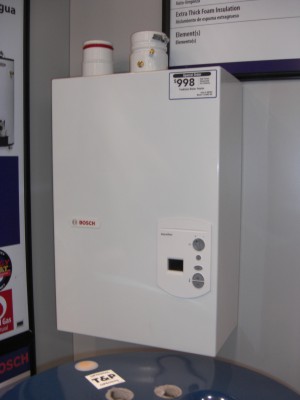


To add a comment visit the Article Page.

Comments

Leonard Juska
21 Jan 2008, 11:09
Very good commentary, Tim. Thank you. Of course, if the price of fuel continues to go up, trade off time can come sooner or partially offset the interest/income loss.

Another, less noted advantage of tank water heaters in times of distress (earthquake, for example), is the reservoir for emergency. Most municipalities require heavy strapping for these, in case of motion. But at least you have 40 gallons or so of fresh water. Humans can last days without food, but not without good water.

For Mr. M. Thomas, I tried the link but I received the "404" page error. Thanks.

Best wishes to all,
Leonard Juska
Costa Mesa, CA
Doug Siebert
21 Jan 2008, 11:59
Tim,

Would Bob really need to spend $1550 extra on a tankless water heater for his vacation home? A water heater sized for a household of five like yours has to be a lot bigger than one for a vacation home, plus he might be able to get by with one of a bit lesser quality since it will see less use and it is perhaps not as big of an issue if it fails. After all, he is only there during the summer, so his family could suffer through a few days of cold showers over the 4th of July more easily than they could in January!

I see tankless water heaters sized adequately for one shower at a time for $500 which would probably be fine for that vacation home (3 gpm, 60* temp rise, 10 yr warranty) To me, the advantages of not having to remember to turn the heater on/off when coming and going, draining it for the winter, etc. are probably worth spending a few hundred dollars more versus the standard 40 gallon tank.

Also consider the space savings, since vacation homes are often a bit cramped as it is. Finally, I think that endless hot water is almost a must have in a vacation home where you bring friends and their kids and the floor is covered with sleeping bags at night. It doesn't matter how big the tank is or how quickly you make the kids shower, it always runs out before the last person takes their shower!
AsktheBuilder
21 Jan 2008, 13:12
Doug,
Bob actually emailed me hours ago after he saw the column. Believe it or not, he said it is a large four-bedroom home and he expects guests that would be taking showers at the same time. So much for your pint-sized tankless heater suggestion. Bob might spend at least $1,200 more in 2008 dollars. People really need to do the math. As I said, if money is not an issue and you want continuous hot water these things are the bees' knees.
MIchael Thomas
21 Jan 2008, 16:31
Hmm.... I see my contribution was deleted.

I thought it was useful - for one thing it included a link to the ONLY study I've ever been a able to find that evaluated tankless payback under controlled conditions simulating actual household use, and I wonder if whoever hit the delete button bothered to follow the primary link, or just assumed it was a SPAMed advert.

If anyone is curious you can probably GOOGLE it up, with was done by the / Exelon Services Federal Group (ESFG) for the Okaloosa Gas District.


AsktheBuilder
22 Jan 2008, 08:52
Michael,
They were deleted because the links didn't work........ It is not a conspiracy...... Instead of making everyone work to find it, can't you summarize in 100 words the findings? Just state the facts.....
Brett
23 Jan 2008, 20:12
Tim,
Perhaps another concern to be taken into account is that of tank water heaters exploding. My grandparents heard of a few such events while talking to people who have vacation homes in the Island Park,ID area. I don't know how often tank heaters fail and the exact circumstances that cause it but, it was a serious concern with my grandparents when they would leave their cabin for extended periods. I also realize you're comparing the costs of new tanks, not old ones. How much do you think, of a difference in safety is there, if any, over the long term?
Doug Siebert
23 Jan 2008, 22:13
Brett,

Newer water heaters have safety mechanisms to prevent that sort of thing, so it should be only older ones doing that. Mythbusters did a segment on that and they had to disable two separate safety mechanisms to get the water heater to go overpressure and explode. But when it did, it shot several hundred feet up in the air, you would not want to be home when one of those blew!

I would think the only risk of explosion with today's water heaters would be a gas explosion, which could happen with any gas fired water heater, with or without tank.
Michael Thomas
24 Jan 2008, 09:10
Even with *electric* water heaters you can get some pretty vicious events if things go wrong in the right way, for example this 5 gal electric unit demolished a considerable hunk of CMU wall at a high school

http://www.safteng.net/Accident%20Photos/Hot%20Water%20heater%20explosion.h tm
- or -
http://tinyurl.com/29hyyl

If someone is determined to run a gas fired unit at an unattended location, IMO an auto gas shutoff like the Watts 210-5 would be a Good Idea.


AsktheBuilder
24 Jan 2008, 15:14
Brett,
Ditto Doug. If the T & P valve and the gas valve fail, then explosion is a reality. I am not worried about mine.
A Rob
28 Jan 2008, 12:54
About a year ago, I had tankless systems installed at our house and at our vacation cabin.

At the house, we got a very large unit, a Rinnai. We have 3 teens and 2 exchange students so there is a lot of demand for hot water for showering and laundry. Bottomless hot water supply has really helped to get it all done without worrying about a showering schedule. We can start a load of laundry and hop in the shower, no problem. A side benefit which makes the economics work out is that by moving the hot water heater into a side closet, we gained a large pantry-size closet in a spot where storage was really needed. We could not have renovated to gain space there. Also, I do not have to worry about the tank leaking (which happened the day after we bought our first house, so I know it is possible!), ruining my pergo-style floors. The old tank was in an interior closet under the stairs. We had to move it to get a place to run the vent pipe.

At the cabin, we did have a water freeze last year, downstream from the water heater so its entire contents emptied into the cabin. This happened in an area which does not normally have a hard freeze, during a time when we go out there semi-weekly. We discovered it about 10 days after the leak happened, so we ended up in a major remodeling project which included tearing out a tub and replacing the subfloor under it. The insurance did not cover it because it was considered negligence. Bad surprise! I've switched insurance companies.

Anyway, the issue with getting a tankless system at the cabin was low water pressure because it is on a well that does not produce that much water. One plumber recommended against the system for that reason, but another plumber who installs these regularly said it would work because there was enough pressure to take a shower (he used a plumbing tool I don't own to determine the pressure). It works because we do have a tank for water in the pump house which is slightly uphill from the cabin and acts like a water tower. The brand we installed there is Noritz.

Anyway, it is great for cabin use. Like one commenter said, at a cabin you either have no use for hot water or you need great quantities of it. The tankless system is perfect for that. It does not take long to get hot water, so there is no great waste of water while you wait for the hot to get to the faucet. We can shower, run laundry and wash dishes all at the same time. I also was able to make one bedroom 3 feet larger by moving the heater to an unused closet in an adjoining room. The gain of this space far outstrips the cost of the heater.

One thing to consider is the electrical supply needed to start the system. We use an inverter and a marine battery if the power is off, but I believe there are other ways around it.

Water heaters do make good water storage devices for emergency use. You can get second hand ones cheap, possibly remove the element for better water quality, and store them out in the garage or some hidden area of your property in case you lose water. I wouldn't choose to keep a tank water heater just for the reason of emergency water storage. Based on my experiences at the cabin, you can go through a lot of water very fast by showering and doing laundry (we have a 1500 gallon tank), so one water heater is just a bare minimum supply.

In my case, I consider the units to be paid off already. I have gained storage space, living space, convenience, time, access to unlimited hot water when needed, and peace of mind that my tanks will not fail and get me involved in future emergency remodeling projects.
Roger N.
31 Jan 2008, 12:36
All this info neglects one thing that I've read and that is the lag time to get hot water to the use point. On average, I understand 3/4 of a gallon per use point. That's a lot of wasted water at some cost. In addition, there can be multiple instances of this water wastage, i.e. at the sink while washing dishes if you turn off the faucet mid-cleaning and start it up again, you, once again, wait for several minutes and 3/4 of a gallon to get your hot water. Now, I've read about this item from Chili Pepper Appliance that pumps the water in a big loop from the water heater through the hot water piping to the Chilipepper, and on through the cold water piping back to the water heater inlet, a big loop. Seems, though, you'd need one for each point of use. At $180 each that would add up. Has anyone had any experience with this item?
AsktheBuilder
31 Jan 2008, 12:50
Roger,
You have the lag time with either a storage or a tankless heater. If you want to discover much about recirculating loops, read all of those columns here at AsktheBuilder.com. I have several - gravity loops as well as pump systems.
John M
01 Feb 2008, 19:36
It seems to me that both Tim Carter's article and A. Rob's post are right. Tim is right to point out that the economics of a tankless system may not save you as much as you had hoped and that it could take decades for these savings to amount to anything meaningful. And you might actually save nothing but actually spend MORE if you start taking endless hot showers.

OTOH, I found all the points in A. Rob's post about the many non-monetary benefits of a tankless system to be an equally valid perspective for those to whom the benefits matter. BTW, another benefit of many of the tankless systems which I did not see previously mentioned is that you can raise and lower the temperature of the hot water using a wall mounted remote control resembling a thermostat. Another potential benefit which is either quite valuable or completely meaningless depending on your personal opinion of it.

In my case, I'm still weighing the decision in my mind. I planning to have a major bit of plumbing work done in the near future to connect my 53 year old house in upstate NY to the town water and sewer lines. A scribbled note on my tank heater's manual says it was installed in 1979. So it seems like a good idea to replace it since it's coming up on its 29'th year. I'm guessing installing a new long warranty, energy saving tank heater would cost me ~$1000. A new tankless heater maybe twice that. Haven't decided which way to go yet.

One thing that confuses me about comparing costs is that it's hard to determine just how much I an paying for gas. The cost/therm varies during the year. In the summer I use less than 10 therms/month, but I effectively paid NYSEG over $3.35/therm for them. During the winter I use 100 therms or more each month, but the effect cost per therm is half what it is for a summer month.
Wayne
08 Mar 2008, 09:04
We have a new house in the carribbean with a 40 gal tank and it works well. No complaints.

However we have begun to have some worries as the tank is above the bathroom in a crawl space. If the tank ever develops a leak we would not know until something bad occurs, like the ceiling coming down, water stains, etc.

There is supposed to be a tray but if the leak was large enough and we didn't see the overflow then it could fail and release a high flow of water which would cause a lot of damage.

And so we are considering a tankless system more from the reliability point of view.
AsktheBuilder
12 Mar 2008, 07:52
Wayne,
So tell me what happens when some part or connection fails on the tankless unit. Will the water go up or evaporate before it hits the ceiling? The reason you give would not convince me you need a tankless unit. You can easily install a drip pan with a 3-inch drain system that will take any amount of water a normal heater would produce - even in a catastrophic failure.
jonbatt3
13 Mar 2008, 09:33
Should a tankless water heater ever be installed in the Attic in a hot climate?
AsktheBuilder
15 Mar 2008, 07:19
Jon,
The answer is easy. Read the instructions provided by the manufacturer and then get the final word from your local plumbing inspector. Your local laws may not permit it.
S. Snider
31 Mar 2008, 11:47
I'm doing hurried research on water heaters this morning because I just discovered that our conventional tank heater started leaking over the weekend. Luckily, we moved the heater to the garage about 7 years ago, so the damage is not severe.

The original heater was in the laundry room. When it failed after about 10 years, water seeped through adjacent walls destroying carpeting and vinyl flooring in connecting rooms.

The cathode tubes in the second heater decomposed sending shards of debris into all the water lines throughout the house and destroyed a new diswasher.

So, it should be apparent why I'm not enthusiastic about buying a 4th tank heater for my 27 year-old house.

However ---- any heater I buy needs to be electric. I'm not finding much information about electric powered on-demand heaters. So far, I've located only 2 manufacturers and neither seem to market a high-demand model.

What advice can you give me?

What can you tell me about
AsktheBuilder
01 Apr 2008, 06:09
S.,
My tankless water heater columns pretty much tell the tale. The fuel source is of little importance since it is the same for whatever heater you buy. But in your case, wait till you get the bill for the new power line to the heater!!! Wow!!!
S.
01 Apr 2008, 06:29
ATB, are you saying that an electric tankless system will require a different power connection than does the current conventional tank? How so?
A Rob
01 Apr 2008, 08:55
We had an all-electric house at the time we started looking at the water heaters. Electric on-demand heaters are available, but both the seasoned plumbers and HVAC contractors I spoke with said they are too inefficient for their cost.

We ended up adding a gas line to the house, since we also converted a wood burning insert to a gas insert at the time. We convinced the gas company that this was our primary heat source to get the line from the street from them.

We have propane at the cabin and the unit works fine on LP gas. We did have to do some gas line plumbing (hired an expert) to get the gas to the heater location.

AsktheBuilder
04 Apr 2008, 04:51
S.,
That is correct. Get the installation instructions for the unit you are considering. Wait until you see the amperage requirements. If you have a standard 240 volt 30-amp circuit, it is too small.
Leo Cleversley
27 Apr 2008, 09:44
All,

According to the date time stamps, I am a couple months late on this discussion. In any case, I just bought a small investment home, it's approx 648 sq ft. I am thinking of installing the Eemax EX190TC in order to both save space and save money. The existing water heater is shot so the replacement is a must. It is also gas and I am going all electric in this house. I will be running all lines, water and electric myself and will only need to fork out for the electrician to install the breaker and connect as I am afraid of electricity. There are only three points requiring hot water: The 1 bathroom and the kitchen (no dishwasher).

Any suggestions?

Thank you.
Norm
21 May 2008, 09:44
One other major cost factor to consider is that tank heater last between 7-9 years on average, whereas tankless last anywhere from 25-40 years. So if you expect to keep your vacation home for 30 years, plan on replacing the tank at least twice during that period. The cost of replacing those two tanks will just make the tankless option a no brainer.
Lisa Lyons
25 May 2008, 09:22
I have a vacation cabin in the Adirondack Mountains of NY -- winters are very cold. We drain the water in the cabin in the winter and turn off the heater. Are there tankless not water heaters that can be totally drained so that they will not be destroyed by residual water freezing in them during the winter -- the temperatures in this region get down to minus 20 at times.

Lisa
liz
25 Oct 2008, 06:00
Our small laundromat's "Natco tankless boiler corroded with leaking all over the tubes. Do we need to fix the unit or replace? What system is best, the tankless or with storage tank?


To add a comment visit the Article Page.

Have a Suggestion?