Compound Miter Saw
Compound Miter Saw TIPS
- Magnificent saws that will work for many jobs
- Sliding compound saws offer the most versatility
- Watch saw stand video below
- Purchase a quality saw to last decades
- CLICK HERE to Get Tim's FREE & FUNNY Newsletter!
DEAR TIM: A compound miter saw has bubbled to the top of my power-tool wish list. To be sure I need a compound miter saw to put up some crown molding.
Would it be better to get a sliding saw if I do go ahead? I'm a serious DIYr and would like a great saw. Furthermore I've read quite a few tool reviews for these saws and I'm confused. Andy D., Nashville, TN
DEAR ANDY: I am sorry to hear about your confusion after reading the tool reviews. That's unfortunate as a compound miter saw is a significant investment, and you do not want to make a mistake when you are buying a specialized tool.
Compound Miter Saw & Crown Molding
A compound miter saw is a specialized saw. It allows the saw blade to pivot in two different directions at the same time. This feature allows the saw to make a compound cut you'd find on the ends of crown molding. Hip and valley roof rafters have compound cuts.
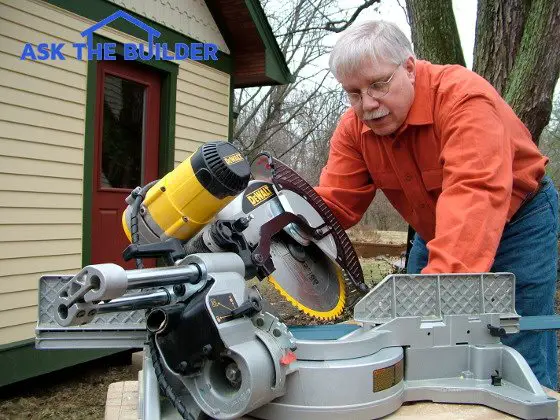
Compound cuts are very rare in typical residential construction. To put it differently the vast majority of angled cuts in a home are simple 90 or 45-degree cuts.
Baseboards and window and door trim casing miter cuts are made with the saw blade cutting down through the material at a 90-degree angle. Consequently the saw needs to swing to the left or right 45 degrees to make most miter cuts. With this in mind the saw you want to purchase will make these cuts with ease.
Free & Fast Bids
Related Links
Miter Saw Stands Are Essential
Cutting Crown Molding with Ease
Compound Cuts Without a Compound Saw
You can cut crown molding without a compound miter saw. The first thing to remember is to place the crown molding in the saw so it thinks it is already hanging up against the ceiling.
As an illustration the table of a regular miter saw and the vertical fence that rises up from the saw table are oriented at 90 degrees to one another, just like the typical wall / ceiling interface so it is easy to hold the molding at the funny angle.
If you put the crown molding upside down in the saw and hold it in the saw the same way it will be installed it your home, all you need to do is rotate the regular miter saw to the correct miter angle and make the cut. Because the crown molding is being held against the saw fence tilted down at an angle towards the table of the saw, the resulting cut is a compound cut even though you were not using a compound miter saw. Isn't that amazing?
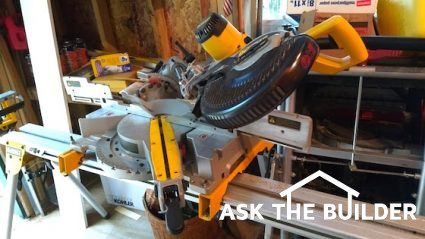
The compound miter saw is set at 45 degrees in both orientations for the purpose of making a compound cut. You'd use this setting to cut a cheek cut on a valley rafter for a 12:12 pitch roof. CLICK THE PHOTO NOW to have this saw at your home in days. Copyright 2017 Tim Carter
Sliding Saws Are The Best
I own a sliding compound miter saw. It is a fantastic tool and I use it frequently.
It's important to realize the 10-inch blade and the sliding function allow me to make precision cross cuts on material as wide as 12 inches.
A sliding miter saw in not much different from a small portable radial arm saw. While it can't do everything a radial arm saw can do, but it sure comes in handy most of the time.
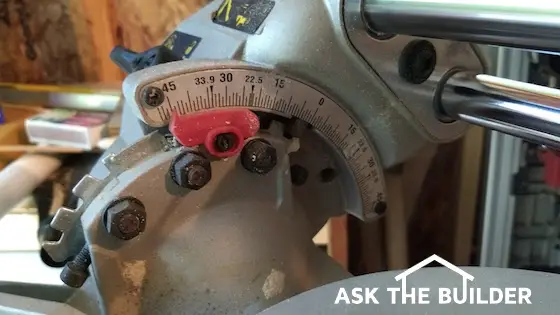
This angle gauge allows the saw to tilt one way or the other past 90 degrees. In fact you can see you can go a few degrees past 45 degrees. CLICK THE PHOTO to have this delightful saw delivered to your home. Copyright 2017 Tim Carter
Very Versatile
A sliding compound miter saw is a wonderful tool to have around the shop or for a serious do-it-yourselfer. For one thing, you'll use it for many purposes. By all means don't buy it just to cut crown molding.
There are many finish carpenters who love their compound miter saws and use them regularly to cut crown molding. But realize that the master carpenters of yesteryear installed crown molding without this fancy tool, much less a saw powered by electricity!
Good Better Best Saw
The best compound miter saw is hard to pin down. In general, tool reviews include bias. A point often overlooked is five different carpenters can have five different opinions when they test the exact same compound miter saw.
With this in mind here's a partial list of things to consider when deciding on a saw:
- weight of the saw
- size and horsepower of the electric motor
- range of cutting angles
- type and shape of the handle
- diameter of the blade
Cut Past 45 Degrees
My miter saws can swing and cut past 45 degrees. For this reason all of the miter saws I own can make cuts up to 50 degrees.
For instance this characteristic comes in very handy when installing crown molding on outside corners. Frequently the needed angle to make perfect cuts is 47 or 46 degrees.
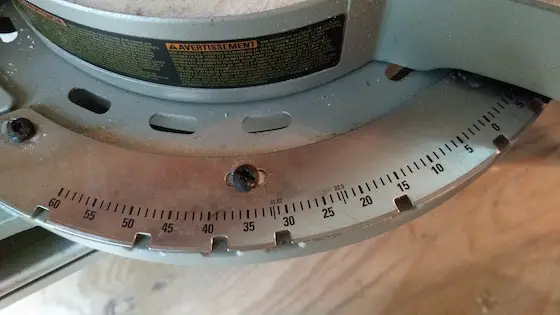
This is the table miter gauge on my compound miter saw. Note how the table can rotate to 60 degrees! This is a very useful feature. CLICK THE PHOTO to have one delivered to your home. Copyright 2017 Tim Carter
Miter Saw Stand Essential
A miter saw stand is the number one accessory you should buy. My stand is lightweight and furthermore it keeps the saw safe and stable.
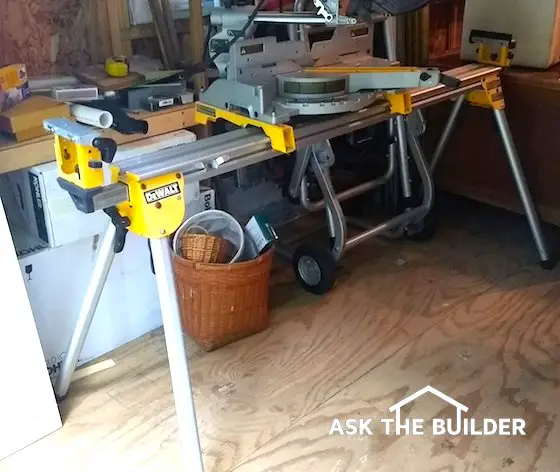
The four-legged saw stand is made primarily from aluminum. It folds up for easy storage and transport. You can place the saw anywhere you want along the horizontal aluminum beam. CLICK THE PHOTO to have this stand delivered to your home. Copyright 2017 Tim Carter
Miter Saw Stand Video
Watch this video of my miter stand. The saw stand will make your mouth water.
Price Is A Good Measure of Quality
Price is often a very accurate measuring device when you are comparing the quality of compound miter saws. This is a very competitive marketplace, and there are enough manufacturers that they have to create crisp features that set them apart.
If you're a manufacturer that wants to deliver exceptional quality, then you will probably include high-quality parts that cost more. These costs result in higher retail costs to the consumer.
In conclusion, I try to purchase high-quality power tools to avoid heartbreak. I want to know it will be durable, and that it will produce accurate work. All things considered those things are very important to me.
Column 712

Tim built custom homes and did ultra-custom remodeling for 20+ years before launching his Ask the Builder media presence. He was selected as one of the Big 50 by Remodeling magazine in 1993. This award gave birth to Ask the Builder in October 1993. Tim also operates https://DrawPlumbingPlans.com. His @askthebuilder YouTube channel was the first home improvement channel on YouTube.
Biggest problem on compound miter saws is ensuring you can find a true zero angle (90 degree as starting point on two axis's ). Even a 0.5 degree off from zero before adjusting will result in a poor fitting or bad cut. All saws can be adjusted toward a zero, but some are just too sloppy right from the factory.
Rollin makes a good point about miter saws never quite being true. It's a good idea to check the fence and table for being level when you take it out of the box. With a bit of tuning, you'll be cutting perfect miters every time!
Cheers
Thanks for the tips on compound miter saws — important stuff for those who want to take this seriously. Until recently I was using an old manual saw that used to belong to my dad. Long story short, it's no longer practical, and so I'm looking for a good (compound) miter saw to buy. I was talking to the guys that own that site and they actually recommended I check out your content. In any event, I'm going to keep these tips handy for when I obtain my new saw. Thanks again.
All good tips, thanks. My biggest problem is setting the miter angle precisely. I made a threaded adjuster to “nudge” the angle slightly. But still have to sneak up on the angles.