Trench Drain
DEAR TIM: Do you think a trench drain or a French drain will solve my soggy yard as well as the chronic leak in my basement? Many of my neighbors suffered from the recent heavy rainfall, and we all are tired of dealing with water in and around our homes. Will a trench drain really work, what is proven design and how does one go about installing a French drain? Robin R., Dawson Springs, KY
DEAR ROBIN: I know for a fact that a trench drain will solve your swampy yard. If you install this trench or French drain correctly, it will also stop the water from entering your basement. Thousands of people have used a trench-drain design I perfected years ago to redirect water that was coming from my neighbor's yard. It worked so well, I started using the same system on all of my jobs where customers had poor drainage and needed relief.
My college degree is in Geology, and I had a special interest in hydrogeology. This is the study of groundwater. To understand how to drain land and keep your house dry, one needs to understand the movement of water after it enters the soil. Many people believe that water travels straight down through the soil on its way to the water table. It can in certain areas, but often as it moves to a layer of porous rock, it travels sideways through the soil. This is especially true in areas where the top layers of the soil horizon have a clay composition. Clay is a highly-effective water blocker, and as such acts as a great liner for lakes and ponds.
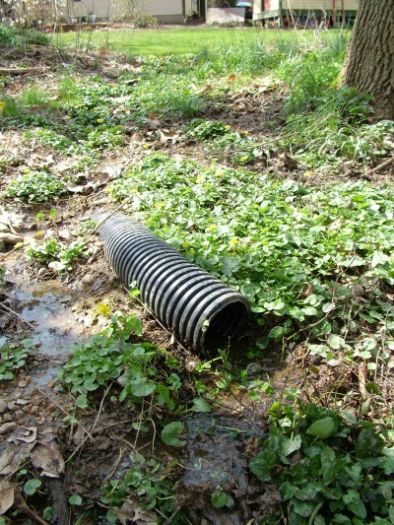
This is the outlet for a trench drain. Since the ground slopes and the trench is kept nearly level, the pipe eventually pokes through the soil to daylight. PHOTO CREDIT: Tim Carter
Top soil has a very open structure, and is filled with lots of air voids when the soil is dry. As rain falls from the sky and enters this top soil, it enters this network of interconnected air spaces. If the water travels down under the pull of gravity and hits a dense clay subsoil, the water starts to move sideways along this clay zone moving down slope as the ground slopes toward creeks, streams and rivers.
A trench drain installed on the high side of your land can intercept this water as it is moving directly towards your home. The trench drain acts exactly like a gutter on a roof by collecting the water and redirecting it to another location. The water enters the trench drain and flows through it because the design of the trench drain offers much less resistance to flow than the water moving through the soil.
My trench-drain design is simple. You dig a 6-inch-wide trench about 2-feet deep. The bottom of the trench stays parallel with the top surface of the ground on the high side of your land and as it passes on either side of your home. Once the trench passes your house, the bottom of the trench should be made nearly level with a minimal slope. As the ground slopes from your house, the bottom of the trench gets closer and closer to the surface until it pokes through to the surface much like a horizontal mine shaft.
The trench contains rounded washed gravel and a perforated 4-inch-diameter drain pipe. The pipe is simply a high-speed conduit that acts like an underground river in times of heavy rainfall. You install 2 inches of gravel on the bottom of the trench then the pipe. The pipe is then covered with additional washed gravel to within 1 inch of the surface. You can then add soil or sod if you want to hide the location of the trench drain.
There is no need to install a geotextile sock around the pipe or use it to line the sides of the trench. These materials are designed to stop silt from clogging gravel or drains. This is needed when you install fluffed dirt over drainage systems. In my design, the small amount of soil added to the top of the gravel will not be a factor.
Water flowing through soil does not contain silt except in the situation described above. In virgin soil or compacted soil, silt is a surface phenomenon. Creek water in a storm is muddy because of dirt that is eroded from the surface and carried overland to the stream, brook or river. Proof of this is the crystal-clear water that flows into wells and out of surface springs. You will also see clear water flowing from the outlets of your trench drain once you install it.
To stop water from entering basements, a trench drain is but one part of a system. The water from roofs and all paved surfaces like patios, sidewalks and driveways must not be allowed to discharge or collect near the house. This water must be collected and piped to the lowest part of the building lot away from the house.
There has to be positive drainage away from the house foundation. The building code, which is a MINIMUM standard, states that in the first ten feet of horizontal distance away from a foundation, the grade must drop 6 inches. This is not enough in my opinion. It is better to have at least 12 inches of drop. What's more, I frequently see landscapers or homeowners who pile mulch around foundation plantings. This mulch creates dams and can cause ponding of rainwater around a foundation.
A trench drain can be installed with a powered ditching machine and some strong boys who can cart away the soil and bring back gravel to fill the trench. If you want to use powered equipment for the whole job, visit a tool-rental business. There are wonderful miniature loaders that can move both soil and gravel with minimal disturbance to your yard. Be sure to have all underground utilities marked before you dig.
Author's Notes:
You may wonder if my advice is worth anything. Well, read what Jim Sanders wrote to me when he was at the end of his rope:
"Hi, I just wanted to write to give you the results of my "Trench Drain". I have had a wet crawlspace for 15 years. Water would fill the crawlspace at times, so we actually had to drill weep holes at the base so that it would enter the basement and eventually, the sump pump.
I have tried everything. Several contractors said that the only thing we could do was to bring the water into the house via drainage tile and let it enter the sump pump. That would work, but because I live on a 6' elevation, there is no reason that I should have water problems. It became like clockwork...when it rained, we would rush home from the lake or wherever we were vacationing so that we could be prepared to start the backup generator, in case the power failed. We even had our alarm company put a sump alarm on our system, so they could notify us if we had a power failure. Battery backup was not an option, because sometimes we lose power for days and during any rain, our sump would run every 7 minutes...just like clockwork.
I found your site and read the article on the trench or French drain. At first, it sounded a bit like "holistic healing" to me. I failed to understand why a 2 ft. deep trench, 4 ft. away from the house would do any good. How could this simple thing correct an extreme water problem that has plagued me for years, cracked my foundation, settled my garage floor and ruined almost every vacation?
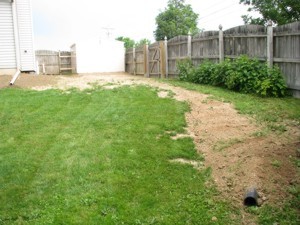
The Linear French Drain trench running from the house. PHOTO CREDIT: Jim Sanders
I decided "what the heck". I had to dig by hand using a trenching spade and a pick-ax, because the builder back-filled our property with brick and blacktop. It took quite a bit of time. Because the ground level varies so much on that side of the house, I was not able to achieve exactly 2 ft. deep. It varied from 18" to 30" in spots, but the slope was downhill. The trench is about 80 ft. long. At times, I thought about filling it all in, because I just didn’t believe that it would work.
I stoned it, put tile in, and filled it with #1 round stone. I socked the pipe just for safety measure and I also used geotextile fabric on top, so I could cover with dirt and grass. I also ordered some clay and pitched from the house to the drain.
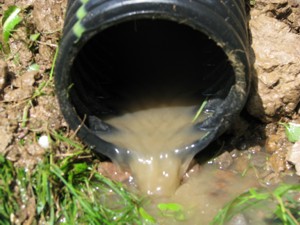
After a short rain, water is running away from the house. PHOTO CREDIT: Jim Sanders
Result? For the last month, we have had 7 or 8 torrential rains, the worst of which was last night. It rained so hard, that our lawn washed out in spots because of the high clay content. Our sump pump, that normally ran every 7 minutes during and after rain, has not turned on for 4 weeks. The silt at the bottom of the sump well is now dry and cracking. Our crawlspace has not shown a trace of water or even moisture.
Since I couldn’t see correcting the foundation cracks or the garage floor settling and tilting until I corrected the problem's source, I waited to see if the trench drain worked first.
This week, I had a company come in and perform sort of a "mud-jacking" technique on the garage floor, which worked perfectly. Also, during the past few weeks, I parged the cracks in the foundation.
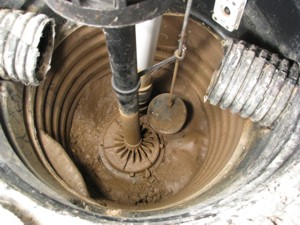
A dry sump pump. PHOTO CREDIT: Jim Sanders
I just wanted you to know how this worked. I stressed for many years over this issue and the solution was nowhere near as difficult as I thought it would be.
As a side note, I went to the end of the drain tile during a hard rain to see what was happening. Water was running out of the drain tile in about the same exact volume that it previously ran out of the weep holes in my crawlspace. This winter will be interesting, because last year, the ground next to the house was so saturated that during a thaw, my sump would run constantly. I'm guessing that the ground between the trench and the house will probably be drier now going into this winter."
- Jim Sanders, Upstate area - New York
CLICK HERE to get FREE & FAST BIDS from local drainage expert contractors.
Column B339
Column 721

Tim built custom homes and did ultra-custom remodeling for 20+ years before launching his Ask the Builder media presence. He was selected as one of the Big 50 by Remodeling magazine in 1993. This award gave birth to Ask the Builder in October 1993. Tim also operates https://DrawPlumbingPlans.com. His @askthebuilder YouTube channel was the first home improvement channel on YouTube.
Last year, before we finished our basement, we had a 3.5" rain storm, that ended with things floating. The sidewalk around the house especially was trapping water up against the foundation. The home is a 1950's build that has no sump pump, sealing, or other such modern trappings for the foundation.
I used your trench/French drain design in an 85 foot section dug out around the entire house. I started at 20" deep in the front and ended up at 36" deep in the back before heading out toward the hill in back to spill. In order to drain inside the sidewalk entrapment I had to tunnel under it to exit toward the hill.
The result? We have and are still getting hammered this week. In the last five days we have received about 7" of rain. Not one drop of moisture has made it into the basement. This drain design seems as bulletproof as they come.
I did however use 4" PVC perforated pipe instead of the black flex tube, and put two cleanout access points on the system. I realize that silt concerns are usually unfounded if done correctly but it would be a monumental task to dig this system back up so I played it safe.
Thanks for all the info on your site.
-Andrew, Oakdale, MN
How can I stop my drain grate from getting clogged with silt, drain works fine until the grate gets covered with silt and becomes clogged! Help!
Two choices: Stop muddy water from entering drain by re-diverting it. Regularly rinse out drain.
I have an above ground Trenching system type in the basement/ garage 1923 bungalow around the perimeter. It goes to a 6" flange inbetted in the concrete at the end of the trench that cones down to a 2" opening to a basin about 8" deep and part of the flange. In the cone to the left just below the flange a hole 1 1/4" threaded both holes seem to service each other being part of the same basin. Water seeps in the basin under the flange above the threaded hole like a French drain and also into the basin from the trench. I'm trying to find out what kind of pump sits in that flange and what it is called. It appears to me as an enclosed above and below grade' type impeller pump. Is there such a thing. And wouldn't an internal float have to command it to on/off when water meets in the cone?
Hey Tim - I tried this trench drain around our old home and what a difference just digging the trench made!
I haven't even got the pipe/gravel in yet and the system is already stopping the watering from entering our crawlspace and we are noticing the humidity levels dropping in the crawl and the house.
Plus the leaking we experienced in the 1/2 basement has stopped!
Based on this success I ordered your trench video.
Just want to say thanks - you are saving me a lot of pain!
v/r
Doug
73's from Northern Minnesota
Doug, WOO HOO! Remember, deeper is always better. Also, don't forget final grading and roof water. All roof water MUST be piped far away from the house in solid pipe. 72 (I'm a QRPr) Tim W3ATB
I just installed a trench drain on the uphill side of my house because during heavy rains I get all the water coming down the hill toward the house. I could have just graded the yard in this area to move the water away from the house, but I wanted to stay away from clay type soils since I have a hard time growing grass on this side. So I did a drain and topped everything off with top soil in the hope I can get a better looking yard on this side.. Typical perf pipe (not the flex pipe). Testing with a water hose shows it's operating well. It's about 18" deep with 3/4 washed gravel fill. All seems to be well,. however I now have a concern.
Seems everyone has an opinion on drainage and how it should be done. As of late I've been reading that you should never use a trench/french drain to deal with surface water because this allows the surface water to move deeper into the soil where you don't want it to begin with. My take is if you have a good drain pipe system and you can move the collected water away quickly there should be no appreciable penetration of water due to the trench.
What say you?
Hello! I am working on a project for an engineering program. My team and I are trying to find a solution to the rising water issue in Boston, MA. By 2050, the water will rise up to about 7 feet.
Would a system like this be able to be used on a larger scale such as this if it was made large enough?
lol, do your own homework
Hi Tim,
I am working on a project for Oak Island in Nova Scotia. There were box drains built out of stones then layered with a grass and coconut fibers that were not indigenous. Do you have any guess as to what grass would do the trick and not decompose?