Hardwood Floor
DEAR TIM: I know I want a hardwood floor, but I need answers. Is hardwood flooring as durable as the salespeople say? Do you think it’s possible to do the hardwood floor installation myself? I have a friend who’s a finish carpenter who said he’d help. How often do you have to do the dusty hardwood floor refinishing? Should I go with oak hardwood flooring, or are there other choices? Michelle D., Londonderry, NH
DEAR MICHELLE: A hardwood floor is nearly as durable as the granite that’s responsible for your state’s nickname. I can take you to commercial buildings in New Hampshire where hardwood floors have been in continuous use for well over 150 years. I would say that absolutely passes the durability test, unless you’ve somehow figured out how to stop your body from aging. With proper care, hardwood flooring can last in a home for generations looking as good as the day it was installed.
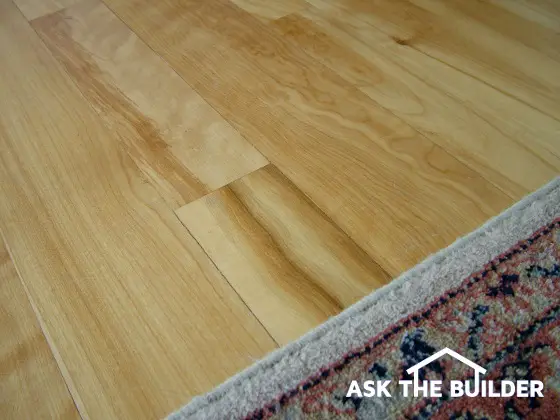
This red birch hardwood floor has a gorgeous golden-red coloration that gets compliments from all who see it. PHOTO CREDIT: Tim Carter
Hardwood floors can be found in every home I’ve ever owned. In my opinion, they add an ambiance that no other flooring material can really match. I believe the connection is hard wired into our DNA as wood was an early building material for man and used heavily for heating and cooking. Wood is engrained in our culture and civilizations. Cleaning hardwood floors is easy, and they are a sustainable resource that grows like any crop.
You and your carpenter friend may be able to survive the hardwood floor installation if the room is small and a simple square or rectangle. While you might think that it’s not hard to install a hardwood floor, it can be very challenging. There are many tricks and skills you have to acquire to have a hardwood floor that doesn’t squeak, stays in alignment and doesn’t buckle or develop shrinkage cracks.
The biggest mistake you can make is not allowing the flooring material to acclimate to the temperature and humidity of the room before it’s installed. Hardwood flooring is a hygroscopic material meaning that it will change it’s shape and size with changes in temperature and especially humidity. Make sure the house and room where the flooring material will be installed is at the temperature and humidity it will be at when you live there. Purchase the hardwood flooring and bring it into the room. Unbundle it and allow it to acclimate for seven to ten days before you install it to be safe.
Hardwood floor refinishing is the bane of many a homeowner. Years ago, it was common for clouds of very fine dust to billow throughout the house as a pro would refinish the hardwood floors. Modern refinishing equipment has eliminated virtually all of the dust. But the great news is that if you do regular hardwood floor care, it should never have to be sanded again.

CLICK this image and listen to the first call on the podcast. I talked to Jill about how to repair wood kitchen flooring, and possibly installing an inlay border as an option. Copyright 2018 Tim Carter
Most hardwood floors are coated with multiple layers of clear urethane. Some of these urethanes are extremely durable. Many people forget that you don’t walk on the wood floors. You walk on the thin layers of urethane. If you make sure the urethane doesn’t wear off in the high-traffic areas of the hardwood floor, there’s no need to ever sand the wood. If you simply add a new coat of urethane every three to five years, you should never have to bring in the heavy sanding equipment. You only need to lightly screen or sand the urethane prior to applying the new coat.
Oak hardwood flooring is perhaps the most common material used as flooring because it’s plentiful, affordable and extremely durable. The two species that I used in my homes and jobs are white oak and red oak. I’m very partial to red oak as when finished with a clear urethane, it looks like the most gorgeous strawberry blonde lass you’ve ever seen. White oak hardwood flooring finishes with a more stark light coloration.
There are many other hardwoods that are turned into flooring. Maple hardwood flooring is a popular choice because of its durability and its fine-grained appearance. Oak has a heavier grain. You can also get, with minimal effort, a cherry hardwood floor or even a drop-dead gorgeous red birch hardwood floor like I have in my New Hampshire house. Walnut, ash and poplar are other hardwoods you may want to consider.
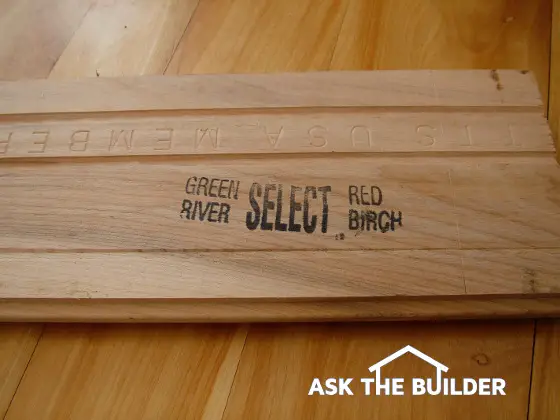
You can clearly see the species and grading stamp on the underside of this piece of hardwood floor.
When you narrow your hardwood floor selection, be sure to look at samples of the wood. Sometimes the showrooms will put on display the finest material that has no knots in the sample. This grade is called Select. Be aware that when you see a larger sampling of the hardwood, there may be some tiny knots in Select grade.
But the salesman may talk you down to a different grade called Number 1 Common. Before you approve of this grade, look at many pieces to ensure you’re okay with the size and number of knots that will be visible in the flooring.
If you’re interested in learning more about prices for hardwood flooring I have an article here.
Some people like knots as they produce a floor with a certain degree of character. I prefer to have as few as possible. The species and grade of the hardwood flooring are almost always stamped on the underside of many of the pieces of lumber. When the material is delivered to your home, unbundle it and look to see if it’s the species and grade you paid for.
Column 769

Tim built custom homes and did ultra-custom remodeling for 20+ years before launching his Ask the Builder media presence. He was selected as one of the Big 50 by Remodeling magazine in 1993. This award gave birth to Ask the Builder in October 1993. Tim also operates https://DrawPlumbingPlans.com. His @askthebuilder YouTube channel was the first home improvement channel on YouTube.
We are considering either the Shaw Hudson Bay SW435-340 Schoolhouse or Ark D03EB02A13 Brown Sugar (engineered) wood floors. Which would you recommend for quality and durability?