Floor Radiant Heat
DEAR TIM: My husband and I were out for a walk and saw the strangest thing. A new house under construction had parallel loops of plastic piping in the basement. We asked a contractor who was there and he said it was floor radiant heating. I’ve never seen this before. How does it work? Is infloor radiant heat effective? Are there different floor radiant heat systems? Nicole C., Meredith, NH
DEAR NICOLE: You got a rare glimpse of the innards of a floor radiant heat installation. Had you come a day or so later, all you would have seen would have been a concrete slab that looked just like every other basement floor you’ve probably seen. The plastic tubing you saw gets embedded in the wet concrete. Once the house is completed, the tubing is connected to a hot-water boiler and one or more recirculating pumps that distribute very warm water through the durable pipes.
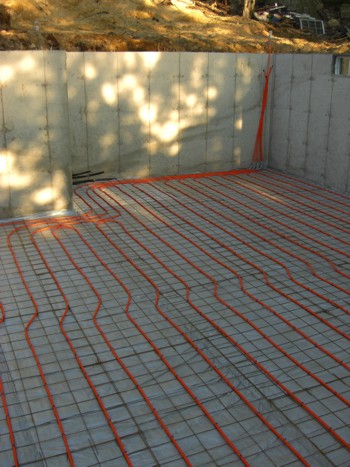
These bright orange plastic pipes will soon have warm water flowing through them producing luxurious comfort on snowy winter days. PHOTO CREDIT: Tim Carter
I have a concrete floor radiant heat system in my own home. It produces the most luxurious heat I’ve ever experienced. Typically floors, especially concrete, can be cold and uncomfortable in the winter months. With radiant heating, the entire floor, or different sections or zones of the concrete, become vast heating pads transmitting the heat from the boiler to you and everything in the room.
The heat is even and the concrete acts like a massive heat sink or storage vessel. The amount of heat is controlled by a standard thermostat as you’d discover in any home. Most homes that employ radiant heat have an added benefit. A room or group of rooms is put into a zone controlled by a separate thermostat. This allows you to use energy wisely as you can easily have different parts of your home different temperatures. I have eight separate heating zones in my own home.
When you’re not in a room or rooms in different parts of the day or night, you or automatic setback thermostats can lower the temperature to save money. The zoning feature allows you to send heat to the rooms only when you’re in them. It’s a very clever system and most radiant heating contractors are very good at setting up zones that make sense to your lifestyle.
You can have subfloor radiant heat in just about any home. If you’re building new with a standard wood-frame home, you absolutely can have a wood-floor radiant heat system. The plastic tubing is affixed to the underside of the wood floor or set very close to the underside of the wood sheathing that covers the floor joists.
Electric floor radiant heat systems have been around for many years, and they continue to be used. Recently, there’s been growth in smaller systems that work well in remodeling situations like bathrooms and kitchens with tile floors. The thin electric mats create tile-floor radiant heat that feels just the same as that created by a whole-house boiler. Be sure to do the math before you think about using electric radiant heat in your entire home. It may be more costly to operate over time.
It’s even possible to have a hardwood-floor radiant heat system. The hardwood-flooring manufacturers over the past few years have worked in conjunction with the radiant-heating industry to develop standards that allow gorgeous hardwood floors to be installed just above the subfloor radiant heat piping. When done correctly, the hardwood floor does not develop unsightly cracks between each piece of flooring from extreme expansion and contraction.
If you decide to use concrete floor radiant heat, it’s very important to insulate the floor so that the heat is blocked from soaking into the earth beneath your home. Rigid foam insulation is typically placed on top of compacted granular fill material. After the foam is in place, it’s covered with a high-performance vapor barrier that prevents soil moisture from invading your basement making it damp and moldy.
You’ll often see the contractors install welded-wire steel reinforcing mats as part of the install. These are a great idea. They not only strengthen the concrete ensuring that cracks don’t grow putting stress on the plastic heating tubes, but they also help hold the plastic tubing in place during the concrete pour. The plastic tubes are attached to the steel fabric often in parallel strips one-foot apart.
Warm-floor radiant heat is nothing new. Archaeological excavation years ago uncovered evidence that Romans used radiant floor heat to keep the stone floors toasty warm in the large Roman hot baths. They discovered that stone retains heat for a long time and that it distributes the heat uniformly. It only makes sense that we’d utilize this time-tested technology with our own artificial stone - concrete!
Column 846

Tim built custom homes and did ultra-custom remodeling for 20+ years before launching his Ask the Builder media presence. He was selected as one of the Big 50 by Remodeling magazine in 1993. This award gave birth to Ask the Builder in October 1993. Tim also operates https://DrawPlumbingPlans.com. His @askthebuilder YouTube channel was the first home improvement channel on YouTube.