Frost Heaves
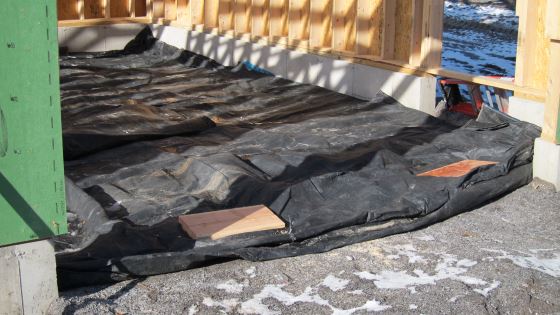
These look like tarps, but they're really special outdoor blankets that help hold heat into the ground. Photo Credit: Tim Carter
DEAR TIM: I live in a warm part of the nation that rarely gets freezing weather, but I own a second home where it does get cold. In the spring I'm going to build a room addition and a deck. Living where it's warm I never knew there were things called frost heaves.
Is it true frost in the ground can cause problems with foundations, cracked concrete, and interior cracks in houses and structures? What causes frost heaves? What soil is most susceptible? What can be done to prevent frost heave damage? Jodie G., Miami, FL
DEAR JODIE: Mother Nature often puts on a display of her many powers. Some are terrifying to witness, and I submit to you hurricanes, tornadoes, tsunamis, earthquakes, etc. Frost heaves are a show of force that happens quietly, covertly and with little warning if you've never been harmed by them. The weather turns, leaves fall, snow flutters from the sky and the next thing you know, you can't open or close a door because frost has heaved the soil causing part of a slab or foundation to lift upwards.
Frost heaving can wreak havoc with houses, barns, sheds, roadways, concrete slabs, basically anything that's connected to the Earth in a place where the ground freezes. Just as the phrase implies, the frost heaves, or lifts, things up. The problem is, the lifting may not be equal around the structure.
I'll never forget a house I purchased about thirty years ago. It was vacant and I purchased it to restore and resell. Up on a hill behind the house was a detached garage. One winter day I went up to work on the garage and was stunned to see the garage floor raised up about 4 inches from where it had been just weeks before. That was my baptism to the power of frozen ground.
Water in soil combined with below-freezing temperatures is what causes frost heaves. Different soil types are more susceptible to frost heaving. Obviously, those soils that can hold more water will react more vigorously to frost. This means sandy, loamy soils can lift higher, on average, than dense clay soils. Where I now live in New Hampshire, the soil is very sandy and loamy. Believe me, it really lifts up in the winter.
There are lots of things that can be done to prevent damage caused by frost heaving. Foundations for any structure need to be placed below the historic frost level in that region. But be aware the historic frost line can be exceeded if the weather is extraordinary.
For example, right now here in New Hampshire it's the second week of January. There's been virtually no snow this season, yet it's been cold. If these conditions persist, the frost can be driven deeply into the soil. Snow cover actually acts as an insulator. If it had snowed early and heavily in the season, the frost might be fairly shallow in the soil now.
The frost can drive deeply into soil that's adjacent to a natural spring. Subsurface water that continues to flow through the winter under the soil feeds the ice lenses under the surface that jack up the soil like a ratcheting auto jack that lifts a car when you have a flat tire.
For these reasons, you may want to put the bottom of a foundation footer a foot or more below the historic frost line of the area where you intend to build. It's vital that the foundations, piers, etc. are shaped properly to prevent frost heave damage. This means that the foundations should be wider at the bottom than at the top.
If you dig a vertical shaft in the soil for a deck pier that's not as wide at the bottom than it is at the top, it will have the appearance of an ice cream cone. Frost can easily push that concrete pier out of the ground just like you squeezing the cone out of your hand.
But if the pier is wider at the bottom than the top, you can see the frost will have a very hard time lifting it up as the pier acts like a wedge anchor.
You can surround your structure with a linear french drain to capture and divert subsurface water that tries to saturate the soil around and under your structures. If you keep the soil pretty dry as you head into winter, there is little fuel to feed the ice lenses that create the frost heaves.
Concrete slabs that are prone to lifting from frost should contain plenty of reinforcing steel. A typical patio or sidewalk slab should have #4 bars (one-half-inch in diameter) placed on a minimum of 2-foot centers both directions. These bars should be in the middle of the concrete slab. They help lift the concrete slab all at once keeping it in the same plane. This prevents cracking and if cracks do happen, the steel rods keep the cracks from opening up.
You can temporarily slow the creation of frost in soil by covering it with special outdoor insulated blankets. These blankets are waterproof and help slow the heat loss of the soil into the atmosphere. They're good if you need to protect the soil from overnight freezing assuming you're going to pour concrete in cold weather.
You can discover several past columns with great illustrations about Linear French Drains here on my AsktheBuilder website. Just type Linear French Drain into the AsktheBuilder search engine.
Matthew, from Creston, British Columbia, Canada wrote to me. It gets COLD in Creston, as it's just across the US border from Idaho. Click here to read his question on frost in the May 24, 2013 Newsletter.
Column 917

Tim built custom homes and did ultra-custom remodeling for 20+ years before launching his Ask the Builder media presence. He was selected as one of the Big 50 by Remodeling magazine in 1993. This award gave birth to Ask the Builder in October 1993. Tim also operates https://DrawPlumbingPlans.com. His @askthebuilder YouTube channel was the first home improvement channel on YouTube.
In July 2013 I had a new cement driveway installed taking out the asphalt and a new stoop and side walk to the driveway installed. My home is a Ryan built bi-level home with a decline slope into the garage. I know it was a cold and snowy winter but where the new cement driveway meets the garage floor and beyond the drains, the cement raised 1.5 inches and the now to clear out my garage floor with water and salt I have trouble since the driveway is higher than the garage floor and I can not get the water and salt to the drains. On my stoop the cement cracked diagonally, even though it has expansion cuts and rebar inside the cement. The other homes I my street have not done this. I am also worried that when the ground is thawed the cement will drop and crack more. Plus my contractor said he used 4 inch concrete reinforced cement class C mix. Why did it raise, crack? Do you have any advice for me now that the warranty has expired? THANKS I GREATLY APPRECIATE IT
Frost, non-compacted soil, continental drift, alien spacecraft hard landing. All are possible. For a detailed discussion, you may want one of my phone consults. 🙂
I have a deck over a two car garage. I looking to install garage door opener on both I was told that the garage door opener would damage my foundation.
how d i stop frost heaving outside my garage doors in winter time