Building a House in Bad Weather
DEAR TIM: I want to start construction on a home, but just about everyone wants me to wait for months because bad weather is just around the corner. Can you build a home in the rainy season or in the middle of winter without causing problems to the structure? What are some tricks one can employ to make headway each week so that the house can get done sooner rather than later? Does rainwater hurt all the lumber as the house is being constructed? Jason S., Cutbank, MT
DEAR JASON: All of your questions are great. You're going to love the answers too. The bottom line is that you can build a home in almost any weather. The only thing that can really inhibit you is frozen ground, but even with that, if there is a will, there's a way.
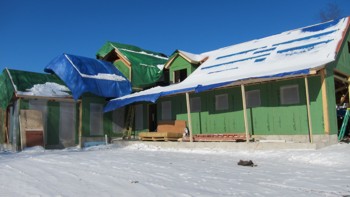
This house is being built in the middle of a harsh winter and they're making progress each day. The roof was covered with tarps so ice and snow will not cake on the sheathing. Photo Credit: Tim Carter
Many years ago, I used to subscribe to a building magazine. In one issue they had a photograph of a large home being constructed in the middle of winter inside an enormous circus-like tent. It was ingenious, and I remember the photo caption saying how even on cold days the inside of the tent was normally over 50F because of the solar heat gain.
The key to building a home in bad weather is getting the foundation installed and the house up out of the ground as rapidly as possible before the onset of extended rainy or bitter cold weather. You can pour concrete in cold weather and bitter cold, but it takes an experienced crew and one with the proper equipment to protect the concrete so it can cure enough to resist freeze damage.
If the ground is frozen, believe it or not, you can actually thaw the soil using a portable ground heater. This portable heater is usually in a trailer and circulates a hot solution of glycol in heavy rubber tubing that lays on the ground. It's important to cover the tubing and soil with insulated blankets that hold the heat in the soil. It's expensive to run the heater, but it can be done if you have to pour in cold weather.
You can connect this same heater to radiant floor heating tubing so that you can pour a concrete slab in cold weather. The concrete thinks it's a late spring day as the warm fluid courses through the tubing causing the concrete to harden even as it's snowing!
There are modern building methods that allow you to build a home totally indoors in a factory. It's quite possible you can build a modular home in your area and have the sections trucked to the job site and lifted onto the foundation in just a day or two.
If you can't do that, you can at least significantly compress the construction time by using walls that are prefabricated in a factory and trucked to the site. This can save weeks of time. Stick building walls at the site in bad weather is slow, dangerous and hard on the carpenters. Prefabricated walls are set with a small crane and a seasoned crew can have a normal house under roof in a week or less.
If you want to roof a house in bad weather, it's a good idea to cover the roof sheathing with tarps to prevent snow and ice from holding up progress. Once the storm passes, you can remove the tarps and the roofers can quickly get to work on a nice dry surface.
If you use the latest building materials, the roof sheathing will not be harmed by rain as some new sheathings have a waterproof coating. The seams between the pieces of coated oriented strand board (OSB) are sealed with a special tape that keeps out just about all water from the wood substrate.
Normal rainwater will not harm the wood that's used to build homes. Many homeowners fear that wood will immediately rot if allowed to get wet. That's simply not the case. The only thing that doesn't fair well if it gets wet is low-grade OSB. This flooring and wall sheathing material is still available and if it gets wet, it can swell and not shrink back to its original size.
There are new OSB floor sheathing materials that are specially made to resist standing water. They will not swell. You can also get OSB wall sheathing that's just like the roof sheathing. It has a special waterproof coating on the exterior side that repels water.
The real key to building in bad weather is to use a builder that's got the equipment and experience to handle extreme conditions. This all has to be talked about before you sign the contract.
It's up to you to vet the builder to ensure he has all the needed skills and moxie to go up against Mother Nature and come out a winner. The key is to get started on the job and make rapid progress, working long days if necessary, until the shell of the building is up and weather tight. It's not as hard as you might think.
You can discover videos of the new flooring, wall and roof. Just type "sheathing" into the AsktheBuilder.com search engine.
Column 918

Tim built custom homes and did ultra-custom remodeling for 20+ years before launching his Ask the Builder media presence. He was selected as one of the Big 50 by Remodeling magazine in 1993. This award gave birth to Ask the Builder in October 1993. Tim also operates https://DrawPlumbingPlans.com. His @askthebuilder YouTube channel was the first home improvement channel on YouTube.
Whenever I pass by houses being built, I always wonder what they do if it starts to rain or gets too cold. It's good to know that you can still continue building in bad weather! Thanks for sharing this.
Currently my new house is under construction. Basically the house frame is partially done (obviously there is no roof), and inside the frame there is accumulated ice and snow and it has been this way since beginning of December. Will the snow and ice cause any problem or damage to the wood frame structure? I am particularly concerned about any problem that might surface after the construction is complete.
Please advise.. much appreciated
No. Please read this column for extra IMPORTANT details:
http://www.askthebuilder.com/rain-soaked-framing-lumber/
Its funny I have my home in the same exact dilemma.
It's been seating half framed since mid December the weather has been harsh with snow and temps in the -25 and colder. Would really like to read the answer to your ? Joseph Good Luck