Mortar Mixtures for Tuckpointing
Mortar Mixtures for Tuckpointing - Hydrated Lime is Best
Original Copyright 1998 - Tim Carter ALL RIGHTS RESERVED - Revised 2023
A Blending Experiment
The mortar mix you see used by brick layers today contains two ingredients: hydrated lime and Portland cement. In fact, the Portland cement ratio is quite high. Old brick layers used to mix their own mortar on the site by blending lime with Portland cement. Old houses, say over 100 years, rarely had any Portland cement in the mortar. The bricklayers just used hydrated lime and sand. This is what the Romans used to make their concrete. They also discovered early on to blend volcanic sand that had a very high silica content. They mined this from local volcanos in Italy. It's called pozzolanic deposits if you want to get technical.
How do I know this? My college degree is in geology. Why is it so important to have a high silica content in your mortar or concrete? Silica has a hardness of 7 on the Mohs scale and is a major component of granite. Surely you know how long-lasting granite is, right?
Hydrated lime and Portland cement are available at building supply houses that supply bricklayers. If you look in the Yellow Pages under "Brick - Supplies" you will eventually find a company that sells bags of lime. It is inexpensive and it is white - pure white! Author's Note: The previous sentence shows you how old this article is. What young person even knows what the Yellow Pages are?
Mortar Strength / Self-Healing Properties
Brick walls are constantly on the move. The heat of the sun causes them to expand and contract. If the mortar between the brick is too hard, the brick will crack. Portland cement makes mortar hard. Older brick tend to be softer than today's brick. Thus, old mortar had much less Portland cement than today's mortar. The lime content of the old mortar was very high.
Why is hydrated lime so important? You need to understand how it's made. You also need to recall a bit of your high school chemistry. Hydrated lime is a powder. It's made by taking the extremely durable rock limestone and heating it to a very high temperature. The heat of the fire creates a chemical reaction in the rock. The Romans discovered quite by accident this as they probably had roaring fires that were surrounded by pieces of limestone to contain the fire. Once the fire was out and a rock was crushed, they discovered if you took the powder and mixed it with water, the slurry would get HOT and once it cured it was ROCK again! They simply reversed the chemical reaction.
Lime adds another benefit, one we could use in today's mortars and even concrete. Hydrated lime is somewhat water soluble and reacts with carbon dioxide and water. Small amounts of the hydrated lime remain in the mortar you make. As time goes on, the lime in the brick will can wake up if a small crack develops. The crack allows water and carbon dioxide to enter deep into the mortar. The lime reacts with the water and gas and heals the crack.
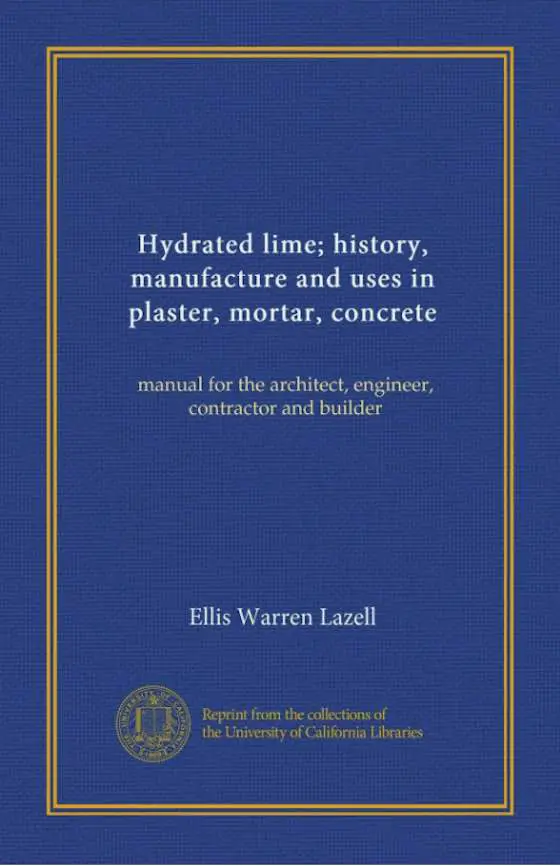
This is a fantastic small book sharing exactly how you should use hydrated lime. CLICK THE IMAGE or HERE to have it delivered to your home in days.
Avoid mismatching mortar! Find a good contractor and learn the secrets to repairing masonry with my Masonry Repair (Chimneys, Stucco & Brickwork) Checklist. I offer a 100% Money Back Guarantee.
Proportions
The first step in mixing new mortar is to blend Portland cement and lime together. If the mortar is very soft and old, you may choose to blend six parts lime to one part Portland cement. If your mortar is very light in color, be sure to purchase white Portland cement. If the mortar is darker, you may get by with gray Portland cement. Mix a very small batch to begin. I would mix no more than 7 to 8 ounces (by volume) to begin. You then mix two parts sand to one part of the blended lime and cement. Be sure to write down your proportions.
You blend the sand, lime and cement together dry. Then add just enough water to make it wet enough to form into a ball. The color of this mixture should match very closely the color of the existing mortar when it is wet. If not, you need to start over with your lime and cement proportions. Pay attention to the sand proportions too. If the existing mortar has not too much sand visible, you may have to mix 1.5 parts sand to 1 part of the blended lime and cement.
To get a perfect match, you should let the mortar dry for several weeks. Hold the sample next to the existing mortar to see how close you came.
Read about an aid for tuck point mortar joints in my September 1, 2009 Newsletter and September 15, 2009 issue.

Tim built custom homes and did ultra-custom remodeling for 20+ years before launching his Ask the Builder media presence. He was selected as one of the Big 50 by Remodeling magazine in 1993. This award gave birth to Ask the Builder in October 1993. Tim also operates https://DrawPlumbingPlans.com. His @askthebuilder YouTube channel was the first home improvement channel on YouTube.