Modifying a Load Bearing Wall
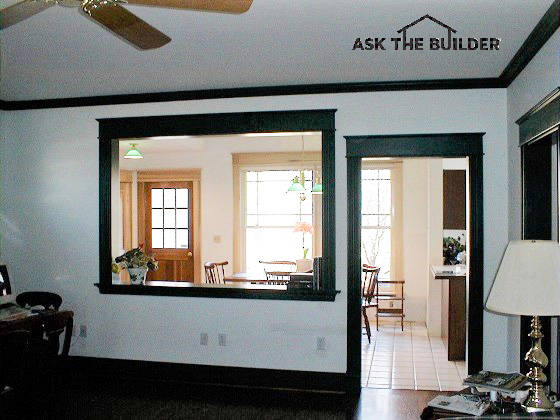
This is a load bearing wall with a large opening and a door.
Modifying a Load Bearing Wall TIPS
- Watch my Bearing Wall Removal VIDEO below
- Consult with a structural engineer
- Concentrated loads hidden on walls with giant existing openings
- Nail temporary supports together
- CLICK HERE to subscribe to Tim's FREE Newsletter
I remember the first load bearing wall I modified. I was in my early twenties and had never done it before. It was in a massive old home in Clifton, an inner-city suburb in Cincinnati, Ohio.
I was working as a sub-contractor for a remodeling company and knew just enough to be extremely dangerous. Fast forward . . . The house didn't collapse and in fact the enlarged opening I created has not sagged to this day. But I must tell you I had lots of luck that day. All sorts of things could have gone wrong.
CLICK HERE to get FREE & FAST BIDS from structural engineers in your city or town.
Knowing the Loads
Creating archways or openings in bearing walls can almost always be accomplished. It simply becomes a matter of where the loads are going to be concentrated. A typical bearing wall tends to transmit a fairly equal amount of load down to the floor below via the wall studs.
If you decide to create a large opening in the wall, then the loads above the opening must be shifted to the sides of the opening using a properly sized beam. Will a double 2 x 6 be enough? How about a single 2 x 12?
IMPORTANT TIP: The truth is, only experienced carpenters who have successfully installed beams, or structural engineers who are trained to size and specify beams, should make the call. Do not try to conjure up your mystic powers and guess.
They can only do this by visiting your home. During this visit the expert will perform an inspection to look for hidden CONCENTRATED loads above the wall.
Do NOT trust advice from other home improvement websites that have little, or no, information at their About Page as to who's giving the advice.
The cost to hire a registered residential structural engineer is well worth it. Often this person will even draw a small plan showing you how to build the temporary supporting wall.
Free & Fast Bids
CLICK HERE to get FREE & FAST BIDS from structural engineers in your city or town who can size the correct beam and tell you how to support it.
Bearing Wall Removal Video
Temporary Support
If you want to install a beam in an existing bearing wall, there are all sorts of tricks and methods. If it is an interior wall, there is a cool way to install a beam without building any temporary support walls.
You need to have access to both sides of the wall into which the beam is going to be placed. All that you do is simply install half of the beam at a time. You make 1.5 inch deep notches at the top of one side of the wall and slide the beam into this recess. Add the king studs at each end of the beam that run from top plate to bottom plate. You then add the jack studs next to the king studs.
These framing members actually support the load from the beam. If the rough opening of the new beam is 72 inches or less, you generally only need one jack stud at each end. Once all of this is in place and the jack studs are solidly supported from beneath, you can take out the remaining old notched wall studs as the weight of the wall will be carried by the one half of the beam that is secure and in place.
Be sure to have the second half of the beam already cut and ready to slide in place!
Hiding a Beam
Let's say you want to remove a wall in between two rooms but you want the ceiling to be smooth just like in the two rooms. You don't want a beam hanging down a foot where the wall used to be.
You can install the beam up in the same space as the floor joists and just use joist hangers to connect the floor joists to the new beam.
This will only work if the beam height is sufficient to support the weight that's being transferred to it.
CLICK HERE to get FREE & FAST BIDS from structural engineers in your city or town.
When You Need One
Often you can't do the cool trick I described. Perhaps you are working on an outside wall and want to salvage the wall finish on the exterior side of the new beam. You need to build a temporary wall 3 feet back from the existing bearing wall.
But stop! Before you start to build the wall, you must build the beam and lay it on the floor next to the existing wall. Why? Many a rookie carpenter has built the temporary wall, created the hole in the existing wall only to find out they can't get the beam threaded into the narrow space between the old and temporary walls!
The temporary support wall needs to have a top and bottom plate, and the studs of this wall need to fall as closely as possible under and above the floor and ceiling joists. The studs are cut tight so they have to be tapped in place. I simply add a few toe nails that just penetrate partially into the top and bottom plates. Be careful about ruining finished floors and ceilings!
Masonry Walls
Don't even think about creating an opening in a masonry wall without help from a professional. Masonry walls are very heavy. The weight from steel roof members and floor loads can be enormous.
Often you need to install needles in a masonry block wall to carry the load while you work to install the beam. A structural engineer may also design a temporary beam that bolts to the course(s) of masonry that are just above where the new beam will be installed. You install this temporary beam first, support it well making sure the supports are on solid bearing, then you create your opening.
Remember, always make sure the new beam is in place, it's the correct size and you can easily lift and thread it into place BEFORE you create the opening in the wall. You want to be able to place the new beam with no, or minimal, delay.
CLICK HERE to get FREE & FAST BIDS from structural engineers in your city or town.
Column B397

Tim built custom homes and did ultra-custom remodeling for 20+ years before launching his Ask the Builder media presence. He was selected as one of the Big 50 by Remodeling magazine in 1993. This award gave birth to Ask the Builder in October 1993. Tim also operates https://DrawPlumbingPlans.com. His @askthebuilder YouTube channel was the first home improvement channel on YouTube.
I am trying to build an opening in a load-bearing wall, which divides our kitchen and another room that would be a great addition for a larger dining table. the wall area is 18 ft. The plan is to make an opening approx 10 ft. ANY ADVISE IS GREATLY APPRECIATED.
We need to talk. Far too much to type. http://shop.askthebuilder.com/categories/Consult-Tim/
I too am working on opening up a load bearing wall. The full opening size will 12'. I own a single story ranch type home and the attic is not used. Is a beam constructed of 2 2x10' with a plywood sandwiched between them enough for that span?
How much would it cost to have a professional come in and put an arch in a load bearing wall (including materials)?
$1,493.26
Ever have to put a recess header under a beam in a load bearing wall? The header replaces the king and one of the two jack studs. Beam is 3 2 x 12 x 10. Can this be done and anything special to account for?
I have a 17'4" bearing wall I want to replace with a steel beam. Its a 2 store home. with the bedroom wall above it. How big will the beam have to be? I can spread the side load up to 2 feet for support!
Hmmmmmmm. I'll have to go back and look at this column - I'm in the backend of the comment approval section. I could have sworn I offered advice that you MUST ENGAGE a structural engineer to size beams. This ALWAYS entails a visit to the job site so the engineer can see all the loads and take all the necessary measurements. You don't size beams based on emails and hunches.
I am replacing a 9 ft french doors with glass panels unit that is on the outside wall of my kitchen opening to a deck. The new unit is 1/2 inch too wide and the opening needs to be enlarged. The jack studs are holding up a header for the 2nd floor. How do I enlarge the opening?
No way I can tell you in comments. This coaching requires a phone consult.
I would like to replace two exterior windows separated by 65" with a gang of four windows. The span will be approx 120 inches and I don't want to bother with engineered lumber, so I was planning on placing a king stud and side-by-side jack studs in between each window. Where each window is 26" wide (four in total), is it ok to have king studs every 30.5" o.c.? Further info: The snow load is 30 psf and the house width is 30 ft. The IBC specifies individual spans, but I was wondering if multiple spans are treated differently.
I have a 2x4 structural wall that support the roof truss along it's axis. This wall is also the wall that covers the 'under-stair well' space on my first floor. Just took out the drywall and realized that it assists with supporting the truss above.
Looking to redistribute the load from three center section studs to make a built-in cabinet opening.
Looking to place a 2x8 header in place and two 2x4 jack studs to support the header.
Think this will be good to go?
How may I go about providing a temporary support while the three center studs are removed?
Thank you in advance.
I need to expand
two door openings to my den. One is a load bearing and one is not. The load bearing wall I anticipate to expand 20 additional inches. How much support would I need. I live in a ranch style house.
Since my mystic powers do not include x-ray vision and ESP, I can't tell you without a visit to your home to see what CONCENTRATED LOADS are on that wall at that location.
I am installing a loadbearing beam on of which one end goes into the outside wall and the other into a wall that's inside the house. I got an engineer to calculate it all for a steel beam and for an LVL. He also gave instructions for the columns for LVL (3ply 2x6). If I go with the steel beam I'll just use steel columns. But here's my question(s): do I need, in addition to the columns (in both cases), a king stud at each end? Just on the interior of the house end? or not at all? What about on the side of the columns - do I need studs next to them to prevent lateral movement?
This is great reading. Thanks. Tim for helping those who cannot be helped.
Hey Tim,
Great thread! Your article was exactly the bit of reference I was looking for. I was wondering if you might refine your knowledge into my specific situation. I would also appreciate the word of advice of just getting a pro, if need be.
Scenario:
I just bought a house that is a fixer upper.... It's a 50' x50' box house with a pyramid peak roof. All four exterior walls are the load bearing wall. So, at some point a home owner cut out a small window and installed a new larger widow with out a header or vertical support, pretty much in the center of the wall. Here we are a decade or so later and the wall has bulged above the window, right at the top plate, about 2-3 inches. I get the temp load bearing wall and beam header with vertical supports.... But how do I bring the wall back in to plumb? Chain and come-a-long 😉 or just tear out wall and start over?
Hey wondering if you could give me some advice I had some framers build a wall a foot too high what is the best way to fix it without demoing the entire wall I figured I could cut the bottom out a foot to rectify the situation but how the heck do i lower the wall or what procedures should I follow to get it done I was told I had 2.5 hours to complete any advice
Lousy builder in 1980. Or maybe unpermitted renos.
I'm an engineer, but not a certified professional in my state. So I know how to read codes and calculate loads. We bought this house and removed some non-structural walls (I climbed in the attic to verify trusses and spans). As we have gone along fixing the damage of 16 cats, 3 dogs, and a pot grow house...we have found hundreds of basic code violations. Two big ones are staring us in the face though. It seems as if the exterior doors were framed or added with out headers. Did I mention this is 2 story, with trusses carrying loads down the exterior walls?
We have a 4' wide front door with side panel windows, and a rear 8' slider patio door. We KNOW the header over the patio door stopped mid span because we had to open up part of that wall to fix leaky plumbing. We partially fized it, but not by installing a real header. It was just supposed to be a patch until we got a permit to do othe work. Now we notice joint fatigue in the sheet rock over the front door, and "squash lines" in the space between the door and windows. Hmmmm. so we tap ve the door. Yup, hollow.
Did I mention I removed an over sized soaker tub from the upstairs bathroom that used to sit above the front entry...unsupported? Day one in house, my boys climbed in, filled tub, water came out at front door and entry light. Appears the tub may not have ever been used before us, but there was evidence of plumbing leaks elsewhere. I mention this because we later checked the spans in bathroom flooring, 2x6's as I recall on 16" OC. I did some quick mental math and said tub with water, no suppot, too heavy.
The stairs also look modified, like maybe there used to be posts at the end of the stairwell run, which opens about 4' from the front door. Now that area is open and unsupported.
My thought is....if there is no header where those 2'6s would land above the door, and nothing floor to ground at staris....what the hell is holding that up?
So how can I tell short of ripping out walls and re-framing? This house has already eaten my lunch with bad stuff we couldnt see in the walls with just a standard inspection (i.e. gas plumbing not to code, failing and molding water pipes...headers....)
It's mostly 2x4 exterior walls, so I'm thinking about just adding another wall in front to provide the support, or maybe some rustic looking post and beam deal where the header should be. But then it would be off from carrying the exterior load?????
Thoughts are appreciated!
I am making about a 12 foot long opening 8 feet high inside a warehouse on the interior metal stud offices built inside this warehouse. Do I need anything special or is it dangerous to leave open. I am just gonna cap the ends with a header on top. Do I still need to load the weight off to the sides before I cut my opening. Or do you think this is too big of an opening without real professional help. Metal framing goes up to the top of the ware house about 30 feet high?
Using the old 2x4 studs and notching them for temporary beam support is pure genius! Regarding all the Q's re: beam size and strength, if you're too "thrifty" to engage the services of an engineer who consults on such matters professionally and still want to tackle this on your own, then I suggest installing a beam that is approx. TWICE as strong as you think you need.
Need to replace a 24 foot load bearing wall with a beam. Single flow house. Nothing in the attic. Any suggestions on what type of beam to use. Thanks
I'm thinking about opening up a load bearingwall from the kitchen to the living room I don't think the other wall is load bearingwall that I want to remove I haven't checked for studs but would it be easier to work around the posts in the wall to make arched windows to the kitchen
I bought a home that has a stairway from the main floor to the basement that the previous owner installed within a closet... The stair is very steep - more like a combination between a stairway and a ladder. This was done because there are supporting beams that go perpendicular to the path of the stairway (parallel to the steps). In order to install a decent stairway, I will need to have a supporting beam cut to support the width of the stairwell. I assume that you can brace the beam with poles on both sides of the stairs. Note that supporting beams run parallel for the length of the house. I am an engineer, but will contract this to a builder, looking for suggestions, ideas, recommendations, etc...
Want to replace the header for a new garage door...
The joist run the same direction as the end wall. The only way I see to support the end wall while I install a header, is to screw to the sides of the top plate and hopefully shore up under those cleats while I slide a header under it...I've opened up many interior walls and installed headers but never on a wall that had rafter running in the same direction with all the end wall weight sitting on top of the plates.
we have a 6lf sliding glass door centered in the middle of a 11lf exterior wall. we have a dog door insert in the slider, which we absolutely hate. wondering waht the possibility that we could move the slider more towards the end of the wall, then put a separate dog door into the wall instead of the insert.
is that feesible? are there codes for how close the slider can come to the corner of the wall? and how much room do we need to leave between the slider frame and a dog door?
My husband and I have just bought a house. There is a small closet attached to another room beside the room we gave my daughter. She has no closet now, but we want to frame up a small space for a bifold closet door so she can use that. The home inspector said it is a load bearing wall tho. Any more advice would be terrific!
I want to widen a doorway which is right next to a half wall. Both the doorway and the half wall have their own headers sitting on jack studs and their own king stud. I'm wondering if i can widen that doorway opening to the point of the kind stud in the half wall and add a jack stud to the other side of it to hold a 50" or so new header. Basic question, can 1 king stud have a jack stud on either side of it holding headers?
Could I put in my king support studs and screw a temporary 2x12 beam to the side of them before removing the middle section of the bearing wall?
So I have a load bearing wall that has 3 door openings. If I build a wall in one of the openings, essentially eliminating the doorway, can I enlarge another one by the same width?
I am remodeling a guest room into a closet. Thee room shares a load bearing wall with another bedroom. Within the wall there are two side by side closets. I want to open the wall next to the closet door in the room that will be a closet to utilize the original closet space from both rooms and create a recessed vanity. I will leave the header and replace studs on both sides of the new opening. In the adjacent bedroom I will replace the closet door with studs and drywall. I do not plan to interfere with existing weight bearing components in the adjacent bedroom. Do you think I need to consult an engineer?
If you're removing any wall studs that you feel are part of a bearing wall, then you need to come up with a plan to handle that redistributed load. If you can't do it, then you consult with a structural engineer. CLICK THE LINKS above to get FREE & FAST BIDS from the professionals in your town.
I have a load bearing wall that I would like to open up a little more not all the way. It is approximately 23ft with 2 30" openings on each end. I want to close up one opening and relocate and make it 42" opening and the other I would like to open to 66". Will I have to put in a support beam? It is between Kitchen and living room. in a tri level home. I am wanting to have a larger opening on one side of the kitchen to accommodate my table when I have guest over and have better flow relocate other opening and widen it a foot. So basically relocating one opening and widening it and extending another opening by 3`
Annie,
All of what you want to do is possible. You have two choices. Both choices below allow you to get FREE & FAST BIDS from both pros:
CLICK this link to get a structural engineer out there and have him specify the beams and columns:
http://www.homeadvisor.com/ext/32182231
OR click the following link and HOPE the remodeling contractor knows what he's doing.
http://www.homeadvisor.com/ext/32181644
Hi, can you hide a replacement beam in the ceiling space along side the rafter/ceiling joists to adequately take the load when removing a load bearing wall?
Hi, I have a load bearing wall between my kitchen & dining room. I want to open it up in the middle, leaving approx 1 meter still closed in at each end. The wall in total is 6 mts wide. Can I do this without adding any extra support.
Gwen,
I believe the above column is crystal clear. Go read it one more time.... It's all about HIDDEN LOADS that can only be discerned with a FIELD VISIT.
Pay very very close attention to the SECOND bullet point way at the top. Then after you read the column again, CLICK THIS LINK:
http://www.homeadvisor.com/ext/32182231
I want to put an attic access door in a second floor vertical wall. The door works require cutting ONE stud, about 36 inches of it, to fit the access door. The wall is most likely load bearing. Do all these rules still apply to cutting just one?
The wall is about 10 feet wide, runs right up to the roof ridge, and the opening world be in the center....
Thanks!
Just put a 2 x6 header across the opening.
i have a kitchen that has a load bearing wall with an interior window to the living room about 3'x'3'. I'm trying to open the wall up an additional 4' wide and 1' high.
I plan to leave/create a column that divides the 2 openings. Could this type of project be done installing a beam without temporary supports? Is there a video showing the notches being made to put beam in without supports?
Also, should the beam span across both openings or just the new opening that I would create?
Here is a picture I made explaining what I want to do:
https://www.renovateforum.com/attachments/f200/118315d1505915692-expand-kitchen-living-room-opening-kitchen-1.jpg
Thanks
Hi I’m looking to open my enterance to the kitchen slightly bigger than it is now.My concern is theres a window next to the opening. Is there a limit you have to have between window and new opening? The wall is a load bearing wall.
Stuart,
Maybe....
I solve difficult questions like this with my phone consults.
You send me a high-res photo, maybe a sketch of what you want to do and I give you the peace of mind over the phone in 15 minutes or less.
Here's how to set up the call:
http://shop.askthebuilder.com/products/15-Minute-Phone-Conversation-with-Tim.html
I have a question regarding my LIVING room. It is an addition to the home that was built maybe 30years ago? It has a flat roof, the locomotion is 18' 2" x 24" with a glulam beam that spans the 24ft with a center pole in the middle. Its for of a decoritive poll rather then your average support pole. It was placed directly under the beam and sits on the carpet. There are cinder blocks in the crawlspace where the pole sits. From what is showing the beam measures 5" wide x 8" tall, am am not sure if it is taller. My question is can I remover the center pole and add supports closer the to walls to open up the space more. If this is possible where exactly do I need to place them? I have seen pictures of nice mini-like half wall supports, that come out around 3-4 ft from the wall. Please let me know thanks for your time.
Crystal,
Yes you can remove the center pole and put in new supports. Want to know how to do it without having the roof collapse on you?
Go back up into the column. See all the "CLICK HERE to get FREE & FAST BIDS from local structural engineers" links?
CLICK ONE and fill out the form.
Hire the best one. The engineer will create a plan showing you EXACTLY what needs to be done.
DO NOT TRUST anyone other than an engineer to give you the best advice - unless you want to be carried out of your home in a body bag at some future time.
I have a low load bearing I beam in my basement and I'm wondering if I can replace it with a pillar(s)?
Luca,
Go back up the page. See all the links that say: CLICK HERE to get FREE bids from local structural Engineers?
CLICK ONE and get an engineer out to your house ASAP. Here's the DIRECT LINK for you:
http://www.homeadvisor.com/ext/32182231
I already have a pass through on a load bearing wall. I want to open it up about a foot higher. This amount will not bring it all the way to the ceiling but about a foot from the ceiling. Since it is all ready a pass through do I need any additional structural support?
As long as you don't widen the opening, you can raise the current header. Good luck and be sure to support the load while doing the work!
Hi I opening up the basement and need to remove a supporting wall apprx. 10'.
Spans from this supporting wall to the other strutual walls are 12' on both sides.
Then there's the main floor on top plus the second storey on top of the main floor.
Would you recommend using either 4pcs of 2"x10"x10' lumber SPF or 3pcs of 2"x9"x10' LVL 2.0E
I'm assuming the 2"x10x10' should have a load capacity, to support a two storey home.
Currently theres a 6' span - 3pcs of 2"x12"x6' which I will be removing. So I figure 4pcs of 2"x10"x10' should work or just stick with 3pcs of the LVL product
Thanks for your help - it might be tricky removing the 3pcs of 12' probably nailed into the floor joist.
Tony,
Sounds like a cool project! I think you need to go back up and re-read my column. Here's why. You said to me above, "...I'm assuming the 2"x10x10' should have a load capacity..."
You know what happens when you assume something.
How can someone determine what the load is on the section of the wall you want to remove? Only a pro who can come out and LOOK at your home.
Up in that column I have at least three links for you to get bids from local structural engineers who don't ASSUME anything. They study your home and produce a safe recommendation. Here's the link again:
http://www.homeadvisor.com/ext/32182231
Hi! I am wanting to open up a staircase wall and unfortunately it is load bearing based on the way the builder opted to install the floor trusses and skimp on one. We are only wanting to bring the wall back 7'2'' from the exterior wall. Any rough thoughts on what we should expect for costs. I am sourcing an engineer but the one quote I have received just for inspection and their hourly rate is quite high. 450-650 base fee with $175 an hour. I have no idea where the company is sending the engineer from but I would have to pay for their drive time too.
I have a 2 story home. I want to open up the room a bit but do not have the funds for the full wall removal with beam. I am open to an artsy approach -can I put a steel metal framed window with not glass to open it up and let that support it with the metal grills and framing, or can i take out the horizontal wood between the studs and I thought i could paint them and leave them exposed. Ive seen pictures of this on Pinterest but no talk of load bearing.
If I am installing a 2ft wide by 3ft High window in a exterior load bearing wall, do I need to brace the wall while putting the header in?
I was wondering how small I could make my header on a 3ft opening on a load bearing wall?