Save Money Building a Home – Lots of Ways
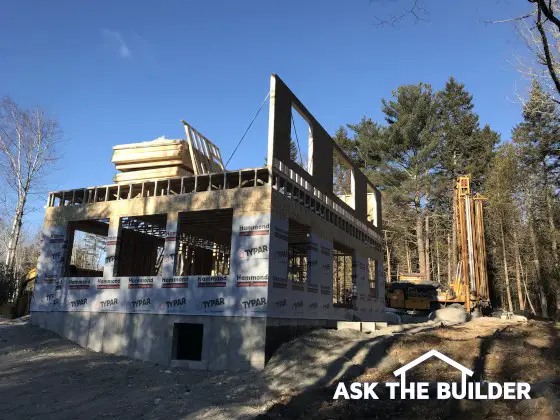
Save Money Building a Home | Save on labor and mistakes using pre-built walls made in a factory. The precision is remarkable. (C) Copyright 2020 Tim Carter
Save Money Building a Home - Many Ways
If you studied Economics in high school or college you might remember the law of supply vs. demand. We experience this law frequently in our lives and the home building industry is by no means immune from it. In fact, there are many building products that see violent price swings even though they are commodity items. Lumber and engineered lumber fall into this group.
Currently, the price of certain lumber products is at or near historic highs. The lumber industry press releases cite all sorts of reasons for the current dilemma. No matter what the reasons are, we consumers have to suck it up and either pay higher prices or decide to wait until prices might drop. For many, waiting is not an option that is on the table.
CLICK or TAP HERE to get FREE BIDS from local builders for your new home.
Can Factory-Built Floors, Walls, and Trusses Save Money?
Factory-built floors, walls, and trusses can save lots of money. The house is built faster saving on labor and it's protected from the weather faster.
Watch these three videos to see what's possible with factory-built components. This is my daughter's new home!
Can changing the height of the ceilings save a lot of money?
Changing the ceiling height in a home can save money. However, the savings may be minimal.
Within the past 24 hours, I received an email from a woman who is stuck in this quagmire. She wants to build her new 2,000 square foot ranch home but is within a fairly tight budget. The original plans called for 9 foot ceilings. These taller ceilings are a very nice touch that adds lots of character to the average home. This woman approached her builder questioning the savings that might be achieved by downsizing to a traditional 8 foot ceiling height.
The response from the builder shocked the woman. He said there would maybe be a $500 savings. She felt much differently and asked me to identify where one can really achieve savings when you downsize a home in this manner. She was hoping for a much larger credit by modifying the ceiling height. This is an interesting problem when you first think about it, but once into the calculation you discover some interesting facts.
CLICK or TAP HERE for Contractor Nightmare stories.
How are the cost savings calculated?
First, there would be savings in lumber. You can easily calculate with a high degree of accuracy the number of vertical studs in a home where the wall studs will be spaced at 16 inches on center. Simply multiply the linear feet of walls by (zero decimal point 75) 0.75 and then add one to the sum.
For example, this woman's home will probably have about 190 linear feet of exterior walls. 190 x.75 + 1 = 143. This same house might have 245 linear feet of interior walls so it would need approximately 185 studs to frame these walls. Currently the cost difference between an 8 foot vs. 9 foot long exterior 2 x 6 wall stud is only 57 cents. The cost difference between 8 foot and 9 foot long 2 x 4 studs is only 28 cents. The total cost savings in wall studs is perhaps only $135.00. That is fairly insignificant amount of money when the house may cost $180,000 overall.
There will also be insignificant savings with respect to the exterior wall sheathing that is nailed to the studs. Keep in mind that the carpenters will not offer any savings to speak of with respect to labor to build the walls. It takes just as much time to handle and nail an 8 foot piece of lumber as it does one that is 9 feet long. The same is true for the large sheets of sheathing. Perhaps they have to use but 4 more nails to secure the larger sheet to the wall studs.
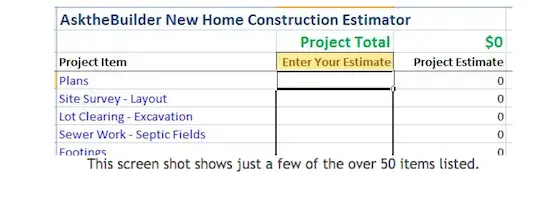
This is a very cool software spreadsheet that can help you calculate the cost of your new home. Divide the square footage of the home by the cost to get cost per square foot. CLICK on THE IMAGE ABOVE TO DOWNLOAD THE SOFTWARE.
This woman will save a small amount of money on wall insulation as it is usually priced per square foot. But keep in mind there is only about 190 square feet of insulation being eliminated. This same quantity is true for drywall material, exterior wall coverings, wall paint, etc. Some of these savings translate to interior walls as well, but in many instances there is little savings in labor. If you were painting a room with 8 foot high walls vs. 9 foot high walls, how much time would you really save painting - maybe 5 or 10 minutes per average size room?
How Can You Save The Most Money Building a New Home?
You can save the most money building a new home by making it smaller. Consider cutting out 20 percent, or more, of the floor area if possible.
The footprint needs to shrink. It is also very helpful to make the plan very simplistic. Offset foundation corners, high-pitched complicated roof designs, and lots of windows typically cause construction prices to soar. A simple rectangle house with a low-slope roof will almost always be at the bottom of the price scale. But unfortunately it often is also at the low end of the curb appeal scale as well.
Column NH023

Tim built custom homes and did ultra-custom remodeling for 20+ years before launching his Ask the Builder media presence. He was selected as one of the Big 50 by Remodeling magazine in 1993. This award gave birth to Ask the Builder in October 1993. Tim also operates https://DrawPlumbingPlans.com. His @askthebuilder YouTube channel was the first home improvement channel on YouTube.