A Strong Asphalt Driveway
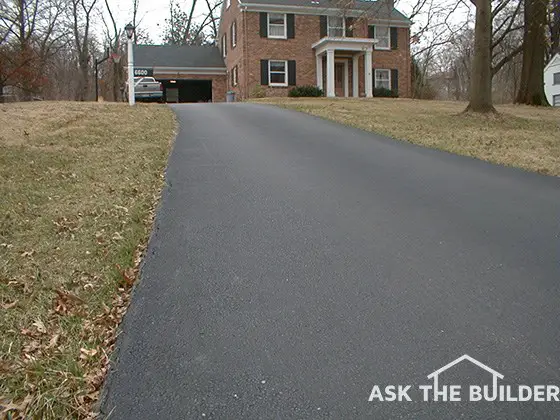
Asphalt driveway paving like this can be done in your city or town. This is a blacktop driveway near my last home. it's in great shape and you know it's got a solid gravel base under it. © Copyright 2018 Tim Carter
"If you want your new blacktop driveway to look good for many years, you need to make sure the gravel or deep-based asphalt base is one foot wider than the actual finished blacktop surface."
Asphalt Driveway Paving - Smooth and Strong
Asphalt or blacktop driveways are often the pavement one ends up with a new home. They are typically the least expensive paved surface a builder can install. Just because they cost less money by no means are they inferior.
Free & Fast Bids
CLICK HERE to get FREE & FAST BIDS from local blacktop contractors.
How long does blacktop last?
A blacktop drive that is installed with great care can last for 30, or more, years with little effort.
Related Links
Repair Asphalt Drive Cracks - DO NOT SHARE - Secret!
Tips From Pros About Patching Asphalt
Is Blacktop a Hard Surface?
Yes, blacktop is hard because it's simply a layer of rock, sand and asphalt cement binder. As the asphalt oxidizes over time, the surface gets harder.
If you've ever watched a dropped glass shatter on an older blacktop surface you would probably testify that it was as hard as a rock.
What is in Blacktop?
Blacktop, or asphalt driveway paving material, is a matrix of small rock chips, sand and asphalt cement. Many worn asphalt surfaces are anything but black. They almost always look a lighter shade of gray.
The stone chips in the mix create this color. Look closely and you will see small amounts of black in between the stone chips and sand particles. This black is the actual asphalt that cements all of the stone chips and sand together.
Is Blacktop Flexible?
But the real truth of the matter is that asphalt, even older asphalt surfaces, are flexible. Newer asphalt is far more flexible than an older surface because the asphalt still retains many of the lighter hydrocarbon oils that allow the asphalt cement to liquefy at oven temperatures where you would normally bake a cake.
Put a piece of concrete in your oven at this same temperature and you will get a hot rock, not a puddle of smoking goo on the bottom of the oven.
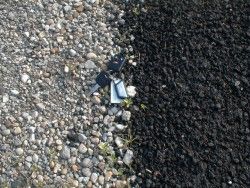
A good gravel base beneath the asphalt is the secret to a long-lasting driveway.
What Makes Blacktop Long-Lasting?
The secret to getting a long-lasting asphalt driveway at your new house that can withstand even heavy truck traffic is the hidden gravel base beneath the smooth ebony surface you and I see as a finished product.
How Thick Should the Gravel Base Be?
The standard gravel base beneath an asphalt driveway serves as the foundation for the pavement. If you install 8 or 10 inches of crushed well-compacted gravel on solid soil, the blacktop finish has a great start at a service life of 30 or more years.
If you don't believe me, come to Cincinnati and I will show you several 30 and even 40-year-old driveways that are still in good shape.
CLICK HERE to get FREE & FAST BIDS from local blacktop contractors.
Get the best-looking asphalt driveway around! Learn what to ask your contractor in my Asphalt/Blacktop/Tar & Chip Installation & Repair Checklist. I offer a 100% Money Back Guarantee.
What is an Affordable Base Material?
Many asphalt paving contractors use crushed gravel because it is the least expensive foundation material. If you want the best underlayment for the blacktop you can have your builder install a deep-base asphalt driveway. This system uses a thick layer of asphalt with larger stones as the base layer. This system is so strong it has been used to build the roadbed under railroad tracks.
What can Ruin the Gravel Base?
Wet soil and weak soil that breaks down in the presence of water can foul the gravel base beneath blacktop surfaces. When this happens, the gravel loses much of its internal strength.
Geotextile fabrics can be laid on top of the soil before gravel is placed. This fabric stops the movement of soil particles into the gravel. The textiles are durable and roll out onto the soil as you might unroll a throw rug.
Would you like to have a gorgeous driveway? How about step-by-step photos and instructions that show you how I had my own tar and chip drive installed? If so, you might want my Instant Download Tar and Chip eBook.
Should the Gravel Be Wider Than the Blacktop?
If you want your new blacktop driveway to look good for many years you need to make sure the gravel or deep-based asphalt base is one foot wider than the actual finished blacktop surface.
All too often the asphalt contractors install the finished blacktop to the edge of the gravel. When visitors drive over the edge of the drive into the grass, they crack off one or two inches of blacktop because it has no support immediately at the edge. The extra six inches of gravel hidden beneath the grass provide this much-needed support.
Should New Blacktop be Sealed?
No, do not seal new blacktop. Resist the temptation to seal your new asphalt driveway.
Lightweight oils in the asphalt need to evaporate into the air. Even under ideal curing conditions where the daytime temperatures are high and nighttime temperatures are balmy, asphalt needs a minimum of 90 days to fully cure and harden.
Remember, this is the minimum amount of time. It is best to let your asphalt driveway cure for 6 or 9 months at the very least, before you think of sealing it.
Sealing a new asphalt driveway before it's time is the kiss of death. The sealer locks in the light-weight hydrocarbon oils that give the asphalt its flexible nature. If this happens, your driveway will be permanently susceptible to imprints from bike kick stands, twisting tires and any concentrated load from a pointed object.
When is the Best Time to Seal Blacktop?
When you do seal the driveway, use a high-quality coal-tar based sealer. These typically should be applied every 3 to 5 years. The driveway should be sealed when either the original black asphalt has worn off the stones or the subsequent coat of sealer has worn off revealing the actual pieces of stone aggregate.
CLICK HERE to get FREE & FAST BIDS from local blacktop contractors.
Column NH025

Tim built custom homes and did ultra-custom remodeling for 20+ years before launching his Ask the Builder media presence. He was selected as one of the Big 50 by Remodeling magazine in 1993. This award gave birth to Ask the Builder in October 1993. Tim also operates https://DrawPlumbingPlans.com. His @askthebuilder YouTube channel was the first home improvement channel on YouTube.

We had our drive resurfaced and it appears that some areas of the new asphalt are losing small stones, making the surface very rough. Is there a hot sealer that can be used to bind everything together?
Bob,
Not really. You might want to do my 15-Minute consult to discuss your options.
We just had our driveway top coated with 2 inches of compacted asphalt. The temperatures have been mid-90's and over since paving. I am concerned about driving and parking on the new asphalt.
How much time would you allow before driving on your new investment?
Thanks,
Tim
Tim, you need to schedule a 15-Minute call with me. There's simply too much to talk about and type.
We are getting our driveway redone. The contractor said that he is leaving the old driveway in place and filling the "pot holes" with QP and will level it. Is this better than tearing out the old driveway completely?
All the other estimates we got, the contractors all said the old driveway would come up.
Which is the right/better way?
Thank you.
Kathy, you need to schedule a 15-Minute call with me. There's simply too much to talk about and type.
We are currently getting bids to replace our 30 year old asphalt driveway. Some of the contractors are saying that they need to remove the old asphalt and put down a new base and some are saying that it is not necessary to remove all of the asphalt, only the portion that has crumbled. Any advice you can give me would be greatly appreciated.
Thanks
Jenny, your question requires lots of typing, plus I have some questions for you so I can give you the correct answer(s). I only do pithy answers here in the comment section. If you want to protect the investment you have in your house and not waste time or money *hoping* you make the right decision, you should talk to me on the phone for just 15 minutes. It'll be the best investment you've ever made in your home!
Hi Tim,
I have a 2200 sq ft blacktop driveway probably over 20 years old. A contractor said he would excavate and lay 5 inches of base with 2 inches of compacted FABC asphalt. What is FABC asphalt and is it good for the north east region?
Ed, you simply call the asphalt plants around your house.
FABC is abreviation for Fine Agrigate Bitumous Concrete or basically road grade asphalt.
how long should you wait between doing phase 1 and phase 2 of a brand new asphalt driveway.
That's not an easy question to answer because of many variables. I'm going to say you've got nothing to lose by waiting 30 days allowing the light oils in Phase 1 to liberate themselves from the mix.
How long should a driveway cure before putting lawn chairs, small fireplace, etc. on it. Our tenant likes to sit, sun herself on driveway. She has already made several small holes with her furniture.
I cover that in my past columns about blacktop and asphalt driveways. Did you read all of them? Please do. Use these secret keywords: "lightweight oils"
My drive is being repaved with Asphalt. The contractor said the driveways base looked very good still. He added about 1-2 inches more of base but added 1 1/4 inch rock to the sides of the driveway and in front of the two garage doors. These areas were not compacted down, we are driving on what we can to settle the driveway. The area's that I am unable to compact are my concern and is the large rock necessary. In your article it does state that these do create a stronger driveway.
Do you recommend showering the new asphalt with water after the contractor leaves to help in the cooling of the hot asphalt? Is watering part of the curing process or does it interfere with the curing process? thx
Cooling hot asphalt with water does nothing to affect the curing of the lightweight oils. Imagine what happens after freshly rolled asphalt becomes the victim of a huge rainstorm.
We are having a detached garage built and will be adding 55 feet to where our current driveway ends to the detached garage. Unfortunately, we have an HOA which has stipulated that the driveway (which will be prepped by the builder) be completed/paved within 14 days of completion of the garage. We think that this (2 weeks) is too short a time frame to allow the prepped driveway to settle before the paving. What is the optimal time frame to allow a prepped driveway to settle before paving? Please advise.
I could EASILY meet that requirement. I could install a new driveway from SCRATCH within two days if need be. Compact subgrade takes two hours. Install base material in lifts compacting each one takes a half day. Pave on the second day. What's the big deal?
We are in South Africa. Recently we laid asphalt. within 3 weeks we had weeds growing through. When a vehice turns, it leaves donut marks at the front wheels. Where the vehicle was standing, the front wheel sank into the asphalt. Could this be a bad mixture or bad laying? a response will be appreciated
Thelma, please read all my Blacktop and Asphalt columns for your answer. Look for the ones where I talk about the "evaporation of the lightweight oils" in them.
We had a new driveway put in in May. How long should we wait to have it sealed? Six months would be November. Should we wait till spring now?
You don't need to seal it now. Go read ALL of my driveway sealer columns.
Looking to have asphalt down over my 6yr old gravel drive. Yes requested I remove all 57 and 78 stone before ABC. Could I install geo fabric and 4-6" Ann before hand over top of this stone and use it as a base in wet areas. I live in Raleigh NC all clay here. Thank you for any info.
I'd NEVER remove any gravel from a gravel drive if I was going to top it with asphalt. I say that assuming the current gravel is the right size, shape and it's at least 8 inches deep.
READ my column above again and concentrate on the fact that the gravel supports the loads, not the asphalt. You want nice big gravel about the size of grapefruits as the first layer, then you start to get smaller sizes as you add layer after layer.
Geotextile fabrics are good, but I feel just creating great drainage away from the gravel is the better idea. Then there's no need for the fabric.
My husband and I are building a house, and I would love to have an asphalt driveway. I think it looks really nice, and I like that it doesn't crack as often. Laying gravel down is such a good idea, it's worth it if it helps keep it looking good longer.
I have a pretty steep driveway in north New Jersey about 100 feet that I want to redo. The bottom section that is surrounded by raised railroad ties due to steep drop at end of driveway, is constantly sinking and cracking the last 10 or so feet of asphalt driveway. What do you recommend to prevent sinking of driveway and erosion from rainwater. We cannot drive up driveway when icy or snowy. Thanks!
I had my driveway re asphalted last July. The blacktop company recommended waiting a year prior to seal coating. Can I wait two years or would that be causing future damage to my driveway? Thanks
My old concrete drive was removed 4 yrs ago. There has been rare parking on the exposed base. I'm getting asphalt bids. They tell me my base is solid and I don't need more gravel/Rock. my area is about 400 sq ft. They don't need to dig up much to level and they offer between 3-3.5" layer for between $2200- $2700. It seems too simple, but have had two companies with lots of good reviews. Any other questions I should ask?
Hi i have gad quotes for my driveway most contractors use class A gravel however one states class B gravel. Would class B provide a stronger base?
We had our driveway asphalted two years ago. There are so many rocks showing through now, it's more gray than black. Is this normal?
We had an installation of asphalt driveway by a general contractor. Some areas seem not well packed and surface water penetrate through these area quickly into the base (~ 2-3 minutes). Other area are more dense with water puddles sitting on surface without seepage. We live in New York State and a harsh winter.
The contractor offers one year warranty. Will this be under warranty typically? If low quality, are there ways to fix it? Thanks a lot!
The porous areas don't have enough sand in the mix. The odds are these will be the first areas to fail down the road. It's impossible to repair this defect. Next time you go to hire a contractor for ANYTHING, use my tips to avoid getting screwed. CLICK the following link:
http://www.askthebuilder.com/contractor-hiring-guide/
We had our driveway tarmaced about 20 years ago, and it's still in pretty good condition. We definitely have some spots where the tarmac has worn out, due to wear-and-tear, and we have put a bit of cement in it to preserve it. It's also drooped in places.
Will probably get the tarmac replaced in the next year.
Hello Tim,
I just got a brand-new asphalt blacktop driveway installed in October 2016, I will wait at least until July or August to consider sealing it. The problem I have now is I just used my snowblower and apparently it was leaking oil and now there is oil soaked on my brand-new black top driveway. I figure if I feel it that's a nonissue so it makes me want to do it even sooner. Is there any natural way I can try to get those oil stains out or is it a lost cause? Thanks so much and I really enjoy your website
You can clean fresh oil spills with just any liquid dish soap. Put a little water on the oil spot, squirt some Dawn liquid dish soap and scrub. Rinse an all will be well.
I would wait a few years before I'd seal the driveway. In fact, most driveways don't need to be sealed. The asphalt cement used to make your blacktop is the same used for the roads around your home. They don't seal roads.
I just had a new asphalt driveway put down over my old asphalt druveway.i have someone insisting it should be stone dusted If I did the calculation correctly, I need about 2.5 cubic feet. Is this necessary? Can I do it myself? Thus person wants $150 for 16'x60'driveway. Is it worth the money as I'm on a fixed income? Thanks
Sharon,
I've never heard of this 'stone dusting'. Is it just sand to stop tracking of the fresh oils in the asphalt? If so, it's a WASTE OF MONEY. Just take off your shoes at the doorway after walking across the drive. In a year the asphalt will have sufficiently hardened and some worn away that it's no longer an issue. Even if you do the dusting, you'd have to take off your shoes or you'd be tracking dust into your home!!
Stone dust is what is left from rocks that have been crushed. I have found it for $11 at a box store. The dust is placed over the new driveway and brushed over the surface as a topper to give a hard finish prevent ing dents from tires when continuously riding over and parking in the same area especially in summer. I searched the net for this application, and found nothing.
I'm thinking I've being sold a bill of goods! Maybe it is something applicable to certain regions of the country. If I find addl info would you like me to pass it on?
Whomever said that this would prevent dents on new asphalt or make it harden didn't know what they were talking about. It will do absolutely nothing but make a dirty dusty mess.
We just had our big driveway (8000sf) cold topped with recycled asphalt pavement on a solid (old) gravel base. The RAP was road regrind with bitumens and fines added (at a blending facility), 4" spread, rolled and compacted to about 2". They applied a dry calcium chloride to the surface. Surface is fairly good and we are careful to not grind our car steering wheels into it.
We have big dogs and their feet damage the finished surface of the new RAP. It is mid October and the temp is fair. I will try and hold off sealing the surface, but? is their anything I can do to accelerate the hardening to prevent the damage?
Who led you to believe that the materials would magically bind together to create a hard surface like *new* asphalt or even a concrete driveway? You'd have to heat up the material - all of it - to about 400F to get the asphalt to become sticky again. Did you go visit a job where this exact same method was used and did you see how hard that surface was after a year?
I visited 2 jobs not far away, each was done only a week before mine. With what I am observing, it might not harden to any great amount. Driving on the surface does not hurt it (except steering i place) I experimented with a small test section and a Rustoleum Epoxy product.
Roll on did not work, spray-on was better. It skin hardened nicely, due to the epoxy. I will seek out local professional contractors for seal-coat type products. Not driving on it for days is viable, as we have use of an alternate back drive.
A few days ago, I had the drive re-rolled with vibrator roller. this helped.
A professional crew (we sought them out) hot spray-sealed a polymer coating that bound up the loose fines and adhered nicely to the aggregate. It is drive-able very soon and we are confident it is strengthened measurably. Only time will tell as it gets cooler and winter snows and ice need to be cleared. We have a neighbor with a large tractor and 8 ft wide blower (throws all snow 60-70 ft.) We hope for no damage to surface from winter snow clearing. I will observe and report to the owners of the other 2 jobs in our area, if the results are acceptable over time. Lesson: do not fall for Contractors going from place to place, seek out professionals in the area and pick best service and method of applying.
So, just to get this straight, my driveway was just freshly done with asphalt. I had a stone / dirt driveway that gets pummel when it pours really hard. The company wanted to seal it right away saying it will b best now to keep that black new look. For another 700.00 dollars. Your blogs continually say to wait approximately 9 months to a year? can you confirm that please?
I hereby confirm what I wrote above. Do NOT seal a new blacktop driveway!!!! WAIT for at least three or four years.
New top layer of asphult was put down in early summer. Can we seal before winter? How much damage will salt/snow/freezing cycles have on the new porus asphult?
Do NOT seal this new asphalt! If it was installed correctly, it doesn't need sealer for 10 or 15 years.
I had my residential driveway completely ripped out & redone last June but it puddled everywhere so the contractor came back & re-did it yesterday & he told me something I cannot believe: If your car sits in the driveway on a hot/humid day (I'm on East Coast) & your turn the steering wheel back & forth to drive out of your driveway you are going to ruin the blacktop! That sounds ridiculous to me but I am a widow with no one to help me (i.e. man wise) so what do I know....! I'd love to hear your comments on this subject! Thank you.
The contractor is telling you the truth. FRESH blacktop or asphalt is quite tender for about a month or so. The lightweight oils in the asphalt cement need to evaporate. In some cases, the new blacktop can be susceptible to damage from tire turning or motorcycle kickstands for up to three months.
No question, just a comment. PEOPLE! You are spending thousands on new asphalt. Pay the builder a bit to talk on the phone with you!