Deicing Salts And Concrete
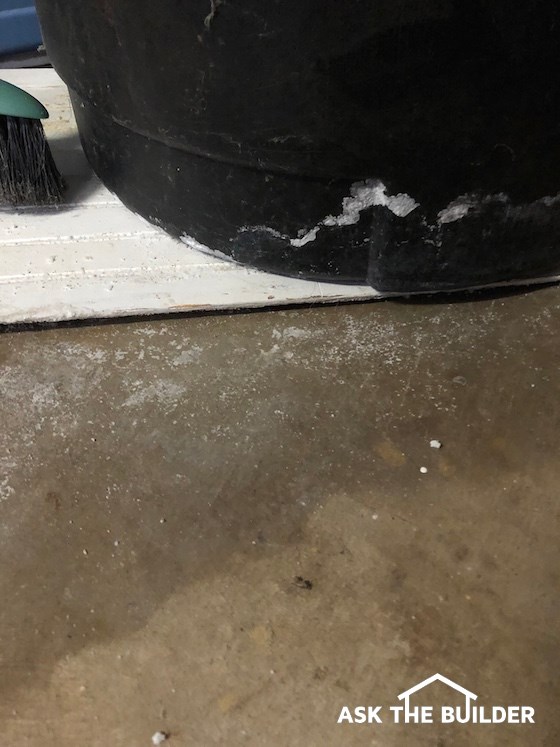
Deicing salts has been spilled on concrete. See the dark stain? The stain is caused by water vapor from the air being attracted to the salt. The vapor is absorbed by the concrete. Do NOT use water to clean it. READ BELOW what to do. Copyright 2018 Tim Carter
Deicing Salts and Concrete Checklist
- Rock other deicing salts will NOT harm strong concrete
- Salt attracts water
- Apply silane/siloxane sealers - CLICK HERE to BUY it
- Apply SAND to concrete
- CLICK HERE to Get Tim's FREE & FUNNY Newsletter!
Deicing Salts - Does It Really Harm Concrete?
DEAR TIM: We just moved into our new house. Our builder has advised us not to use rock salt on our concrete sidewalks and driveway for snow and ice removal.
He told us that it will damage the concrete. I don't believe him, because our city uses it on our streets every winter. Does my builder know what he is talking about? S. D.
DEAR S. D.: Your builder's advice is somewhat accurate. Rock salt can be one of concrete's worst enemies if the concrete was not mixed, finished and cured properly. Avoid using it on your concrete sidewalks, driveways, and patios if they have not been installed correctly.
Related Links
Installing Concrete in Cold Weather
Efflorescence Salts and Concrete
Free & Fast Bids
CLICK HERE to get FREE & FAST BIDS from local concrete contractors who can seal your concrete.
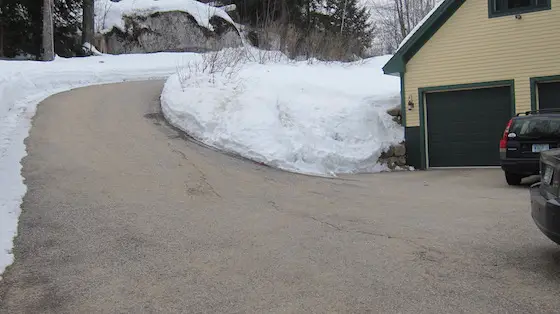
Deicing salt can be used on asphalt or blacktop with no worries. If you shovel first and get off most the snow before spreading the salt, your driveway will look this great in just 24 hours. Copyright 2018 Tim Carter
Is All Concrete Harmed By Deicing Salt?
No. Lots of old concrete was installed correctly and deicing salt does not harm it.
I grew up in the Midwest in Cincinnati, Ohio. Cincinnati can get brutal below-zero temperatures in the winter. I can take you to places in downtown Cincinnati that have concrete sidewalks that have been in use for fifty or more years and the top surface never spalled or was damaged by years of rock salt used to melt snow and ice.
How Strong Is the Old Concrete?
I've never had the opportunity to core drill one of these old concrete surfaces, but if we could I'm willing to bet you that the concrete would test out at least 5,000 pounds per square inch (PSI) of compressive strength. You just need to add an extra bag of Portland cement per cubic yard to get this strength or greater.
Watch this video by a top chemist who explains what salt can do to concrete. Pay CLOSE ATTENTION to what he says starting at 3:00 into the video. You'll note that he mentions if the concrete is mixed and placed properly, it can withstand the pressure from the freezing and thawing cycles.
Why is New Concrete Damaged By Salt?
I can also take you to new homes where concrete driveways and sidewalks look horrible after two years of winter weather because the concrete was not mixed, installed, finished or cured properly.
Concrete is a magnificent material. As a paving material, it can be one of the longest lasting surfaces that you can use. However, its useful life can be significantly reduced if you do not recognize its weaknesses.
How is Concrete Weak When Stretched?
Concrete has high strength when it is compressed, or 'squeezed'. However, it is extremely weak when it is subjected to tension, or 'pulled'. Rock salt can take advantage of this weakness.
 Get a 24-page guide right now that answers all your questions about Deicing Salts. Will it RUIN your concrete? Did you know that salt can SERIOUSLY harm you? What about your expensive landscaping? You can have all these answers and more in less than a minute. Buy it NOW. Get a 24-page guide right now that answers all your questions about Deicing Salts. Will it RUIN your concrete? Did you know that salt can SERIOUSLY harm you? What about your expensive landscaping? You can have all these answers and more in less than a minute. Buy it NOW. |
Does Concrete Absorb Water?
Believe it or not, while concrete appears to be a very dense material, it is in fact quite like a blotter. It can and does absorb water. You can actually see this happen on a hot summer day. Sprinkle some water on your sidewalk or driveway and look very closely. You can actually see the water penetrate the surface of the concrete.
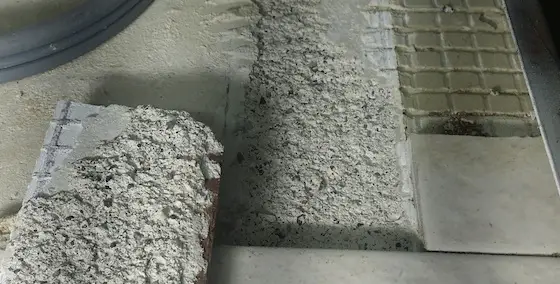
This is what spalled concrete looks like. Note how rough it is and the top finish is gone. Copyright 2018 Tim Carter
When you spread rock salt on your concrete to melt snow and ice, the salt dissolves the snow and makes a salt water mush. The melting action of the salt allows water to enter the concrete. If the temperature then drops and the water freezes, the growing ice crystals can blast apart the concrete.
Does Salt Attract Water?
Salt is also hygroscopic. It attracts water. It can cause concrete to become more saturated with water than it would otherwise. The presence of this extra water in freezing conditions can spell trouble.
The volume of water increases by 9 percent when it freezes within the concrete matrix. The pressure of the growing ice crystals can cause the surface of the concrete to fail. It usually spalls off.
New Concrete = DANGER
Freshly poured concrete is most susceptible to damage. Concrete placed in the late fall needs at least 30 days of drying time. This young concrete is still highly saturated with water. The water within the concrete can freeze and cause the surface to pop off.
However, if enough cement was in the initial mixture and this cement was not diluted by the addition of water, the concrete will be able to resist the damaging forces of the freezing water.
CLICK HERE to get FREE & FAST BIDS from local concrete contractors who can seal your concrete.
What is the Best Concrete Strength Mix Recipe?
Always order concrete that will attain a minimum compressive strength of 4,000 pounds per square inch (PSI). Some parts of the USA call this a six-bag mix. In order to achieve a 4,000 PSI rating, a cubic yard of concrete would have six bags, or 564 pounds of Portland cement in it. A typical bag of Portland cement weights 94 pounds.
IMPORTANT TIP: Remember, this is a MINIMUM requirement. If you're pouring an outdoor slab, driveway, patio, sidewalk, etc. and you want it to look great for thirty, forty or fifty years, then order it with seven or eight bags of cement per cubic yard of concrete.
Portland cement is CHEAP. A bag of it retail at a big box store in 2017 only cost about $10.00. Ready-mix concrete plants pay much less than that for 94 pounds. In other words, would you pay $200 more for your concrete if you knew it would be extremely strong?
Should I Add Air To Concrete?
Be sure that is air entrained as well. These two things are a good defense against salt attack. Concrete which is ordered, placed, finished, and cured properly can resist decades of contact with rock salt. Concrete surface failures such as spalling can almost always be traced to workmanship errors.
Can Finishers Ruin The Concrete?
Yes, it's my belief that most concrete that is harmed by deicing salts happens because of workmanship errors.
The placement and finishing of the concrete is critical as well. The upper surface of concrete can be severely weakened by poor workmanship. Sometimes workers add water to concrete at the job site or use it as a finishing aid.
These practices dilute the amount of cement at the surface of the concrete. The cement is the ingredient in concrete that holds everything together. To resist the freeze/thaw action of water, you need to have strong concrete at or near the surface.
IMPORTANT TIP: This means water should NOT be added to the concrete at the job site. It means that the workers should NOT trowel in the bleed water that comes to the surface after the concrete has been bull floated.
Is Sand Best To Use on Snow and Ice?
There is an alternative to using rock salt. You can use sand. The sand will not melt the snow and ice, but it will provide you with traction.
Should I Seal Concrete With Siloxane?
Yes, you should seal your concrete in the early fall with a silane/siloxane clear penetrating sealer. You can also treat your concrete with clear coatings that minimize or eliminate the possibility of water being absorbed by your concrete. CLICK HERE to BUY a great silane siloxane water repellent.
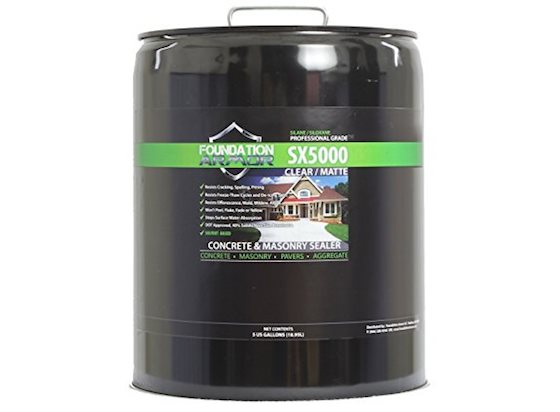
This is a magnificent silane - siloxane water repellent that soaks into concrete. CLICK HERE TO ORDER IT.
These ingredients allow the clear coatings to breathe. Avoid using products that contain silicone or paraffin.
Should I BEWARE of Film Formers?
Some sealers can produce a surface film. A surface film may not allow the concrete to breathe.
I've walked on some film-forming sealers that are very slippery when wet. Only buy a sealer like the one above that SOAKS into the concrete.
Concrete soaks up water from the soil. This water passes through the concrete and eventually evaporates. However, if you trap this water at the surface with film forming sealants, you may cause spalling. Be careful!
CLICK HERE to get FREE & FAST BIDS from local concrete contractors who can seal your concrete.
Column 008

Tim built custom homes and did ultra-custom remodeling for 20+ years before launching his Ask the Builder media presence. He was selected as one of the Big 50 by Remodeling magazine in 1993. This award gave birth to Ask the Builder in October 1993. Tim also operates https://DrawPlumbingPlans.com. His @askthebuilder YouTube channel was the first home improvement channel on YouTube.

Hi, OK, I know that I shouldn't use salt on new concrete driveway that was installed about 4 months ago. What should I be using??
Help!
Thanks
Lynda
Sand...... Mother Nature will melt any ice. Get rid of snow quickly and just sand.
What is the best product to use to clean rock salt stains from concrete in your garage?? I have tried scrubbing with a strong detergent and the stains still return from the pores of the concrete. Please help, as it has been a horrible winter and a lot of salt is on my garage floor.
Thanks
You need to watch this video of mine about efflorescence!!!!!!! Water is the WORST thing you can do!!!
I've used salt on my stamped concrete driveway one time, by accident. Will this damage my driveway? It was minus 28 and I thought it would be safer. But I have since learned not to use it.
Salt will NOT hurt concrete that's been mixed properly, is 4000 PSI or greater strength, was placed properly with NO ADDED water during the finish process, no bleed water was troweled into the top surface AND the concrete was properly cured. The issue is you have no idea about if any of that was done ne
Salt will NOT hurt concrete that's been mixed properly, is 4000 PSI or greater strength, was placed properly with NO ADDED water during the finish process, no bleed water was troweled into the top surface AND the concrete was properly cured. The issue is you have no idea about if any of that was done ne
Salt will NOT hurt concrete that's been mixed properly, is 4000 PSI or greater strength, was placed properly with NO ADDED water during the finish process, no bleed water was troweled into the top surface AND the concrete was properly cured. The issue is you have no idea about if any of that was done unless you were there during the entire pour.
we have a water softner. and we use salt tablets, when I poor it into the softner is it posssible for salt dust to get on the floor and cause moisture on the floor?
Hi,I'm living a new built house (house building date started September 2014) and my concrete patio, sidewalk and driveway was poured on the 19 of December 2014, we moved in 25 of February 2015.it snowed on and off during the end of December,January, February and very heavy in march. The driveway and some of the sidewalk is badly spotted, spalling,and flaking. We did not put anything on it. And we shoveled the snow a few times of the driveway.
My question is what causes this things to occur?
You may have had a bad batch of concrete. I had a driveway poured, it did the same thing as your driveway. I had it replaced under warranty. Check with the person who poured your driveway.
Think I got one for you Tim,
The house was built in the late '40s. A 60 foot hand dug water well at the basement door (well failed early '80s) with a concrete slab poured 4 foot above the well top. Mom and Pop moved in 1979 and the next winter very bad winter. Pop (72 yr. old at time) needed to get wood for the furnace (out the back basement door) and used melt to rid the ice. The old slab started to spall and has continued 'til today and has spalled in places up to 1 inch deep. Aside from replacing the slab, is there anything to be done to stop spalling and resurface?
Thank you, Ebe
We poured concrete last 2/20*2016. Later on, we noticed that the concrete looked real white and it appeared to turn green. Also, we noticed that when we used a weed eater the line would actually break the concrete. Since it was less than a year we decided that the concrete needed to cure. However, it snowed in 12/2016, so as we normally do, we put down some salt. when the snow melted, we noticed that the concrete started eroding away. You could take your foot and it would turn to ash.
Any ideas? Please advise. Thanks!`
Ed,
Sorry to hear that you got taken. The concrete finishers RUINED the concrete. All you need to know is above in the column. You can also read these past columns to. One of them tells you how to FIX the damage:
http://www.askthebuilder.com/concrete-spalling-repair/
and
http://www.askthebuilder.com/concrete-overlays/
What do you think about using Ecotraction or Grizzly Grip on new concrete for ICE Traction control? Both are made from natural zeolite, which is also a soil amendment product so can be swept into gardens and lawns once winter ends
I've never tested them so I can't comment. Let us know how it works out for you.
Hi, My steps ( bluestone?) have an eaten away look--like the wind swirls in fresh snow & the concrete supporting it falls off very powdery when touched. I'm assuming from winter salt. Is there a way to repair/seal it?
Thank You,
Paul
Maybe.
This is a complex situation with lots of moving parts.
For me to give the BEST answer, I need to ask you lots of questions and that takes time.
You have this option:
http://shop.askthebuilder.com/products/15-Minute-Phone-Conversation-with-Tim.html
So...what if I wanted to use salt to help demo my badly damaged concrete driveway? I put salt down a few days ago not realizing that it was going to basically disintegrate large sections that were already damaged (top layer was already gone in lots of places when we bought the house.) The salt turned it to powder. This got me thinking-could I demo with salt? It would save a little money when we get the driveway redone.
You can try it. I doubt it's going to do much unless the concrete was ordered wrong. Usually salt will hurt the top 3/8 inch because the finisher made mistakes.
Salt's fairly cheap. You've got nothing to lose except any expensive landscaping near the drive. The salt runoff will poison the soil.
I am from York pa.I have salt problem with my sidewalk, my neighbor said a company that builds buildings an employee of there said the Knowsley is using a product called planned I do not know the last name 9f it, but Kinsley makes there own cement. Is there such a product to patch cement.
Our driveway was done about 15 years ago as I recall, at least 4000PSI plus rebar. At this point it is rather dirty and we plan to have it powerwashed in the spring. Any thing we need to know first? I gather from what you said above that we ought to then have it sealed with Siloxane. Does that make sense for us?
Thanks,
Ron
It all makes sense. Please use my link above to purchase the silane/siloxane.
You did not mention the other chloride options. I thought they were much more less likely to cause damage.
Hello, sure like your comments on different stuff. Please keep sharing your advice, and Ideas. Thanks.
My question is; Is calcium chloride still good to use on concrete. I really didn't see this listed. Live in the North East. Allentown area.