New High Performance Vapor Retarders
High Performance Vapor Retarders
DEAR TIM: I am building a new home. The floors of some of the finished living space will be concrete slabs poured directly on the soil. What is the best material to use to prevent water vapor from passing into the living space where it can fuel mold growth and ruin finished flooring materials? Is the common clear poly vapor barrier good enough? I also own a summer home with a crawl space. Will the same product stop the musty smell in that home? Cindy M., Ocala, FL
DEAR CINDY: You need one of the brand-new revolutionary vapor retarders. Many people call vapor retarders vapor barriers. The term vapor barrier has been misused for many years. A true vapor barrier would block all water vapor. The clear plastic products sold in most home centers and building supply businesses allow huge amounts of vapor to pass through them. What's more, some of these products can actually degrade over time. Many soils contain alkali and other chemicals that can cause the readily-available clear plastic products to fail.
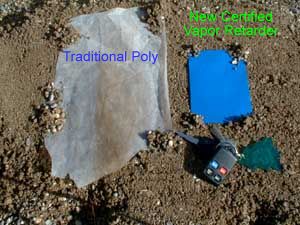
The home building industry has experienced tremendous advancements over the past 25 years. Many of the advancements have made houses much tighter and more energy efficient. But these advancements have a price tag attached to them. Because older homes were drafty, they could more easily dissipate water vapor that seeps in through concrete slabs and foundations. Small or moderate amounts of water vapor that raised indoor humidity levels slightly years ago in an older home may cause dangerous mold growth and buckled wood or laminate flooring in a tight newer home. Excess water vapor can sometimes cause water-based flooring adhesives to mold and degrade.
In light of these problems, manufacturers from the flooring industry and those that made vapor retarders worked with independent testing officials to develop a standard by which high quality vapor retarders can be measured and rated for effectiveness. In 1997, ASTM standard E 1745 was established for just this purpose. The bottom line for homeowners such as you and me is simple: you want a vapor retarder that meets this standard. These vapor retarders allow minute amounts of vapor to pass into your home, they resist chemical attack and they are very resistant to punctures during installation and the placement of the concrete over the retarder.
It is absolutely essential that you install the best vapor barrier under concrete slabs as well as any walls that also require vapor protection. The reason is straight forward. It requires an enormous amount of work and expense to re-install a vapor retarder after the fact. You must get it right the first time. The vapor retarders that pass the ASTM E 1745 standard only cost several hundred dollars more for a roll that contains 3,000 square feet of product. This is a small price to pay for long-term moisture control and peace of mind.
Homes with crawl spaces also need these wonderful vapor retarders. When installed according to all manufacturers' specifications, they block the water vapor that is fueling the offensive aromatic microscopic mold growth in your summer home. The manufacturers of these high quality retarders also make special tape that is used to seal seams that may be required should you not be able to place one giant sheet of material under the home. It is vitally important to seal seams with this special tape.
Be sure your builder installs the under-slab vapor retarder correctly. A common mistake is to cut the material carelessly against the foundation. The vapor retarder should actually lap up onto the foundation so that the concrete slab is completely isolated from the soil and the foundation. The special seam tape should also be used to seal the retarder to any pipes or other objects that penetrate through the retarder and the slab. Without the tape, water vapor can escape past these objects.
These high quality vapor retarders are not hard to locate. The best places to find them are businesses that sell concrete supplies to contractors. Look in your Yellow Pages under the heading Concrete - Supplies. Be sure to verify that the vapor retarder you are buying meets the ASTM standard.
August, 2004
The August 2004 edition of Professional Builder magazine (vol. 69, #8, pp. 57-60) had an interesting article on "Choosing Insulation" that touched on vapor retarders. In it the author, Glen Salas, brought up a good point that vapor retarders should not be used in warm climates such as the deep South of the USA. In those areas it is thought that unfaced fiberglass batts should be used in walls.
Glen also says that if you are inclined to add an additional layer of insulation, never install a vapor retarder in between layers of insulation.
One point I disagree with in his article is the placement of a vapor retarder in a ceiling. I feel it is not a good idea and he seems to think it is okay to do this. Glen also says to place a vapor retarder on the room side of insulation above a crawl space, but I feel it is better to stop the water vapor at its source and place the best vapor retarder on the soil and close off the vents to the crawl space to block atmospheric air from entering the crawl space.
Related Column: Stop Water Vapor Now
Author's Notes:
I received this email from Michael P, Cincinnati, OH. Here's how he helped with his crawl space problem.
"I live in Turpin Hills and wanted to thank you for your advice for sealing a crawl space. This is our third winter in our home and the basement is always much colder than previous basements from other homes. I did as you suggested and put heavy duty, thick plastic on the gravel and put doors on the opening of the crawl space. It's been a few weeks and I can see water droplets forming under the plastic. I may put a second layer of plastic for good measure. The basement is warmer and so is the room above the crawl space. I don't smell the mustiness either. Thanks again for the tip."
Here's another one from Marilyn W. in Troy, MI with a similar issue.
"I read your answer concerning musty smells coming from crawlspace and slab foundations. The musty smell is in our cottage. Part is a slab and part is a modified crawlspace that we can not get under. The space is too small and there is no entry. If we remove the carpet and spray the the floor with the liquid water vapor barrier, would this take care of the smell? It is closed a good part of the year, and when we do open and use it, the smell permeates everything including our clothes, hair etc. Please help us make our cottage usable. Thanks!"
Column 445

Tim built custom homes and did ultra-custom remodeling for 20+ years before launching his Ask the Builder media presence. He was selected as one of the Big 50 by Remodeling magazine in 1993. This award gave birth to Ask the Builder in October 1993. Tim also operates https://DrawPlumbingPlans.com. His @askthebuilder YouTube channel was the first home improvement channel on YouTube.
If you spray the top of the flooring with a vapor barrier, the water vapor coming from the ground will condense as liquid water and soak into the wood flooring and/or subflooring itself; the moisture may be kept away from the interior of the cottage for now, but it'll rot the flooring pretty quickly (i.e. probably five years or less).