Installing Downspout Drain Lines
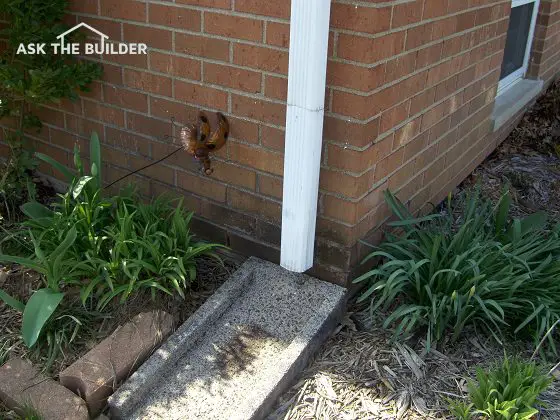
Install Downspout Drain Lines | Splash blocks don't do much to channel water away from the foundation. © 2022 Tim Carter
Install Downspout Drain Line TIPS
- Use solid SDR-35 PVC pipe
- Use only 45 or 22.5-degree bends underground
- Call 811 to locate underground utilities
- Don't put pipes in un-compacted fill dirt
- CLICK HERE to Get Tim's FREE & FUNNY Newsletter
Ethel had a flooding disaster similar to Rich's issues. Check out the May 21, 2020 Newsletter to read her story.
DEAR TIM: I need to bury downspout drainage pipes in my yard before the yard is seeded. Where is the best place to put them and how deep should they be buried? What type of pipe do you like? How far away from the house should the pipes extend? A friend suggested using pop-up valves to help water the lawn and plants. Are those a good idea? Rich T., Jackson, MS
DEAR RICH: Stormwater drainage from roofs is a topic sometimes ignored by builders and homeowners alike. I can't tell you how many houses I see where the downspouts empty onto a splash block at the base of the foundation.
CLICK HERE to get FREE & FAST BIDS from local landscapers who can install downspout drain lines.
Often these homeowners are plagued with water seepage into basements or crawlspaces and it's no wonder. Heavy rainfall on an average-sized roof can produce hundreds and thousands of gallons of water that spew from the different downspouts located around the house.
Read another column of mine about downspout drain lines that shows you how much water can come off a roof in as moderate rainfall. You'll be AMAZED!
Harvest Rainwater
I regularly visit the Southwestern part of our great nation and am somewhat astonished that stormwater is not collected and stored by homeowners that live in this arid area. Laws passed decades ago often prevent homeowners from harvesting and storing water that falls on their land. River systems that feed into the Colorado River are affected by this because the water in this drainage basin eventually flows to and through the Hoover Dam.
The water held back by this dam is used to irrigate crops grown for many people in the USA. The water also makes electricity that's sent to tens of millions in southern California and other parts of the Southwest. It's a complex situation.
If you're permitted to collect and store rainwater, this water can be easily collected and piped to above or below ground plastic barrels or tanks. If the storage is above-ground and placed at the highest part of the lot, drip irrigation piping can be extended from the water storage.
The stored rainwater can then be used to help irrigate plants that otherwise would have enjoyed the drink before the house was built.
A simple phone call to your local town office will allow you to discover if you're permitted to harvest rainwater.
Why No Harvesting
The issue with harvesting rainwater is that it lowers the cubic-feet-per-minute of flow in the major rivers. If you collect the rainwater and then use it to water plants, drink and then put back into the earth via your septic system, that water never makes it into the river and then down to the large dams.
Contracts negotiated decades ago count on the water making it to the dams. The entire water-rights issue on private land in the Western USA is very complex. It's far beyond the scope of this column.
Urban Storm Sewers
Before you proceed with any work, you should check with your local government to see if they have special stormwater rules and regulations. Sometimes you have to pipe this water to special underground storm sewers or above-ground channels. Some local governments or agencies have no rules or regulations.
Trenching Tools
I usually dig a trench about 12 to 14 inches deep for downspout drain lines. The fastest way is to rent a trenching machine from a local tool rental.
If you have hard clay soil, or rocky soil, you can use an electric hand-held demolition hammer tool to dig a trench.
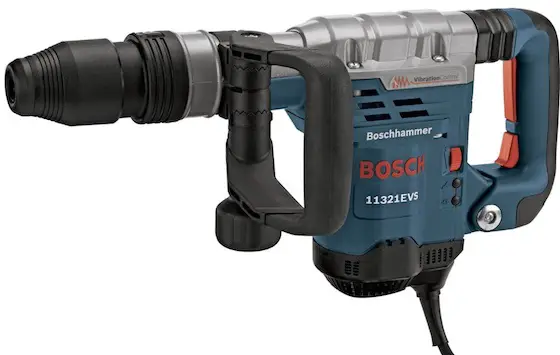
This is a great demolition hammer tool to chip out rotten concrete. If you've got a bigger job that's going to last a few days, you should BUY one, keep it in good shape and then SELL it on Craigslist once done. This will be cheaper than renting one. BUY THIS GREAT POWER TOOL right here. I own one just like it.
These electric demolition tools can be outfitted with chisel tips to crack larger rocks or clay spade shovel tips to carve through dry or damp clay soil.
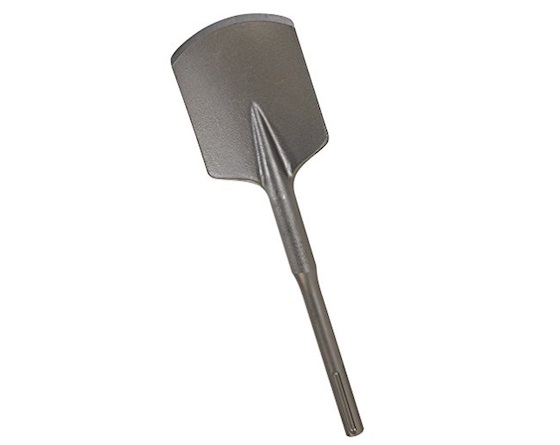
This is a miniature shovel that fits on the end of the Bosch demolition hammer. It carves through clay soil like a hot knife through cold butter. BUY THIS FANTASTIC ACCESSORY right here.
If the lot is fairly flat, the pipes will get deeper the farther they extend as you should create 1/8 inch of fall for every foot the pipes run. The pipes should never be buried running parallel in the non-compacted fill dirt that is placed against the foundation.
CLICK HERE to get FREE & FAST BIDS from local landscapers who can install downspout drain lines.
Over time this dirt or soil settles and it can cause piping to break, kink or develop reverse, or backwards, slope.
Downspout piping can cross the un-compacted fill at a 90-degree angle so that it is placed in undisturbed soil. But as the soil adjacent to the house settles over time, this small length of piping needs to be checked and lifted to ensure it drains.
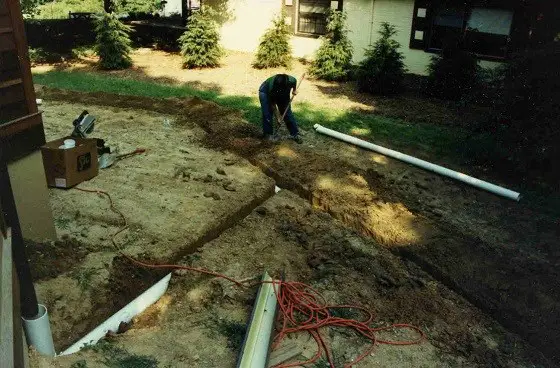
The pipe in the lower left of the photo is crossing an un-compacted fill around the basement of my house. I allowed the fill to settle for months and watered it before installing the downspout drain lines. The pipe is 4-inch SDR-35 and it intersects the other pipe farther in the yard using a standard wye fitting. (C) Copyright 2017 Tim Carter
SDR-35 Pipe And Fittings
A smooth 4-inch-diameter plastic SDR-35 sewer pipe is the material I prefer to use. This pipe has a smooth interior and closely resembles the thick-walled plastic piping used for interior house drain and vent piping.
Fittings can be permanently welded to the pipe with PVC cement. These fittings come in all types including the all-important Wye fitting where one pipe connects to another.
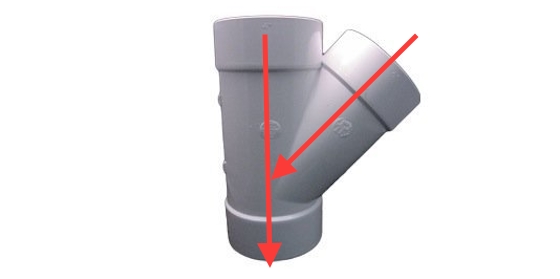
This is a standard Wye fitting. Note the red arrows that show you the direction of water flow through the fitting. BUY THIS WYE FITTING HERE NOW.
If you don't want to use glue, you can buy rubber-gasketed fittings. These fittings have a rubber o-ring incorporated into each end of the fitting.
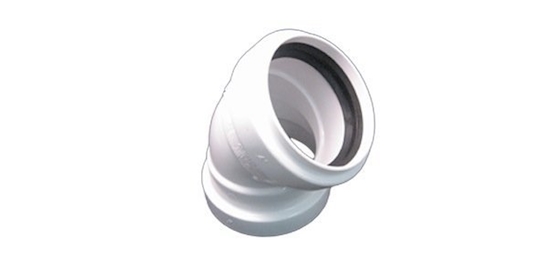
This is a gasketed 45-degree SDR-35 fitting. Note the black gasket. You use lots of these. All underground bends need to be 45 degrees. If you need to make a 90-degree bend underground, you should use two 45 bends and put a 1-foot piece of pipe in between them. You do this so it's easier to get a drain-cleaning snake through the pipe if it ever gets clogged. BUY THIS FITTING HERE now.
You need to keep the pipe clean of all sand and dirt when you work with gasketed fittings. You also need to use a coarse file to taper the cut ends of any pipe. If you don't file the ends, you'll never slide the pipe into the rubber gasket. You also lubricate the pipe and gasket with liquid dish soap.
If you install either type as directed, tree roots that create clog nightmares will never be able to enter the piping system. I am not a huge fan of the corrugated flexible black piping for downspouts. It can crush easily and it is nearly impossible to clean with professional drain cleaning equipment.
All underground bends in downspout piping should be made with 45 degree or smaller angle fittings. Ninety-degree angles underground become obstacles in the event the piping has to be cleared by a professional drain cleaning company.
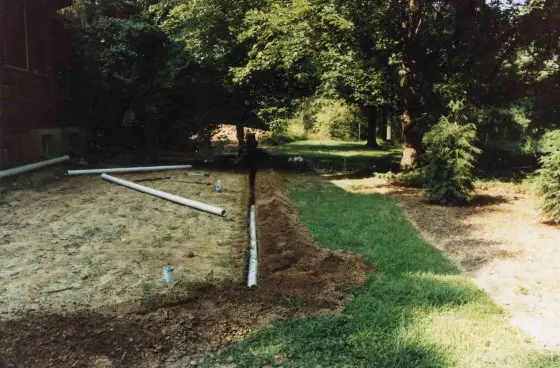
The downspout drain line had to make a bend. In the lower part of the photo, the pipe you see connects to a 45-degree fitting. - © 2017 Tim Carter
You can use a 90-degree angle at the base of the downspout where the underground piping begins, as a drain cleaner can usually insert his metal snake here with no difficulty.
Pipe Away From House
If you are allowed to drain your stormwater on your own lot, do so as far away from your home as possible. Try to pipe all water to a low point away from your home.
Don't drain more water to a point on your lot than would have ended up there naturally before your home was built. Simply keep in mind where the water is falling on the roof and where that water would drain if your house had never been built. If you pipe the water where it used to go, you should not harm any of your surrounding neighbors.
Pile Up Rocks
Where the downspout drain line terminates above ground, it's going to cause erosion because you're concentrating lots of water from your roof at this point. Create a large area of softball-sized rocks that the water will flow onto. This absorbs some of the energy and spreads out the water.
Inline popup valves do a good job of allowing rainwater to discharge onto your property, so long as you are allowed to drain the stormwater on your property. Try to strategically place them where they will do the most good for your vegetation.
Photographs & Videos
An invaluable tool that will come in handy in future years is a collection of photos and videos that are shot as the downspout piping is being installed. Videos are best because you can talk and describe what the camera is seeing. Upload these to cloud storage and pass them onto the future buyer of your home.
If you stand back and include parts of the house in the photos and place shovels or other objects in the photos for scale, these prints will help you locate the pipes in the future. Over time it is very easy to forget where hidden pipes pass in the ground.
My own photos saved me lots of work in the past. I had to install a small field drain in a side yard. The photos I had taken years before allowed me to locate within five minutes the drainpipe to which the new drain was to be connected. I could have dug for an hour and missed the pipe by inches without the aid of the photographs.
CLICK HERE to get FREE & FAST BIDS from local landscapers who can install downspout drain lines.
Column 517

Tim built custom homes and did ultra-custom remodeling for 20+ years before launching his Ask the Builder media presence. He was selected as one of the Big 50 by Remodeling magazine in 1993. This award gave birth to Ask the Builder in October 1993. Tim also operates https://DrawPlumbingPlans.com. His @askthebuilder YouTube channel was the first home improvement channel on YouTube.
Hi Tim,
Re: "I usually dig a trench about 12 to 14 inches deep for downspout drain lines." -- would the same depth be sufficient in Canada where I live? I was talking to somebody at Home Depot and they repeatedly warned me that no underground drainage pipe should be closer to the surface than 4 feet (for the fear of freezing).
Would appreciate your opinion -- I am about to start a drain pipe burial project, don't want to dig too much, but if freezing is a concern, I'd probably have to go deeper than 4 feet.
AG.
Alex, your question requires lots of typing, plus I have some questions for you so I can give you the correct answer(s). I only do pithy answers here in the comment section. If you want to protect the investment you have in your house and not waste time or money *hoping* you make the right decision, you should talk to me on the phone for just 15 minutes. It'll be the best investment you've ever made in your home!
Hi Tim
We have a crew who is currently installing the under ground spouts, I noticed they have only dug down maybe 8" we also live in Canada and it can really get cold! I would like to know the proper way to install before our guys leave....thanks
Arrange a phone consult with me.
I have a house in the country area , I leave lots of trees .i would like to know how to bury downspourt.
Tim,
Same question on the underground horizontal drain lines for down spouts. My experience has been the horizontal lines freeze (glacier style) and eventually block the pipe closest to the exit point. ALL lines eventually exit at ground level away from the house and therefore the ground freezes HARD in that vicinity...thus the glacier ice. HOW do you prevent this? Add a heat tape? And IF yes, one has to remember to turn it on/off as the conditions change. Oftentimes it is very cold with NO snow melt off the roof, so heating the pipe is not necessary. Will the heat tape damage the plastic pipe? What IF Schedule 40 was used? Thanks in advance for your advice. We are doing a NEW home build and want this to be taken care of permanently. Plus, some of the drain lines will go "under" paved areas like a driveway and/or patio. Therefore, got to get this right.
Install a wye fitting and above-ground clean out far upstream where you can open it and add a very salty brine hot-water solution IF it does freeze.
Brine should melt the ice and open the line.
Tim,
You recomend 4" diameter pipe, but I am trying to determine how many downspouts I can run in one 4" diameter pipe. I live in KY and the way the lot is set up, I will have plenty of slope and it will be draining into a creek, but the square footage of my roof is approx. 4500 sq ft. This is a new construction and I am trying to get the drains installed before I sow my lawn this fall. I have had people recomend running a 4" line for each drain and others saying that all of them could drain in one pipe. Thanks for any help that you can provide.
Put half the roof on a 4-inch pipe and the other half on another 4-inch pipe. Where the two pipes meet to run to daylight, increase the pipe size to 6 inches.
Tim,
I need to run the roof runoff from the gutters to a lake behind my house. I currently have the gutters draining into 4" PVC and then into 2 lines that are 6" PVC. The roof is 5000SF. The PVC is buried. during heavy rains one of the runs to the lake doesn't seem to keep up. The rain overwhelms it. The landscaper says that it's because the run drains into the lake below the waterline. Does this sound right to you?
Yes. If the outlet of the pipe is UNDERWATER, then the water pressure in the lake is reducing what can run through the pipe. The outlets of the drain pipes MUST be open to the air for maximum flow.
i guess it takes you some time to respond to questions?
Yes it does. Can you imagine how many I get a day? I can only devote about 15-30 minutes a day to this free service. Not many people can work for free all day - I know I can't. If you need help FAST, I offer a phone consultation service.
Hi Tim,
Will pop-up emitters freeze up in the Midwest (northwest Missouri)? If so, what is a good alternative solution? Thanks in advance.
Anything that traps liquid water in a pool where it can then freeze is bad jujumagumbo. The water needs to flow across the surface and soak into the soil.
Mine did.
I live near Detroit Mi, we have lots of snow and frost. We've been installing underground downspouts in our area for over 20-years. Our area is mostly clay so we need to take the water away from the home, to keep the basement dry. I sell a system with a filter installed under the downspout (just before the system inters the ground), then go at least 10-ft away from the home to a 4" pvc tee, a strainer on top to discharge water installed over a post hole filled with pea gravel. The tee over the gravel (what we call a mini French drain) prevents the system from holding water for very long.
NOTE FROM ASKTHEBUILDER.COM
I'm a college-trained geologist with a specialty in hydrogeology - the study of ground water. I'm sad to tell you your system has virtually no ability to dissipate water because the deeper you go in clay soils - into the B horizon - there's LESS ability for the water to move through the clay. What's more, most of the post hole is filled with stone so there's very little capacity to hold water. I'm afraid your system is based on bad science.
Hi, are you still installing this system in Detroit area? If yes, I would like to get a quote for my house for underground downspouts.
Jonathan Lozier
Great website and very informative. I plan on installing a french drain with 4" perforated HDPE approximately 30' in front of my house. I own a backhoe which is necessary in order to dig through my very heavy clay soil. I have plenty of room for pitch and the overall length is rough 150' around the back of the house. I plan on burying the gutter downspouts with 4" solid HDPE and having it run right over top over the perforated out to day light, essentially stacked.I figure dig one hole for several purposes, the roof water is not going into the french drain pipe it will be contained within its own solid pipe. One 4" solid pipe for each down spout. Question: I live in upstate NY and the winters are rough, I am very worried about the 'glacial effect' within the drain pipes, how do prevent that? do I have to dig down 4'?
Thanks for your time
Jonathan
Tim,
First let me say " Thank you " for the time & effort you freely invest into this site.
I recently ripped up all the grass (weeds) in the backyard of our new house. We live in Pennsylvania area incase that may effect your opinions. Currently our rain spouts empty where they end and I know this is the worst possible case. While the backyard is nothing but dirt Id like to install a drainage system to remove water away from the home. Backyard is approx 60ft from back of home to rear fence, slightly sloping away from house. Outside of rear fence is a 20ft evesmeant between the neighboring yard. My plan is to install a drain box w/grate under each downspout, each traveling to one of Two main 4in PVC (one main for each side of house) each main will end discharging into one of two buried perculating dry wells.
My soil makeup is mostly Clay, I did a Perc Test by digging 4ft deep hole with a post hole digger & filling with water, after three days the water has dropped maybe 2inches. so my concern is will the drywell perc system even work for me? If not what might you suggest?? I'm also planning on putting a 12x12 shed in the lowest back corner of the yard on a concrete slab, have the area dug out to begin preparing the base for the shed. It recently rained and I noticed the hole filled with water in the one corner which sat pooled for some time.. I need to do whatever I can to address drainage prior to pouring cement for shed slab and seeding the lawn. I know this is a lot to take in but I figured the more information i give the better you might envision my situation. Thanks in advance for any help your able to offer.
Dan
The fact that people in the southwest (of the United States) don't collect rainwater is not surprising because it's actually illegal. "Water rights" is the "third rail" in politics in the west. If water falls on your ground and you don't have rights to it, you have to let it go downstream.
We bought a house ten years ago previously owned by wanna-be gardeners who installed a lot of "stuff" we are just now discovering. One of those things is a downspout that goes into the ground. We have no idea where the water is draining; that side of the house is very close to our neighbor's property. Would the City be able to tell us if that pipe flows into the City sewer system? This house was the first built in the neighborhood...Are there any other clues we could look for? The house sits on a slight hill so the logical thing would be a pipe that comes out somewhere near the street/curb near that side of the house, but not seeing anything like that...
Do the drainage lines need to pass under or over water lines, coming in to the house, or does it not really matter
The reason rainwater is not collected in most of the Southwest is because it is illegal. The author should do a little research on the lack of a right to collect rainwater in most southwestern states before spouting his mouth off about how we don't know what we're doing. Capturing rainwater in drought areas makes the drought worse.
Since you have done research perhaps you can tell us which SW states don't allow rainwater collection? I live in San Diego and we can collect rainwater. Also where is the author "spouting his mouth off" about how we don't know what we are doing?? I thought he was providing free information to people who need some help or ideas on various topics. If you read the article more slowly you might catch the line, "If you're permitted to collect and store rainwater, this water can be easily collected".
Hi Tim, I justed moved into a house that is 15 years old and have found the black corrugated drains are crushed in different spots. The rest of the drain is ok. I know this because I dug one up and used a camera on the others. My question is if I dig up only where the crushed drain is and replaced it with PVC, do you think this will suffice? Again the corrugated pipe has been there 15 years.
Just SUCK IT UP and get rid of that crap. Abandon the Black-Pipe-of-Death and put in the pipe I talk about in the column above.
Do that and you'll NEVER have issues.
HI TIM,
i AM WANTING TO INSTALL UNDERGROUND DRAINAGE DOWNSPOUT EXTENSIONS. I HAVE 2 QUESTIONS.
1. I LIVE IN MID MISSOURI AND WANT TO KNOW HOW DEEP I SHOULD DIG THE TRENCH TO SET THEM IN.
2. I WANT TO CONNECT 2 GUTTER DOWN SPOUTS INTO ONE RUN USING A Y CONNECTION. SHOULD I GO FROM 4 IN AND INCREASE IS TO 6 INCH WHEN THEY MEET.
One foot is plenty deep. You'd only need to upsize to 6-inch pipe if you have a huge roof like I did on my home. My roof was over 5,000 square feet of surface area.
Hi Tim an thank you for your response. I have another question. Where I terminate the pipe I am going to dig a 3 foot deep hole where the t-connection will be placed. I know I need to put gravel at the bottom of the hole. My question is how high should I have the gravel rise. Should I have it to the bottom of the t-fitting so as not to have any dirt blocking the water draining into the gravel. I am concerned that if I fill just the bottom with the gravel and then dirt on top of it, the dirt may cause a blockage or prevent the water from draining smoothly from the bottom of the t fitting.
Thank you
I'm sorry I'm not completely clear on your situation. Rather than give bad advice, you may want to consider this option so we're on the same page:
http://shop.askthebuilder.com/products/15-Minute-Phone-Conversation-with-Tim.html
I have had an ongoing issue with drainage from storm water. It seems all my downspouts empty behind my house on one side of my property. Consequently this area is almost always to saturated to cut grass or even walk on it. This is a large house, (ranch style) of about 6200sq ft so has a lot of roof runoff. My questions are: is it unusual to have all drainage on one side of house? Seems It would make more sense to have half on one side, half on the other. Also, do drain pipes have holes or perforations to catch runoff in front yard ? I think maybe when we had a inground pool put in 4 years ago one drain line got broken, buried or both. Not sure who to call to even begin to diagnose the problem...?
No it is not unusual. You don't need to call anyone. Just go back up and re-read my column. Look what I did at my house. Think about how the sewage leaves your home. If you can't figure it out, I offer a phone consult service and can walk you through it.
http://shop.askthebuilder.com/products/15-Minute-Phone-Conversation-with-Tim.html
Hi. I’m installing a trench drain in my backyard to discharge onto the curb with a pop up emitter. The exit in the trench drain is 3 in., with an adapter to connect a 4in pipe. The pop up emitter is a 4in. Since the exit hole of the trench drain is 3 inches, should I use a 3in or a 4in pipe to the emitter?
How much water capacity does 3" drain pipe have? Is there a rule of thumb for underground drain pipe?
Thanks!
140 gallons per minute with gravity tugging on the water.
Tim,
I have a ditch that is usually empty until it rains but fills up and flows quickly during heavy rains. If the water level gets above the pvc will it still drain correctly since it is flowing water?
Hi Tim!
I’m connecting my downspouts to be discharged to lower part of yard and was wanting to put a walkway over the trench with rock as the pathway. Will this work like a French drain just with no perforated pipe. I know this isn’t best option but wondering if rock will help absorb some of the surface water after a hard rain.
Fill the entire trench the pipe is in with rounded gravel the size of grapes. Do NOT put in any soil in the trench. This will capture the water and channel it to the low spot where the pipe ends.
What kind of professional should I hire to tie my downspout into my underground drain? My basement floods if we have a heavy rain in the winter. I'm sure it's because the underground pipe freezes. If I can get a wye fitting installed it would prevent the water leaking out of the connection I now have. I live in Birmingham, MI near Detriot. Help!
Sussane,
This is a job for a handyman. CLICK the following link to get free bids:
http://www.homeadvisor.com/ext/32181851
I'm going to have to bury a pipe underneath a front walkway I am replacing at the same time. Can the PVC piping bear the weight of several inches of compacted paver base and flagstones?
I have zero experience or training in gutters and drainage in general so please bear with me. My husband and I disagree on the application of an extension to a downspout. He says the extension must always fit on the outer edge of the downspout even though the spout needs to be crimped so the extension can fit around it and then screw it on. he cannot give me a reason why this has to be just "that's how gravity works".
I think that the water will take the path of least resistance (yes, I took physics) and if you have to use an adapter that fits inside the downspout then connect that to an extension it will work the same way (provided the adapter is not too small and is welded with putty and screwed in securely).
Does it really make a huge difference and why?
I could find nothing while researching the pertained to this specific issue. Thank you in advance 🙂
I've been a master plumber since age 29. It's all about male/female coupling - just like in real life. Not trying to be crass.
Your husband is right. Downspout tubes and fittings have crimped male ends that slide into the normal 2x3 female ends.
Period. Yes, you screw the two together or pop rivet.
Is it legal to put lines in to take runoff from downspouts on house into a creek?
Hi Tim. We just bought a house and found out the seller had used a slotted pipe under the sidewalk when burying a downspout. It is our understanding that a slotted should
Not be used due to the colder weather and freezing in Indiana and the sidewalk will crack and eventually have issues. Can you clarify?
Well, think what happens when it rains in Indiana in October, November, and early December. I lived in Cincinnati, Ohio for 55 years, so I know. Then I want you to read ALL of the columns here on my website about Linear French Drains. Pay attention to what I say about where water moves through soil. My college degree is in geology with a focus on hydrogeology.