Rust Removal from Concrete Pavers
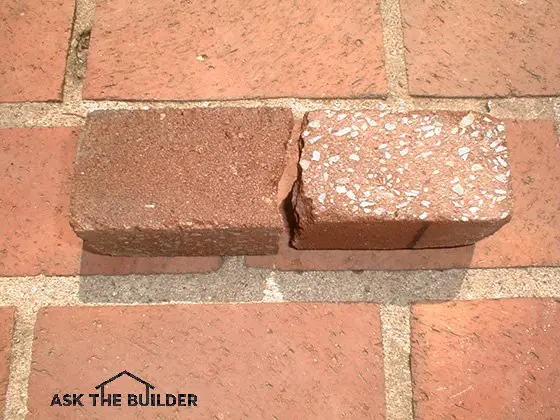
I cracked the new paving brick in half. Look at how light-colored the aggregate is! Over time when the red cement paste wears off, the pavers will look different. My traditional clay paving brick patio will stay red forever, because the red clay is the same color throughout the entire brick. © 2017 Tim Carter
Rust Removal TIPS:
- Use oxalic acid crystals CLICK HERE to ORDER
- Mixes with water
- Test on small area with cotton swab
- Check for surface damage - if none, proceed
- CLICK HERE to Get Tim's FREE & FUNNY Newsletter!
DEAR TIM: Last fall, we had two new colored interlocking concrete paving brick patios installed. This spring we noticed the color of the patios is not the same and some of our patio furniture has left some rust stains. To make matters worse, something fell on one of the brick and took a large chunk out of it exposing a different colored core. What is causing the color fade? Is it possible to remove the rust stains? Can the damaged brick be easily repaired to match the existing colored paving brick? Vicki L., Villa Hills, KY
DEAR VICKI: Congratulations on the new patios! My wife and I love our regular red clay paving brick patios. They differ from yours in that my patio will always stay the same color because the clay used to make the brick is the same color throughout the entire brick.
CLICK HERE to get FREE & FAST BIDS from local handymen who can remove rust for you.
Fading and Rust
The fading you are witnessing is a small, but pesky, problem with your concrete paving brick. Unfortunately, the color fade will continue to get worse over time.
Concrete paving brick surfaces look stunning when new because all of the sand and small gravel aggregate in the brick are covered with the pigmented cement paste. The same thing happens with new blacktop or asphalt roadways and regular brick mortar in a brick home.
A freshly laid roadway looks as black as night when new because the deep-black asphalt cement coats all of the sand and gravel in the asphalt. But over time, the roadways start to turn gray as the black asphalt cement is worn off the gray stones and sand by traffic and weathering.
Look at a new brick job and the mortar joints are one color. But look closely at 30 or 40 year-old brick homes and you will notice that you can see the actual colored grains of sand as the thin cement paste has worn away exposing the sand particles.
Remove Rust with Oxalic Acid
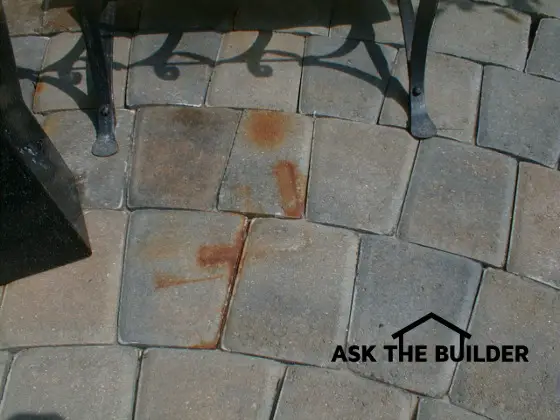
This rust can be removed with oxalic acid. © 2017 Tim Carter
The rust stains are somewhat easy to remove. The first thing to do is to remove the offending furniture from the surfaces and repaint them so there is no exposed metal. I love to use special metal primers that contain zinc or zinc-chromate pigments.
These are often hard to find because the metals are considered to be toxic. If these primers are unavailable, go to a real paint store and ask them for their best rust-preventative metal primer.
I happen to like a wonderful spray paint that's got both the primer and finish paint in one. I've seen the actual lab samples where the paint is exposed to accelerated salt-fog testing and it outperforms all other consumer paints.
It's X-O Rust Professional spray paint.
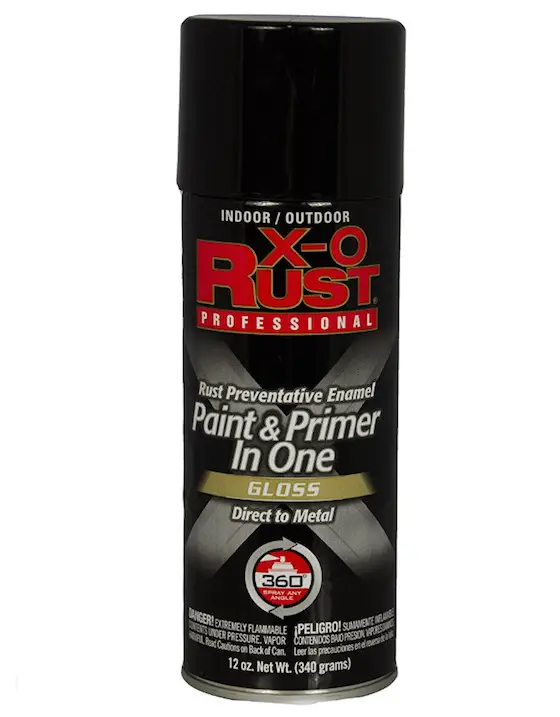
Here's a spray paint that's great for steel beams and columns. It contains a metal primer. This brand also is available in quart or gallon cans if you have LOTS of steel to paint. CLICK THE IMAGE TO ORDER IT NOW.
Follow the directions on the paint can label and then apply the paint as directed.
If you use a traditional primer, always apply the finish paint the instant the primer says it can be recoated. Doing this allows the primer and the finish paint to interlock chemically and mechanically for an excellent bond.
CLICK HERE to get FREE & FAST BIDS from local handymen who can remove rust for you.
Buy Oxalic Acid!
You need to buy some oxalic acid to remove the rust stains. It is a crystalline toxic organic compound that is mixed with water.
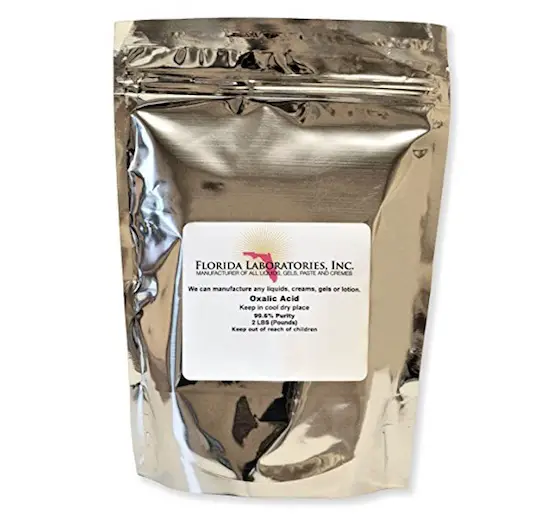
This is a bag of oxalic acid magic crystals. It's great for removing extractive chemical stains, especially on redwood. CLICK THE IMAGE NOW TO ORDER IT.
Commercial laundries often use oxalic acid to remove rust stains from fabrics and it will really work well as it chemically reacts with the iron oxide in the concrete. The iron oxide is put into solution with the acid and then simply rinses away.
Be careful using this acid and follow all instructions on the product label. It is a good idea to capture the runoff from the process as otherwise it may kill nearby plants and trees.
Repair Damaged Brick
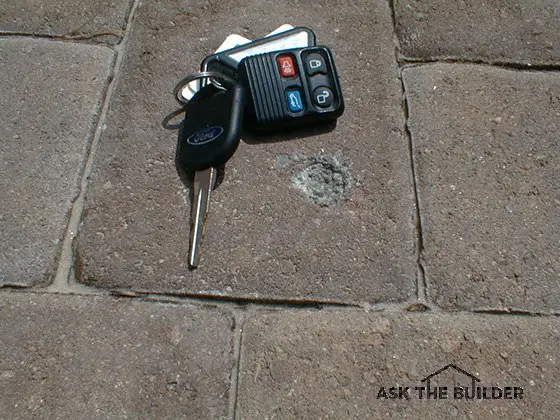
The hole in the brick reveals the different colored aggregate. © 2017 Tim Carter
The damaged brick can be repaired by using a coarse sand, Portland cement and a colored pigment powder that will colorize the patching material to match your existing brick. These colored pigments that are added to the sand and cement can often be purchased at brick yards. Brick masons use these same pigments to color mortar.
You'll probably have to mix several different batches and make test samples to get a perfect color match. The mixture always dries lighter than when it is wet, so don't fret once you have mixed the material. It can take up to 30 or even 45 days for the samples to cure to a finished color.
Replace Paving Brick
The best way to repair damaged concrete paving brick is to simply replace the damaged brick with a stored one. I hope that your installer left behind extra paving brick of all the sizes and colors within your patios. Better yet, these brick should be stored outdoors in an out-of-the-way location where they weather at the same rate as the patio brick. This way when it is time to replace a brick, it is an exact match.
If you are forced to buy new brick that do not match in color, you can accelerate the weathering process to make them match your existing pavers. Simply mix some muriatic acid with water - one part acid to ten parts water - and start to dissolve the colored cement paste from the top surface of the brick. Do this carefully and make sure the brick completely dries so you see how much cement paste you have etched away with the acid solution.
Work Like a Dentist
The key to long-lasting repairs in the brick is to ensure the patch is keyed into the brick. Typically most holes that occur are smaller at the bottom of the hole than the top area or outline of the hole. The resulting hole is similar in shape to an ice cream cone. If you simply install patching compound, frost action can pop the patching material out of the hole with ease.
If you carefully chisel the sides of the hole so that the bottom is larger than the top, the patching material will not pop out. This is how dentists put a filling in a tooth.
You can also achieve the same results by using a small rotary hammer drill bit to drill angled holes at the base of the defect. These holes should mimic tree roots that angle out away from the base of a tree. When the patching compound is packed into the hole, it enters these small tubes and permanently roots the patching compound to the brick!
CLICK HERE to get FREE & FAST BIDS from local handymen who can remove rust for you.
Column 527

Tim built custom homes and did ultra-custom remodeling for 20+ years before launching his Ask the Builder media presence. He was selected as one of the Big 50 by Remodeling magazine in 1993. This award gave birth to Ask the Builder in October 1993. Tim also operates https://DrawPlumbingPlans.com. His @askthebuilder YouTube channel was the first home improvement channel on YouTube.