Hurricane Katrina
Hurricane Katrina Ground Zero Waveland, MS
Author's Note: More photos of Katrina-damaged houses in New Orleans here.
On New Year's Day 2007, my youngest daughter Kelly and I packed ourselves and some luggage into our car and headed off to New Orleans, LA . We had tickets to attend the Sugar Bowl game. We left a day early so we could tour New Orleans and the surrounding countryside to see Hurricane Katrina damage. It never crossed my mind that my 14-year-old daughter would utter one simple sentence in a moment of frustration that would forever change how I look at my own home and all the people, pets, and things that are inside it.
Sixteen months had passed since the monster storm had plundered New Orleans and points east, so surely cleanup and rebuilding efforts had healed the scars from Hurricane Katrina. Well, you know what happens when you assume something. On the second day of our drive, we followed Interstate Routes 59 and 10 from the north towards the Big Easy. Just after crossing the border between Mississippi and Louisiana, signs of Katrina were everywhere.
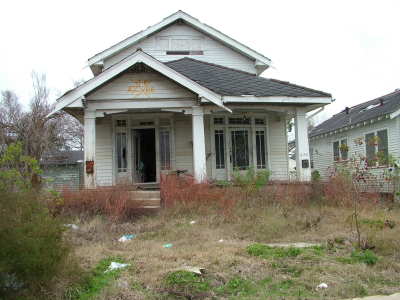
This is one of thousands of vacant homes in the city of New Orleans. Rebuilding is happening in some neighborhoods, but houses like these far outnumber those being rebuilt. PHOTO CREDIT: Tim Carter
Still many miles from the French Quarter, twisted and snapped trees, empty storefronts, piles of debris and drapes fluttering out of open windows was the "Welcome to New Orleans" sign that whispered to Kelly and I we had arrived on a desecrated part of the Gulf Coast. How, after these many months, could all of this damage still be visible? Why wasn't it being cleaned up? Where were all of the workers trying to breathe life back into the outer edges of this historic city? The answers would come the next day.
Deserted Lakeview
"You want to see a hard-hit area, go to Lakeview. It's off Interstate 10 just before the airport. Drive down any street," said Bill Kingman, a friend of mine who acted as our guide on the first day of our arrival. Bill, a resident of New Orleans for the past 22 years, was in Iraq when Katrina hit, and his home missed being flooded by just inches. But he had many friends and neighbors who had lost everything. Bill told us all sorts of tales about the storm as we walked through the seemingly untouched French Quarter.
Dawn broke with a steely gray on our second day in New Orleans. Since the Sugar Bowl game kickoff was not until 7:30 p.m., Kelly and I had the better part of a day to tour the city, and do some shopping. "Let's go take some Hurricane Katrina pictures, " I said after eating breakfast. Kelly sighed, shrugged her shoulders and murmured, "Okay." No doubt I am pretty out of touch with the top ten things a 14-year-old girl wants to do while visiting New Orleans.
The suburb of Lakeview was less than a ten-minute drive from our hotel on the edge of the French Quarter. Getting off the expressway ramp, I immediately sensed something was wrong. There was some traffic on the Clearview Parkway, but the streets that branched off this main thoroughfare were deserted.
For Sale signs stood guard over house after house that had windows missing, doors open and the spray-painted tattoos left by the search teams looking for survivors or those less fortunate. Each damaged house also bore the indelible black ring marking the high-water line as well as secondary rings recording the slow recession of the murky brew as it was pumped back to the sea.
Going to Ground Zero
After taking several Hurricane Katrina photos of this aftermath, I was pulled by the invisible force of curiosity to where the wicked beast had made landfall. I needed to see exactly where the center of the vortex smashed into the coast. Kelly and I pointed the car to the east and set our sights on Waveland, MS.
An hour or so later we entered the town limits of Waveland, MS, a small hamlet on US Route 90. There was a small sign that pointed to the Waveland Beach. Perfect. That's exactly where I wanted to go. Kelly and I turned down the small road and couldn't see the beach at all. No wonder, we were well over a mile or more away.
But as Kelly and I crept south towards the water's edge, we did see concrete slabs at the end of deserted driveways on either side of this small road. Fifty and sixty-foot-tall pine trees with trunks as large as 55-gallon drums were snapped in two like dried twigs. The remaining trunks were poking up out of the sand about 15 or 20 feet. Katrina's fierce storm surge had reached that high, and the howling wind and crashing waves must have snapped off the tops of the trees above the water line.
The damage and destruction kept getting worse as we got closer to the beach. Mother Nature had decided to wipe away all traces of habitation of the land. She decided she wanted the Waveland area to be like it was 400 years ago. She almost achieved perfection.

This is the deserted beach at Waveland, MS.
When we arrived at the end of the road at the beach, there was a large sign warning people to not go into the water. The sign mentioned sharp metal fragments, broken glass, etc. that would slice your feet and legs like a brand-new razor. Trust me, I had no inclination to wade in the Gulf of Mexico.
There was an eerie silence wrapped around us. All you could hear was the gentle lapping of the salt water as it tried to cleanse the beach area of all the debris. That, no doubt, would take many decades without help from us.

This is all that's left of the Gardfield Ladner Memorial Pier in Waveland, MS.
I stood in awe of the enormous power of Katrina.
Kelly finally spoke up, "Dad, I don't get it. There's nothing here. Why in the world did you want to drive an hour to see nothing?"
The first thought that crossed my mind was, "That's exactly why I wanted to come here. To see how a hurricane takes something and churns it into NOTHING.
I said that to Kelly and took a few more photos.
We got back in the car and drove in silence all the way back to New Orleans.
If you live in the path of a hurricane that's going to produce a record storm surge like Katrina, you need to evacuate. Hurricanes are just like the Game of Thrones.
When you play the Game of Hurricane, you win or you die. There is no middle ground.
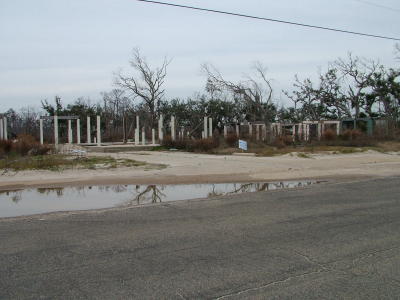
This was some building just back from the beach in Waveland, MS. All that's left are concrete piers and the building slab. Copyright 2007 Tim Carter All Rights Reserved

Tim built custom homes and did ultra-custom remodeling for 20+ years before launching his Ask the Builder media presence. He was selected as one of the Big 50 by Remodeling magazine in 1993. This award gave birth to Ask the Builder in October 1993. Tim also operates https://DrawPlumbingPlans.com. His @askthebuilder YouTube channel was the first home improvement channel on YouTube.
Tim,
Thanks for sharing. Just another reason why I won't move to Florida or the Gulf Coast.
We had family in Gulf Breeze, FL, just below Pensacola. Katrina hit Thursday and we drove from Elm Grove, WI arriving Saturday PM. I could not believe the devastation. There literally were chunks of houses on the golf course fairways. At the end of one fairway were two houses that seemed to have received relatively damage...a few siding boards, shingles missing, etc. As I got closer I realized that there originally was a house between the two that was completely gone..without a trace. Unbelieveable!
I live in Vero Beach, FL and am waiting for Milton to make his trip across the state. Copious amounts of rain today along with tornados all around us. I've been through a lot of these things since arriving here as a kid in '62. It looks like Milton has melted a tad will see what he offers up in a few hours. But enough is enough, the Wife and I are leaving hurricanes and the coconut telegraph in our rear view mirror as we re-locate to Las Vegas!
I visited N'awlins the year before Katrina, and stood on the levee with the river on one side and the poor side of town down below me on the other. I thought, maybe these folks don't believe in climate change because a few feet of surge is going to drown the town.
In Tampa, if Helene didn't convince them, Milton will. (Wednesday, 10/9)