Drywall Repair
DEAR TIM: My testosterone-filled son was practicing some self-defense punches, and now I am left with a pesky drywall repair. Should I go look at the drywall repair kits, or is there a better way? I can't afford to hire any of the drywall repair services. Can you teach me how to repair drywall? Cindy R., Racine, WI
DEAR CINDY: Drywall patching and repair is not a difficult job. In my opinion, this is what I would have an apprentice drywall finisher do for the first week if I were in charge of training. The steps required to repair drywall are few and not too challenging.
If I had a dollar for every drywall repair kit I have seen at the various conventions I attend, I would be a very rich man. Many of these drywall repair kits are wonderful, and a few border on genius. I have always liked the one that was a thin perforated piece of aluminum. It had adhesive on one side. You peeled off a layer of protective paper, stuck the metal over the gaping hole making sure the edges of the metal lapped over solid drywall at least one-half inch and you were 80% finished!
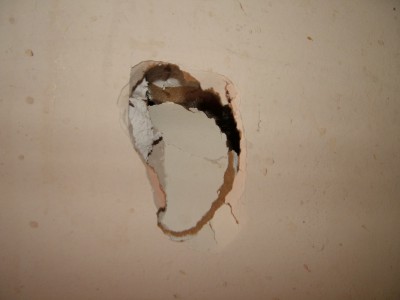
This nasty-looking hole in the drywall can be completely repaired in three hours or less with the right products. PHOTO CREDIT: Tim Carter
All that was left to do was cover the metal with two coats of drywall topping compound. The first coat would ooze through the holes and once dry would make the flimsy metal patch quite stiff.
But as much as I am smitten with many of the drywall repair kits, I usually prefer to do drywall repair using a small piece of drywall. This ensures there is a solid piece of drywall where there was moments before a hole. Be aware that there are many ways to do drywall repair using a small piece of drywall, but the method I am about to describe has never failed me.
Start the job by trying to rip out the dangling piece or pieces of drywall from the hole. Then carefully insert your finger into the hole trying to probe and feel if there are any pipes or wires behind the drywall.
Assuming there are no wires and pipes in the way, you now need to use a pointed drywall saw that resembles the spear on a sailfish. Create a square or rectangular hole using this saw. The hole should be at least 3 inches wide and at least 3 inches tall.
Column 702

Tim built custom homes and did ultra-custom remodeling for 20+ years before launching his Ask the Builder media presence. He was selected as one of the Big 50 by Remodeling magazine in 1993. This award gave birth to Ask the Builder in October 1993. Tim also operates https://DrawPlumbingPlans.com. His @askthebuilder YouTube channel was the first home improvement channel on YouTube.
Your article on drywall was informative as far as it goes. I have a condo in Mn where in every room there are areas of paint crackling. My handyman has been scraping & patching these, The bldg. was built in 1978. It was a foreclosure . What causes this?