Fireplace Design & Dimensions
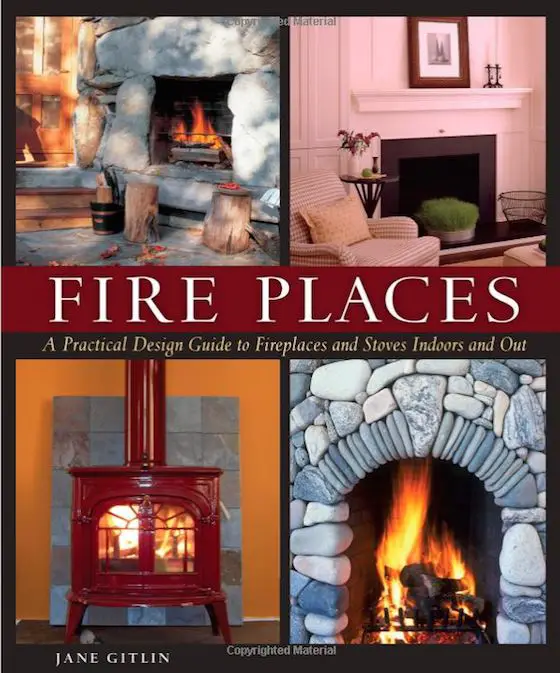
Fireplace design details can be found in this amazing book. CLICK THIS IMAGE TO GET INSPIRATIONAL PHOTOS of GREAT FIREPLACES.
"Fireplace design details do not stop on the front face of the fireplace. The firebox must be shaped and sized perfectly so it doesn't smoke."
Revised September 2018 and featured in the September 30, 2018 AsktheBuilder Newsletter.
Be sure to check Tim's (not the AsktheBuilder one) smoking fireplace, featured in the January 31, 2021 Newsletter and his email in the Fix Smoking Fireplace - You May Have to Start Over.
Fireplace Design Details Checklist
- Sides of firebox must pinch in towards back
- Back wall of fireplace must be straight up for first 12 inches
- Back wall must slope towards front for remainder of height
- Width and height of opening MUST come from table below
- Smoke shelf up above fireplace must be sized correctly - see below
CLICK HERE to get FREE & FAST BIDS from local masons to build your new fireplace.
Why Does a Fireplace Smoke?
A fireplace will puff smoke into a room if its design is flawed. The physics of smoke rising into a chimney is complex and several things must be done right so all the smoke from the fire exits your home.
It's important to realize there are three aspects of fireplace design you should be concerned about. The first is the inner shape and design of the firebox where the fire burns (firebox), the hidden smoke shelf area above the firebox, and the flue that rises up and through the roof.
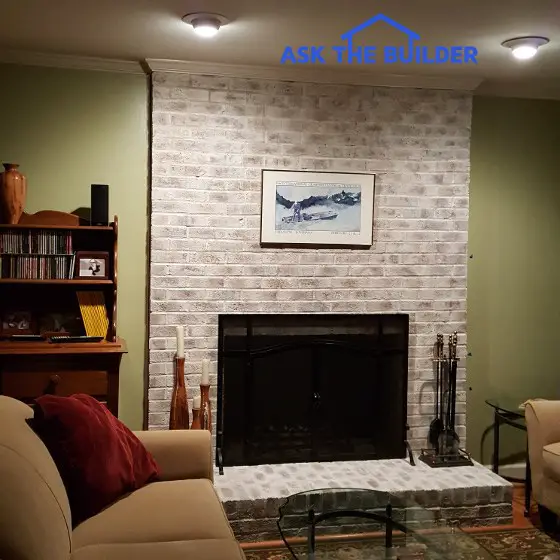
Here's the fireplace once finished. Maggie and her daughter did a magnificent job and the hydrated lime will look this good for decades. Copyright 2017 Tim Carter
All three of these things MUST BE done correctly or your fireplace will send billowing smoke into your home. All you need to know is below.
Is Stone the Best Fireplace Material?
Stone fireplaces can be very durable. Granite and many other dense stones can make a gorgeous outer face of your fireplace. Here's one I saw in Southwest Harbor, Maine.
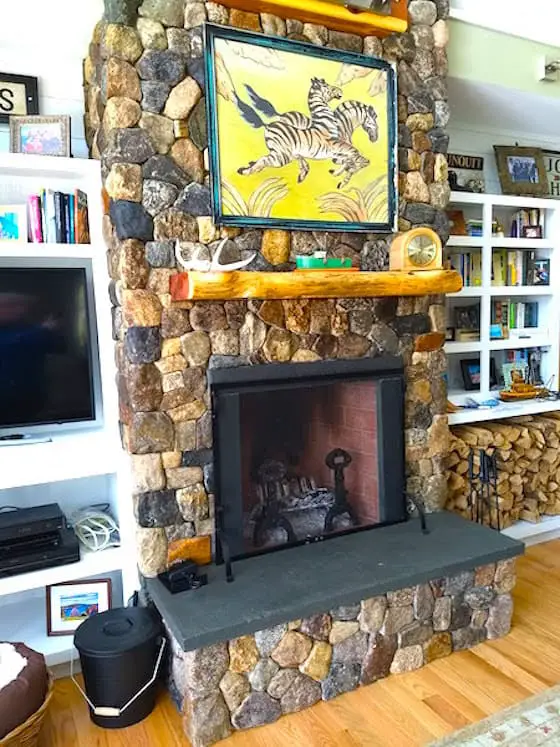
This is a stunning fireplace made with real stone. The colors of the stones really make it visually attractive. The mason did a magnificent job of shaping the stones so they fit like pieces of a jigsaw puzzle. Copyright 2018 Tim Carter
The second design consideration is what the fireplace looks like to those who look at it while in the room. If you need inspiration and want to see stunning photos of some fantastic fireplaces, then order Fire Places: A Practical Design Guide for Fireplaces and Stoves
Related Links
How To Build a Smoke-Free Fireplace
Fireplace Design Basics - IMPORTANT TIPS HERE
Where is Free Fireplace Design Literature?
The Brick Industry Association has three excellent pamphlets about fireplace and chimney design and construction. I recommend you read these three things:
#19 Residential Fireplace Design
#19A Residential Fireplaces, Details and Construction
#19B Residential Chimney Design
Watch this short video to see properly sloped firebox brick:
CLICK HERE to get FREE & FAST BIDS from local masons to build your new fireplace.
What are the Best Fireplace Design Dimensions?
The best fireplace design dimensions are the ones that ensure your fireplace will not smoke. The Brick Industry Association is perhaps the most respected source of fireplace design criteria in the world.
Be sure your mason builds your fireplace according to the values in the following table. All the data is courtesy of the Brick Industry Association.
.
| Fireplace Opening Width | 24" | 28" | 32" | 36" | 40" | 42" | 48" | 54" |
| Fireplace Opening Height | 24" | 24" | 29" | 29" | 29" | 32" | 32" | 37" |
| Firebox Depth* See Note Below | 16" | 16" | 16" | 16" | 16" | 16" | 18" | 20" |
| Rear Firebox Width | 11" | 15" | 19" | 23" | 27" | 29" | 33" | 37" |
| Rear Firebox Vertical Height | 14" | 14" | 14" | 14" | 14" | 16" | 16" | 16" |
| Smoke Chamber Height | 19" | 21" | 24" | 27" | 29" | 32" | 37" | 45" |
| Throat Height | 8" | 8" | 8" | 8" | 8" | 8" | 8" | 8" |
| Nominal Flue Size | 8x12" | 8x12" | 12x12" | 12x12" | 12x16" | 12x16" | 12x16" | 16x16" |
| Minimum Chimney Height | 18' | 22' | 19' | 21' | 15' | 19' | 23' | 23' |
*Note: The firebox depth does not include the thickness of the facing material you see when looking at the fireplace.
The firebox design is critical. Here is a photo of a new masonry firebox in my own home. The rear wall of the firebox rises vertically from the floor of the fireplace and then begins to slant towards the fireplace opening just at the top of the gas logs. The sidewalls of the firebox are vertical. Note that the firebox is not the same width front to back. It gets narrower towards the rear of the firebox!
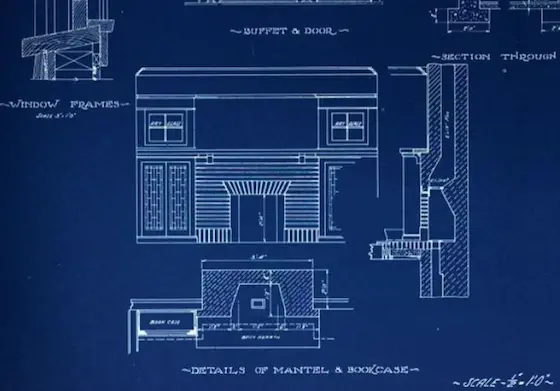
This blueprint is nearly 100 years old. The architect knew EXACTLY how to design the fireplace, chimney, and firebox so it would NOT SMOKE. Use this as your North Star.
Can You Mix and Match Flue Sizes With Chimney Heights?
You can mix and match flue sizes with chimney heights. To properly size a flue, you must use a Nomograph.
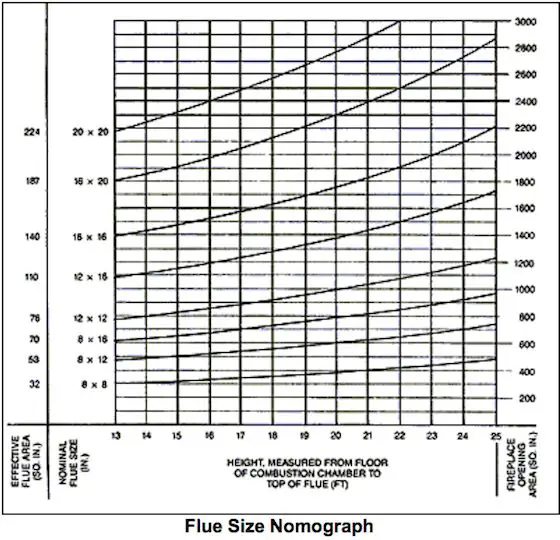
This is a wonderful flue-sizing tool. It's a Nomograph from the Brick Industry Association's Technical Notes #19. Copyright 2018 Brick Industry Association
What is the Best Flue Size?
It's always better to use the smaller flue size when you have two choices. When using the smaller flue size, you will be required to raise the height of the chimney.
Do Tall Chimneys Draw Better Than Short Ones?
Taller chimneys draw better than short chimneys of the same flue size.
Is the Smoke Chamber Height Critical?
The smoke chamber height and design are very critical. You generally can't see this space as it is hidden above your fireplace damper.
How High Up Should the Damper Be Above the Fireplace Opening?
The bottom of the damper should be a minimum of 8 inches above the top of the fireplace opening. This part of the fireplace is called the throat. If your damper is not at least 8 inches above this spot, you will have smoking problems for sure!
I urge you to read the pamphlets I have mentioned from the Brick Industry Association. They have excellent illustrations which will enable you to clearly see what I am trying to explain! The following table and its values are courtesy of the Brick Industry Association.
What is the Best Mortar for the Beige Fire Brick?
The best mortar for firebrick is fire clay. It's often called refractory cement and it rated for temperatures above 2,000 degrees F.
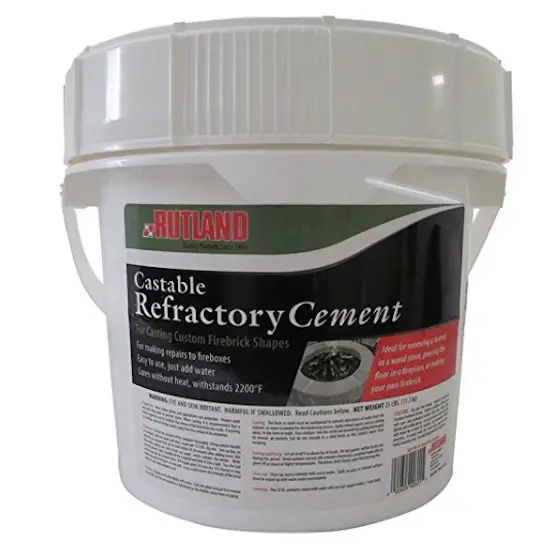
This is fire clay. It's a fine powder that you mix with water. CLICK THE TUB to have it delivered to your home in days.
Fire clay is a fine powder you mix with water to the consistency of gravy. You dip one edge of the firebrick into a pot of the wet fire clay to coat it. You don't want large wide joints. The joints between firebrick should be no greater than 3/32nds of an inch!
Column B110

Tim built custom homes and did ultra-custom remodeling for 20+ years before launching his Ask the Builder media presence. He was selected as one of the Big 50 by Remodeling magazine in 1993. This award gave birth to Ask the Builder in October 1993. Tim also operates https://DrawPlumbingPlans.com. His @askthebuilder YouTube channel was the first home improvement channel on YouTube.
Hi , i have a room (size 30ftx20 ft height 12ft ) i would loke to install chimney in the middle open all around , but i cant exit the hood direct from the roof . Can i open the hood from side ? what size of the exhaust is requested ? do you have material in brass?
thanks
Walid, you should consider investing in a 15-Minute Consult with me. Look at my cart for that. Lot's to discuss. I just do short pithy answers here.
I'm putting a mantle on my fireplace , how many inches do I need from the fireplace to the mantle ? On the hight and width ? Please help I know legally u required so many inches I'm just not sure how much .
I have a customer that wants a 48 inch damper. They want the opening to be 60 inches tall. The fireplace opens outdoors to patio. Is it possible to do this ? All research says that it cant be but 38 inches tall.
It may be possible. You need to order a 15-Minute Consult from me. Much to discuss.
my house (and fireplace) was built in 1923, it has a 8X8 flue and the fireplace opening is 29 high x 42.5 wide and I set off my smoke detector every time I use the fire place. (18 deep and sides tapper to the back). I grew up around wood stoves and fireplaces but can not get this this to not smoke ( I use paper to start a draft, wood is now 2 years old, smokes using kiln dried oak boards) Based on the table from your website , do I need to reduce the opening to stop the smoking? and if so how.
Sheldon,
Read all my past columns about the shape and sizes of fireboxes, smoke shelves, flue sizes in relationship to fireplace size, etc. and then determine if your fireplace was doomed from day one.
The mason's rule of thumb for your flue is it needs to be at least a 10% ratio of the opening of your fireplace: 29 x 42.5 = 1233 (10% is 123) Your flue is an 8 x 8 =64 than 123.
You require a draft inducer or power vent fan that is designed to be installed at the top of your chimney & flue; and runs off electricity. Would be cheaper to order one yourself and hire an electrician to install and run control switch to fireplace room --may need another contractor or sweep to install on top; expect to spend at least $1500 for reasonable combined costs.?.
I've been a custom FP professional for 15 years and am telling you this is about your only solution.
Hi,
I have to replace doors on the wood-burning fireplace.
The opening in the wall is 25.5" x 36.5"
What door format fits in this : small, medium or large (I'm a bit puzzled by the fact that actually any of the doors size specs available eg. from the LOWE's can fit that opening).
Thank you for your time and consideration,
I have a fireplace that is 34"H X 28"W with an 8" diameter flu liner. My chimney is 30' tall. This fireplace is in a room that is 16' X 16' with a door (my den) .. The liner is brand new ... The chimney has a cap on it that sits about 18' off of the top of the chimney...
I started a fire the first time today in the fireplace after seventeen years... I have been refurbishing an old house that was built in 1750... The fireplace was the first thing that I had a contractor work on about 15years ago... The flu is a masonary liner that was poured inside of the chimney..
The chimney smoked ??? Any suggestions ?? I opened two windows to allow for make up air.... I decreased the opening height by about four inches... The only thing other thing that I have not tried is to raise the height of the fire box by putting fire bricks in the bottom ...
I have waited to have a fire in this den for 17 years hope you can help..
God bless
Denny
Yes I can help. Please READ all my columns about fireplace design and look at the tables about measurements with respect to all aspects of the shape and size of the fireplace. Pay attention to what I discuss about smoke shelves. Flue size is also important. They have to be perfectly sized. Fireplaces are very complex.
I'm building a masonary fireplace and I would like to have an opening of 48" wide x 48" tall. What would the remaining dimensions be? ( depth, rear wall width, rear wall vertical height, etc.....)
Well, use the table I provided. You CAN'T have a square opening.... READ ALL of my columns about Fireplace Design, Fireplace Smoking, etc.
We are renovating a large floor to ceiling brick fireplace that overwhelms our small family room. Plan to remove the brick and reface with smooth finish/tile. We'd like to reduce the size of the fireplace opening (currently 25" tall x 40" wide to 20" tall. We do not want to put in gas insert. Fireplace is masonry w gas/gas logs.
Is it possible to reduce the size of the fireplace opening?
Thank you.
We have a wood burning fireplace in a new home. When I try and light a fire, there is air blowing down the flu and the smoke goes back into the house. Someone has told me that this is called negative pressure. Once the fire is lit and gets the flu hot it will burn. I have tried opening a door when lighting the fire but it doesn't help. When the home was being constructed, the builder added a finished 3rd floor to our home and the top of the chimney is lower than the floor on the finished 3rd floor making finished area higher than the top of the chimney. My question is: Does the top of the chimney need to go higher than the fished area on the 3rd floor?
I have a very large fireplace. The opening is presently 52" wide, and the thing doesn't draft well at all. I would like to rebrick that opening down to 42" wide so I can install off the shelf, rather than custom, doors. It's a 2 story house, and the chimney is about 30' tall. Thoughts?
Yes. My thoughts are for you to go back up and read this column and look at the table that shows you all the relative sizes based on the opening. Just do what I say in the column and the smoke will go up the chimney.
Is it normal construction to have a built in Prefab Fireplace, with Metal Sides and Refractory Panels for the Bottom and Back?
want to add depth to an existing fireplace to align it with bookcases on either side. The additional depth might be 8" or so. I could angle the new masonry clad walls back to the fireplace, but would this affect the draft?
My girlfriend is set on getting a fireplace. She wants to put it in the middle of our livingroom which happens to be the middle wall of the double wide. Is it safe or even possible to put a fireplace in the middle of the house?
About how much would it cost to get the fireplace put in and the vent out the roof?
I have a wood burning fireplace with 36"x30" opening and metal firebox inside of it,
And I want to install lp gas insert that requires opening Niger then the existing opening
What's the procedure to accomplish that?
I need all the size measurements to build a good fireplace ...Regards
Tim,
is it possible to consult with you? I have 2 fire places in a home my wife and i recently bought. One leaks water into the firebox fairly heavily when it rains. This unit down drafts heavily when cold and is an exterior chimney it fills the home with a burnt wood smell. This unit and the other unit both spill smoke when burning a fire. Looke at the damper and the bottom flat area of the damper is only 3 inches above both fireplace openings. Pleas advise what details would be needed prior to your consult and the fee associated with your time.
Thank You
Frankie
I have a wall unit that is a veneer wood with a resin finish, but I would like to install an electric fireplace?
The dimensions of the opining for the fireplace on my wall unit is 19"wide by 16 3/4 tall.
Is this possible to do and How?
Hi Tim
My office is in an old building and our landlords are allowing us to restore the fireplace. We've run a 6" round metal flue down the brick chimney cavity. We're now designing a metal firebox, but I'm unsure about what size opening we'll need to make sure it works well. Is there a fast answer for this question?
Looking forward to hearing back.
Brennan
I have a fireplace with lousy draw, smoke rolls out the face rendering un usable.
Fireplace Opening Width 30"
Rear Firebox Width 29"
Rear Firebox Wall Vertical Height 29"
Nominal Flue Size, opening at top flange sheet metal. 13 1/2" X 4 1/4"
Minimum Chimney Height 24"
Hi, What are the 2 most common (standard) size fireplace fue?
I bought a home with a sunken in living room I plan to fill it in but there is a fireplace in the rooi will be filling in with cement 6 inches can I add cement up to the fireplace size of fire place opening 36 inches wide by 30inches tall
You can do whatever you want. But if you mess with the dimensions of the fireplace opening by RAISING the bottom of the fireplace, don't be surprised if the fireplace smokes.
Hi Tim,
I am trying to rework an old fireplace that smokes out a lot and make it usable. Dimensions for fireplace are way off the charts and its size needs to be scaled down. Before doing that I want to check if is even possible to make fireplace which will work fine with chimney size that I have. It is 3.8 m (12.47 feet) long and its inner clearance is 25cmx25cm. I could not fit it somewhere in the charts that are given. Is it possible for fireplace to function well with chimney that short? longing the chimney for additional 7 or 8 feet is not an option for me and I will abandon the restoration process if this the case.
Do you also maybe know how elevation can affect the fireplace performance due to changes in pressure? My cottage in which this fireplace was built is around 1100 meters above sea level.
Sorry about my bad use of technical expressions in this question. English is not my first language.
Thanks,
Best regards,
Djordje
I currently built a standard firebox everthing is square inside dimensions are 27x27 customer was worried about the heigth being no more than 5 fe
My fireplace is 54” wide x 49” high, and 21” deep. After we burn a fire, if we let the ash lay there it smells really bad. Any idea why this is?
When you compared your dimensions to those in the table above, what did you discover?????
I am building a house in Italy where I live and they are notorious for having their fireplaces smoke. I already have the chimney in place and the aluminium flu is in place but have not yet chosen the fireplace. when i do can i have a consult on the exact sizing of the inside and what to do? Please advise
David,
It's all pretty clear in the above column. Look at the sizing table.
If you're buying a pre-made metal fireplace, it should have the correct smoke chamber, etc.
If you have Skype or Google Hangouts we can do a trans-oceanic consult. You set it up here:
http://shop.askthebuilder.com/products/15-Minute-Phone-Conversation-with-Tim.html
I am building a new house with a wood burning double sided fireplace, open to two rooms. Do I still use the chart for dimensions?
Thank you
Yes, you use the same dimensions.
Tim, i am building 2 fireplaces and using antique mantles. Firebox 1 is 45" wide and 30" high. Firebox 2 is 39" wide and 33" high. Both flues are slightly over 20 feet. I think depth of 20", throat 8" above lintel, and12 x 16 flue liners will be best for both. Box 1 - I'm thinking rear width of 29"and Box 2 - I think rear width of 27".
How do I figure throat size and smoke chamber height and depth? Can you help? Thanks, Mac
Everything you need to do the calculations is in the column above.
Hi, My exterior fireplace has an interior box opening of 40" deep x 43 " wide x 40" height. The exterior chimney and fireplace height it 8'. I am unable to go any higher on the chimney. The wind comes from the back to front of the fireplace thus there is very little smoke drawn up the flu. Would it help to purchase an Anti Downdraft Chimney Cowl?
Are the dimensions above for wood burning? I want to have an outdoor gas fireplace with an opening width of 48" and a much shorter chimney that is perhaps no more than 8 feet tall. Is that possible? It will have a 100k BTU pipe. Someone suggested a 60k BTU burner with key valve and 12"x12" rain cap.
Hi,
My cheminey only smokes when it is windy outside.
I will get a mason to put a chimney pot on top of the chimney to reduce downwards draughts.
Should the the pot be as tall as possible and which type is best?
( Btw, I work in metrics...)
Thanks.
Can i make the firebox opening 4' wide and 42" high with a 13x18 flue?
How high can up make the opening of firebox with a width of 48"
Hi there;
We are building a new home and are currently shopping for an appropriate modern rectangular gas fireplace. The width of the area to place the fireplace is about 72 inches. How large should the fireplace be?
(ie how much space is appropriate on either side if the insert? Thanks.
For an existing firebox that doesn’t draw well, is it best to decrease the width or the height of the fireplace opening?
I am wondering if you know any fireplace design that the height of the firebox is taller than the width other than the Rumford fireplace.