Thickness of Poured Concrete Foundation Walls
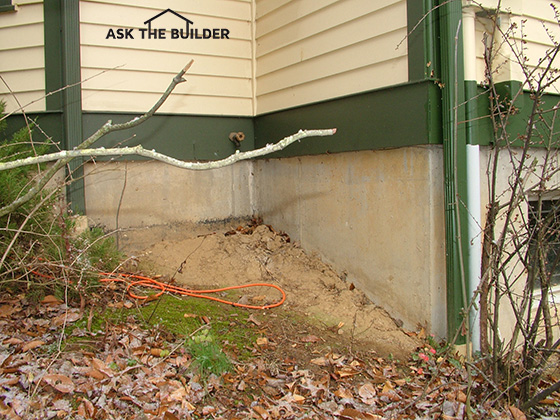
The thickness of the foundation walls you are looking at are not the same. The wall below and the one to the left of the hose bib faucet are only 8 inches thick. The other walls are 10 inches thick even though there is less soil pressing against them. Why? The 8 inch thick walls are very short and they form part of half an octagon that creates a vast amount of strength. The thicker wall is straight and runs nearly 40 feet from the corner where you see the downspout. © 2017 Tim Carter
Thickness of Poured Concrete Foundation Walls TIPS
- 8 inches is minimum
- 10 inches thick on walls taller than 8 feet
- Higher PSI for extra strength
- Exceed code requirements
- CLICK HERE to Get Tim's FREE & FUNNY Newsletter!
DEAR TIM: How thick should a poured concrete foundation wall be? Is it a function of the size of the house? Bob McKnight, Hagerstown, MD
DEAR BOB: The answer, although fairly intuitive, is not as crystal clear as you might think. As a poured concrete wall gets taller, it needs to be thicker. But there are many other variables that control the thickness of the wall.
A structural engineer would consider lateral loads as well as loads from the structure above. Even concentrated loads from columns and beam pockets within a wall must be considered.
Really A Retaining Wall
To help visualize what is really happening with foundation walls, especially those that are buried in the ground, think about simple retaining walls.
Perhaps you have seen a retaining wall that has tipped over, was leaning or has cracked. The soil on the other side of a basement wall exerts a powerful force and this needs to be taken into consideration when designing and building a foundation wall.
Add Steel
To add further confusion, you also have to factor in reinforcing steel. Steel bars that are incorporated into poured concrete add enormous strength to the wall system. The placement of the steel is critical depending upon how you are trying to strengthen the wall.
Huge Soil Pressure
For example, if soil loads are significant and a house is built into a hillside, vertical reinforcing steel is a must. The pressure of the soil creeping down the hill can cause a foundation wall to develop a horizontal crack much like when you snap a saltine cracker in half with your fingers.
Vertical steel bars of a given thickness spaced a distinct distance apart and placed at a precise place within the wall can help ensure the wall will not fail. Structural engineers know exactly where the steel needs to be and how much to include.
Recommendations
There are some basic rules of thumb for foundation wall thickness and these are outlined in many modern building codes. Poured concrete foundation walls that are less than 8 feet tall and have soil outside that is 6 or 7 feet deep against the wall can often be 8 inches thick and function quite well.
As soon as you go higher or have greater depths of soil pushing against the wall, you need to increase the thickness to 10 inches.
Pilasters / Buttresses
You may even have to put in pilasters or buttresses to strengthen long, tall walls. A pilaster is a thickened part of a wall in a short distance.
For example, a 10-inch thick wall may all of a sudden thicken to 16 inches for just a foot or so. That's a pilaster.
A buttress is a short stub wall that extends inside the perimeter of the foundation. It might be 3 or 4-feet long. It does the same job as a beam would do under a floor joist.
High-Strength Concrete
Don't forget that the concrete comes in different strengths depending upon how much cement is added at the ready-mix plant. I would use a minimum mix of 3,500 pounds per square inch(psi) mix. You can upgrade to 4,000 psi concrete if you desire, but I would only do this if it was specified by the structural engineer.
One last point: Remember that the specifications in the building code are minimum standards. You can always improve upon the guidelines you see in the code.
Column N4

Tim built custom homes and did ultra-custom remodeling for 20+ years before launching his Ask the Builder media presence. He was selected as one of the Big 50 by Remodeling magazine in 1993. This award gave birth to Ask the Builder in October 1993. Tim also operates https://DrawPlumbingPlans.com. His @askthebuilder YouTube channel was the first home improvement channel on YouTube.
What would be the requirement for wall thickness of a cellar floor having 7 feet gravel at the sides. ( cellar is 7 feet down and remaining 2.5 feet above ground ) . The soil sarounding cellar is very hard natural rock type strong gravel . There is no extra pressure coming from the sides. The red stone earth at the cellar wall is used for constructing walls. I am planning to use steel reinforced concrete for 7 feet height. What would be the required thickness of wall . The soil is so hard and no chances for water coming to location. Please suggest .
regards,
suresh
Suresh, your question require lots of typing and I have some questions for you. You should consider investing in a 15-Minute Consult with me. Look at my cart for that. Lot's to discuss. I just do short pithy answers here.
The site had all the answers I needed . Very informative. Thanks tim
Only the beams are projected out 6ft in a RCC building.Then comes the reinforced concrete wall which is 60 ft high. This wall is hooked onto the edge of the projected beams at all floors. This creates a 6 ft gap between the building and the wall. How thick should be the wall?
This was one of the most informative answers I've ever read on any topic online and we are talking quite a bit of info. Im an IT Network Engineer so Ive read a few topics over the past 20yrs. Thanks, I feel much better about cutting a 3'x 9-10' section out of my basement wall now to add a single car garage door. No worries, it will be supported and reinforced with laminate header & posts. Plus the builder will be on hand to ensure we have good structural support.
This has been really useful as I am looking at constructing a basement within a barn (built 1870 on Thanet beds, essentially siltstone) prior to conversion when I have a single large. The basement will be inset by a couple of feet so walls are not undermined. My structural surveyor has been talking about 1 meter thickness of concrete, 750mm at minimum! This seems an incredible amount of concrete, he also wants it reinforced. Any thoughts? I'm going down about 3 meters and effectively making a box with a concrete roof/floor
I am wanting to have a basement under a modular home with a 4 inch brick ledge. What thickness does the wall have to be?
I’m looking to lift an old 2 story farmhouse, demo existing basement walls and floor, then construct a new walkout basementto sit the home back on. Would be 3 poured walls and a framed wall on the walkout. I’m wanting 9’ finished ceilings in the new basement so I’m probably looking at close to 10’ tall poured walls. The (3) walls that are poured will have earth the first 7’ then potentially 3’ exposed. In your opinion 10” thick on the poured walls enough?
Good Morning
I want to build a retention wall between myself and the neighboring property, the reason is my property is at an elevated height (2 meters) and my neighbor has a bare farmland. The construction company recommended a concrete wall that is 1.20 Meters tall and 12 inches thick which is causing some concern with my neighbor. Would this be sufficient in your view?
soil depth against the wall is important to calculate, what if you have 7-8ft of soil plus a hillside 30ft off the house?
Hi Tim,
I am building a house on a slope and I think the foundation wall on the uphill end will need to be 14' tall and 40' long. How thick and how reinforced should it be?