Loretto Staircase
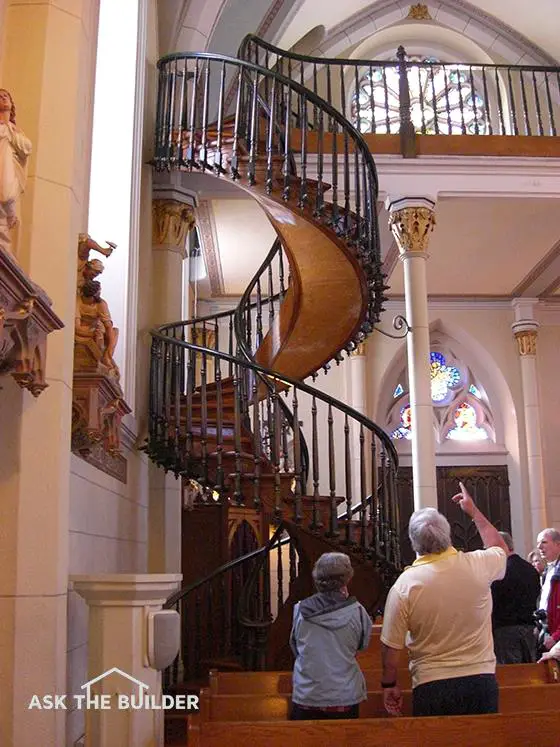
The owners of this staircase want you to believe it’s a miracle that it doesn’t collapse because of a lack of a visible support. Any carpenter worth his salt knows what’s holding it in place. ©2017 Tim Carter
"No one knows, or if they do, it's a closely guarded secret, who built this staircase.
Loretto Staircase Facts
- Well worth the visit and money to see
- Spiral stringers that support treads are just simple beams
- Design very common throughout Europe for centuries before
- Miracle man built it but using common engineering in your own home
- Go here to Get Tim's FREE & FUNNY Newsletter!
DEAR TIM: I recently was vacationing in Santa Fe, NM, and saw the Loretto Chapel staircase. It’s a beautiful wooden circular staircase thought to be constructed between 1877 and 1881 by an unknown carpenter.
There's no center support and nothing seems to be holding up this staircase but the will of God, or so promulgates the private owners of this building. Is the miraculous staircase in the Loretto Chapel just that, or is there a scientific explanation for why it’s not a pile of splinters on the chapel floor?
Michele B., Minneapolis, MN
DEAR MICHELE: I’ve also seen the Loretto Chapel spiral staircase in person.
Loretto Chapel Staircase - Work of Art
It’s a magnificent work of art, that humbles me, and I've done my fair share of finish carpentry, including installing several circular staircases. To create a staircase today like this using an assortment of power tools and modern hand tools would be a feat. But understand that extraordinary finish carpentry even more complex than this staircase was done without power tools and can be seen in European castles, the Vatican, and other famous government buildings. These were all built hundreds of years before the Loretto Staircase. It was all done by master carpenters with exceptional skill, talent, discipline, diligence, and determination.
Is it Really Possible To Build It Without Power Tools?
Yes, it's possible to build a circular staircase like this without power tools. It’s mind-boggling to think about constructing such a marvel with crude hand tools, no electricity, and minimal resources.
IMPORTANT NOTE: Nothing in this column is meant to question your faith about who built this magnificent staircase. The discussion that follows simply speaks to the regular engineering principals that everyday engineers and builders use to build things.
No one knows, or if they do, it's a closely guarded secret, who built this staircase. It's without question a magnificent example of finish carpentry that was done by other carpenters in Europe for hundreds of years before this staircase was built in the desert southwest of the USA by some mystical carpenter.
Related Links
Building Simple Stair Stringers
How Complex is the Staircase?
It's very complex to create a circular staircase.
But that doesn’t make it impossible, nor more complex or mystical than many other building and engineering masterpieces that are clearly visible in old structures around the world.
Another key point is there are countless examples of extraordinary workmanship like this scattered all over Europe in cathedrals, castles and royal residences like Versailles.
What Do the Owners of the Chapel Claim?
The current private owners of the Loretto Chapel state on their website:
“The stairway confounds architects, engineers and master craftsmen. It makes over two complete 360-degree turns, stands 20 feet tall and has no center support. It rests solely on its base and against the choir loft. The risers of the 33 steps are all of the same height. Made of an apparently extinct wood species, it was constructed with only square wooden pegs without glue or nails.”
Who are the Confounded Architects?
When I read that statement it makes me wonder if the owners of the Chapel have only talked to a handful of architects, engineers or master craftsmen or they didn’t listen closely when they talked. It’s painfully obvious to me that there's nothing miraculous holding this staircase in position.
Have the Owners of the Chapel Challenged Your Claims?
The owners of the Loretto Chapel have never reached out to me to challenge what you're about to read.
It’s important to realize the Loretto Chapel staircase is subject to the same laws of physics as any staircase in your own home, even if they’re not circular. Another key point is I'm quite certain the owners of the chapel have Google alerts set and knew about this article within a day of it being written.
What Secrets Did the Carpenter Possess?
The carpenter that built the Loretto Chapel staircase knew about the secrets of circular staircase construction that had been known for hundreds of years in Europe.
This will all make sense if you allow me to explain to you the basic structural components you might discover in your own home. The talented carpenter who built the Loretto Chapel miracle staircase just happened to know what I and a few others know about beams.
Can the Staircase Stand Up All Alone?
Yes, a balanced circular staircase can stand up on its own just like odd-shaped rocks stacked upon one another.
Here's an image taken from an online store that sells models of the exact same spiral staircase at the Loretto Chapel. Note how it's able to stand on its own and doesn't even connect to anything at the top. I explain how this is possible below.

What Supports the Staircase?
The twisted outer and inner rings of wood that hold up the stair treads are supporting the staircase.
If you live in a house with a wood floor system, the floor you walk on each day supports you. It doesn’t collapse under your weight, the weight of the furniture and any guests you may have during a large party.
The floor system is made up of joists and wood that covers the joists. The floor joists under your feet are beams not unlike steel I-beams in a skyscraper.
Are Floor Joists Parallel Beams?
Floor joists next to one another are just parallel beams. Most run parallel with one another on 16-inch centers. The joists are covered with plywood or other wood sheeting.
The joists rest on a foundation wall or sometimes another beam that rests on a foundation wall. The weight of the entire system and anything on it is transferred to the foundation by the joists.
Gravity is pulling everything towards the earth including this spiral staircase.
Can Two Joists Create a Narrow Floor?
Imagine if you had a narrow floor, meaning just two joists and you cover these with plywood. This would be very similar to a narrow footbridge.
You could walk across it and the platform or bridge would not collapse. Drop one end of this narrow platform to the ground leaving one end up on the foundation wall. The platform becomes a ramp.
Is a Staircase Just a Steep Ramp?
The normal staircase in your home is just like a steep ramp. Ho,wever the carpenter made flat steps or treads so you could climb it without slipping or sliding.
Do Most Staircases Have Two Beams?
A point often overlooked is a simple staircase has two beams, called stringers, and the treads of the staircase rest on these beams or are connected to them. The stair treads are no different than the wood that covers a flat floor.
When the carpenter set your steps in place, the weight of the staircase was transferred to the floor below where the two stringers touch the floor.
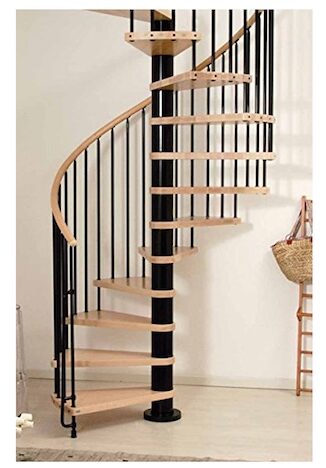
If you hit the lottery or have too much money, you can have a carpenter build you a spiral staircase like at the Loretto Chapel. Otherwise you'll be getting one like this. Go Here NOW TO ORDER THIS STAIRCASE.
Can Beams Be Twisted?
Yes, staircase beams can be twisted. The only difference with the staircase at the Loretto Chapel is these beams or stringers have been twisted into a helix. Think how a piece of licorice candy is a twisted stick. You can do the same thing with a piece of wet wood.
You can take a piece of flat wood, get it wet and then twist it. It's much easier to do this with thin pieces of wood.
Can a Paper Towel Tube Reveal the Stringer Secret?
To put it another way, just carefully cut apart the center cardboard core of a roll of paper towels along the glued seam. Stretch it and you'll recreate one of the spiral stringers you see on the Loretto Staircase.
Go one step further and flatten this piece of cardboard out and you'll see it's just a simple rectangle. No magic or miracles here unfortunately.
Is the Loretto Staircase a Miracle?
No, the staircase is not a miracle. I'm sorry to be the one to challenge your inner ideology.
If you took the staircase apart and just allowed the inner and outer stringers to stand there by themselves, they would do so like the flagpole just outdoors on the plaza, even though each stringer is made up of several pieces of wood glued and pegged together.
It’s that simple. For one thing, it’s not a miracle at all that the staircase is standing there in front of you and that it can support the weight of people climbing it.
Are the circumstances surrounding the construction of the staircase a miracle? Perhaps.
That's where your faith comes into play.
Who Is Shielding the Whole Truth?
This legend is being perpetuated by the owners of the chapel. The Loretto Chapel owners have a vested interest to make sure tourists come to see this masterpiece. They make significant money from couples that continue to get married in this magical building.
If the owners just told you that the staircase was just a regular staircase that was resting on the floor of the chapel and it was connected to the choir loft above like your staircase is built in your home, you’d might not part with your cash at the entrance to the chapel.
Is It Worth Seeing?
But please understand that it’s well worth the price to see it. I say this as a very modest carpenter who stands in awe of the man or men who worked together to build the staircase in the Loretto Chapel.
All things considered, if you're near Santa Fe, NM, I urge you to go to the chapel. In order to see what can be done with simple hand tools hand over your money to view the stunning staircase.
At the same time be sure to dust off your high school physics and math. Not only will you see a great example of diligence, determination and discipline, but also expert psychological marketing!
This popular column was the Secret Link in the February 2, 2010 and the July 24, 2015 AsktheBuilder Newsletter.
Column 812

Tim built custom homes and did ultra-custom remodeling for 20+ years before launching his Ask the Builder media presence. He was selected as one of the Big 50 by Remodeling magazine in 1993. This award gave birth to Ask the Builder in October 1993. Tim also operates https://DrawPlumbingPlans.com. His @askthebuilder YouTube channel was the first home improvement channel on YouTube.

The tools and machines of that day were not as primitive as what you might think. I know they had table saws, thickness planers, bandsaws, lathes and many very sofiisticated hand tools. I am sure this beautiful work of art was not built with a t-square, hammer and saw as the nuns suggest. It was done by a master who would not have walked away without puting the handrail in place for safety sake. Just the carving on the side would suggest that he also had wood chisels.
I too am a master carpenter and cabinet maker and I enjoy reading your articles.
Frank
i think you are very very wrong! The staircase was possible to have been built however back than with the tools this man had its amazingly difficult. The man built it in a few months. With the items he used it take much longer than it actually did.
The story which from the start said the nuns prayed to Saint joseph and someone randomly came asking for work. this man even mysteriously left with no pay. The wood was of unkown origin not from the region and the steps were 33 representing Jesus Christ. Although the construction was possible back than and today. It does not diminish the fact that its a miracle.
The people who own it are not lying. Nothing they are saying is a lie. It did and still does confound many carpenters and architectures. Its an amazing work of art especially for its time.
And its not a magical building. It was once a church and also a miracle is not magic. Its a act of God. And God can act out of the laws of physics. However miracles can be done within physics as well.
Alexander, your comment is a perfect example of people hearing something different than what is SAID. The point of my post is that the owners of the staircase are leveraging the LEGEND that the staircase has no means of support. That's WRONG as I state in my article. The curved stringers are simple beams. A beam does not have to be straight and a beam doesn't have to be LEVEL to work.
There's no dispute about the fact that the man who created it was very talented. I couldn't build this with hand tools as he did. But it's not anything that unusual - and he was probably a European carpenter that was trained in this work. The craftsmanship you see in that staircase was COMMON in Europe not only 150 years ago, but long before that. Any master carpenter in Europe could have created the same staircase.
My article is simply trying to pull back the curtain of mystery the owners of the chapel use to collect money.
I'll close with this. If I was WRONG about what I say, the owners would be on my like white on rice. They've never contacted me to dispute what I say. No engineers have written comments. That tells you all you need to know. Finally, I'm a church-going person each week and a Christian. So I believe in God and his power. The only thing God had to do with this staircase is put that carpenter in that town for the time it took to create it. God also gave the mystery man his skills.
You mind stating your sources, other than wikipedia? because what Alexander said holds truth, and in the bible it states that God cannot deceive or be deceived. From a Catholic perspective miracles can be so small you don't notice them. even with all the knowledge we have today at our fingertips you my not notice that one small miracle. A miracle is also nothing like magic. Magic is something satanists believe in, and comes into play when they call on other world spirits. Magic is not God, and to make something clear if you had actually been to the chapple you would see that the wood is one big piece
Something I never see mentioned are the places where the staircase is bolted to the building wall as it descends. There is also a large brace attached to the pillar at the right side of the staircase. WIthout these braces and supports, I wonder if the thing would stand?
The "legend" of the staircase holds that the church was built with a choir loft, but no means was provided for reaching it. The story goes that the sisters then prayed for 9 days to St. Joseph to provide a means of access. But why would the designer/builder of the church create such a building, with a floor that no one can reach? Answer: he wouldn't. The story just doesn't add up.
According to the oral tradition of this story, the original builder unexpectedly died during the construction.
Sounds great! Since its so easy, maybe you should make one too!
Many have said they can do it and None has for all the naysayers put your money and skills where your mouth is!!!Personally i am a Journeyman Carpenter not a Master and you couldn't pay me enough to try this feet of engineering even with today's Tech Just my Opinion!!
google helix staircases images
The funny thing is the "image" this author "posted" of a "spiral staircase" that you can just purchase off the internet, is only 8 inches by 14 inches. It is a MODEL of a staircase and NOT AN ACTUAL STAIRCASE for walking on.
St. Joseph: 100
naysayers: 0
The really funny thing is I clearly state it's a model. The only things that could use it effectively would be ants, lady bugs, and spiders.
People have a need of the miraculous. We seek out the beautiful and the unexplainable because they are beautiful and unexplainable. Yes, the laws of physics apply. Yes, it's an amazing feat of knowledge and skill. That doesn't matter. Like any work of art, people will take from it whatever they see and feel. Rather than debating the truth of the staircase, let each person believe what touches them. I choose to hold the legend, perhaps not as truth, but as a story that touches my soul. I'm looking forward to my trip next fall to NM. This is a must see for me.
I may be very young and not a carpenter but let me explain something about this, the one thing you never said anything about was 1 the type of wood 2 the rails 3 the helix design. Now I may not be a carpenter and only 12 but I have just recently visited the staircase and I believe you are wrong for a lot of reasons. First of the wood was never known. Second the rails were never there it was built without rails. Third the metal spiral attached to the pole was never there and the whole thing was built with just wooden pegs. Fourth the builder was unknown and the sisters had to add supports for law reasons so the supports were never there. Last the spirals are 360* degrees and if you have gone up the stairs, the stairs continue up to the bells and thank the wood was soaked in wood plus I have a sample of the wood and it was soaked and known to be extinct in that time period.
Person with a reason.12.
Dear Person with a Reason,
My column above doesn't deal with anything in your comment. It deals with the fact that the staircase is not collapsing because of a *miracle*.
I'm a devout Catholic. The carpenter who built this staircase was trained how to do it in Europe. There are countless spiral staircases over there in the palaces and mansions of the aristocracy.
Please go re-read what I wrote about the stringers. Those are the bands of wood that are on either side of each tread you walk on as you go up the steps. Those are just twisted beams.
This is not rocket science.
You are an amazing, gifted 12 year old. Very good article. Very well put together. Very good points. The tiny issue of it "structurally" not defying the law of physics is negligible. Designers and engineers ~might~think they can see a cause for structural stability. This happens a lot in science and physics, and explanations of events of the Bible. But there still remains all the facts, that: someone showed up that had any concept of the mind blowing work required to accomplish this; that the source of this type of wood is mysterious; that the length needed for the bending required without steam or special equipment is staggering; that it has been standing this long is not reasonable; and the list goes on and on. We know that it is Jesus that holds the world together and whether we can explain cause and effect, or think we can, does not diminish the miracle of the universe and Life. Your gifts are a work of God; as you depend on Him, He guides you; if you depend on yourself, there is darkness.. and wrong directions. Note Exodus 31:2-5 a microscopic example in the infinite ways God is alive and working. All blessings in your journey with Him.
This staircase is not a simple stringer with treads. It is actually a box beam which is much stronger. I don't know if it is solid or hollow in the center since I have not seen it. A better analogy to imagine would be a rectangular tube that is formed into a 720 degree spiral and then the top surface is formed into steps that have a top surface and a back surface.
I just love the story. Though, small myths can become legends, many acts of God usually seem to go unnoticed. This one did not. Many seem to forget that people are instruments of God and if the story is true, then this mans gift was heavenly. Great Article Tim!
If you are right in your analysis as "master carpenter" why don't you make one yourself? Do that, call CNN and they will be gladly give you the credit. You have all the modern tool. Looking forward seeing your results.
I love the story of this staircase but have yet to see it. From what I've learned, it's a fantastic example of how faith and human ingenuity are not at war with each other. Yes, it can be done. Yes, tradesmen were much more skilled before the age of industry. Yes, wood from extict trees was often collected and traded, and still is. The story still moves the heart. Who was that man? Why did he pass that way and what kind of mind developed such brilliant skills? I think that the moment that we strip such stories of their human element, is the moment that we lose faith in ourselves and what we're capable of. Faith is knowing that we're capable of great things with the humble tools we've been given. Thanks for writing up the engineering basics like a teacher here. What you can do with a few tools and basic physics is quite amazing. And Mr. 12 years old... never stop asking questions. That's how we learn. 🙂
I made a 20ft.tall helical staircase that turns through 720 degrees of arc with no side supports back in 1993. I was definitly influenced by the Sisters of Loretto staircase.It took me about 1200 hours with hand and power tools.It was a great learning experience.
This man gives an amazingly simple explanation of the staircase. His example is joists resting on a beam..... this staircase is a marvel in that it supports itself. The man that gave the explanation of the geometry of this staircase.
Cannot find his rear pockets with both hands
gary mathe, i am not a carpenter and have a hard time understanding the physic of the staircase. if you or anyone can maybe post some pictures would be great. i don't understand how the beam supports being bent could still support this. i seen a picture where 10 or more nuns were on the stairs at the same time. this simply blows my mind. it is interesting and unexplained to me. much respect and thank you.
Troy A. Baumgardener
When building a helical stair think of the stringers as curved beams. The beams are attached to each other by horizontal members [treads risers]. The horizontal members, mostly the risers, are able to transfer the live and dead loads to both stringers. The most important transfer is the compression force from outside stringer to inside stringer. This compression force vector is relatively low pitched, but of adequate strength for most stairs. The Loretto as well as the stair in the stair shown in the below web page have a secondary brace system which has a straight strut connecting the outside stringer to the inside stringer in the soffit. The evidence of the struts can be seen in the Loretto stair by the “ghosting” of straight lines seen in the soffit plaster. These struts form a steeper support vector as well as creating more triangulation. This whole thing is nothing more than a twisted box beam. To see a picture of my stair google my name or go to:
https://buffalonews.com/2015/09/13/master-artisans-best kept-secrets-in-local-craftsmanship/
Gary, you work is very beautiful. It just goes to show that man can make such an amazingly beautiful work of art.
The article still makes me wonder how a person with this type of skill, comes looking for work and accomplishes the staircase with few tools. Nothing is impossible when God intervenes in the lives of men.
Dear Tim Carter,
Although I am not a Carpenter, my Father was an Architect and yes I understand your explanation. When I see the pictures I think the craftmanship is Heavenly, but believe God gave a mortal Divine inspiration. What mystifies so many people is the fact that this man showed up right after the Novena to St Joseph was completed, and he only had 3 tools (power of trinity) that he was traveling around on foot with, plus he didnt stay around to accept payment or even food from the story I saw on Unsolved Mysteries about the staircase. Also his level of Carpentry skills is very advanced, and there is definitely an energy around this work. Must go see it in person, and yes, would love to be married there!
Tim,
As a structural engineer I agree with your description of why the stairway stands and that others in Europe have been built this way. I also saw the Loretto stairway and don't remember seeing any joints in the stringers. I have questions though about the actual process of forming the stringers.
1) Was the outside stringer made from one approximately 50' long board soaked in a 50' tank of water while it was bent around a form to get the helical shape? (The inside stringer would be considerably shorter because is wraps around a much smaller radius and rises at a steeper angle.)
-or
2) were the stringers made up of narrow vertical plys of shorter boards that could be placed in a shorter water tank and glued together with the joints at the ends of each board staggered? I assume they would have made a form for these to bend the plys around.
I have never tried to form wood by soaking it. I would think that the pieces of wood can only have their shape changed very gradually while they are soaking and that they would have to be bent around a form to get the proper shape while they are still in the tank. If this is correct, the water tank for the outside stringer would have been a slightly larger diameter than the diameter of the outside of the stairway? I'm guessing that would be 8 or 9 foot diameter.
Did you see joints in the stringers? If not would they have used a very thin continuous veneer glued to the surface to cover the splices in the outside ply of the stringer.
I had read that the railing was added later as was the anchor to the wall and as I recall they said the builder arrived on a mule or burro with just a few tools. They never said where he got the lumber.
Thanks for this article. It certainly was one of your most interesting.
Steve,
I think the staircase stringers are covered with a veneer. The owners won't let you get close for all the obvious reasons.
They don't want people like us knowing too much.
It's easy to get veneer to match so well that you don't see a seam.
The outer stringer does have joints. I saw it just a few weeks ago, and I specifically looked at the joints.
Fascinating article with fascinating / amusing responses. Thanks for writing it in such an informative, tactful and respectful way. The facts speak for themselves.
Fantastic article! Steve Schaefer, if you want to bend wood, I thick the process is probably faster and easier to use steam instead of soaking. Look up boat building -- I. Remember an article about a guy who wrapped his lumber -- long heavy pieces -- in plastic wrap and pumped the steam in.
As to this event, it sounds like a miracle to me, under the circumstances.
God bless everyone.
Bill Velek
The railing and metal brace are not original, they were added 5+ years after the staircase was built. And I also believe the structure is a twisted box beam, not just two stringers.
And the source of spruce for the structure isn't all that mysterious. It grows in the sub-alpine region of the mountains to the east of Santa Fe,
Just for your information, Reader's Digest, the magazine, write a n article on this staircase many years ago, long before the present owners. For sll you self-ordained enginèering and construction experts, including Snoops, who claim knowlege of similiar structures i Europe, please provide at least ONE existing example, or withdraw your unsupported contentions. Better yet, provide engineering drawings showing stress and strain loads with appropriate vectors. Better than this, build one. I challege you to either or both, Good luck!
Leo,
I provide you all the engineering knowledge you need to know in the above article. You're obviously a person who's deep inner faith about God is in conflict with the simple Laws of Nature God himself has also created.
The outer stringers of the Loretto Staircase are just simple beams. I hate to break it to you, but there's nothing mystical or magical about it other than the fact a man built it with very basic carpentry tools and no electricity.
I never made the claim I could build one and I don't need to to prove my point. I may make a simple video though showing how the stringers actually work. That may help you get over the hump.
Also, he keeps referring to the owners as not telling the truth to get tourist dollars, but all of this happened long before these owners occupied the church. Such a shame to try to dismantle this lovely story.
What? There's no place in my story above where I say the owners are NOT telling the truth. Go back and re-read my column above.
What the owners are doing is everything in their power to help *you* hold onto what you want to believe.
For example, aren't you interested in the credentials and names of the confounded engineers, architects and master craftsmen they mention in their brochure? I know I am.
Or is that made up?
There's an old saying, "A half truth is a whole lie."
When you're sworn in on a witness stand, the oath you take is: "Do you promise to tell the truth, the WHOLE truth and nothing but the truth so help you God?"
Most don't think about the middle phrase - the WHOLE truth.
If you leave out some of the truth in a story, it changes the perception of what happened.
The only thing this column of mine is about is dispelling the myth that the staircase is not collapsing because of some miracle.
If you want to believe the laws of physics that God created are a miracle, and there's lots of evidence that supports this, then you should be very happy with my column!
Inside the Historical museum of Gdansk Poland situated in the old town hall, ornate spiral staircase.
https://commons.wikimedia.org/wiki/File:635537_Gda%C5%84sk_Ratusz_G%C5%82%C3%B3wnego_Miasta_wn%C4%99trza_01.JPG
Leo, Look at comment 15 above and click on the website. The challenge to build a like staircase was met decades ago.
As far as I know a miracle is something which can't be explained by any normal means. It seems that the facts of what actually happened or exactly who the builder was can't be verified so basically normal means can't be ruled out. That means that it can't be considered to be a miraculous staircase.
There are many such occurrences in Catholic history and some can be discounted but crucially some cannot, for example a host appearing out of thin air on the tongue of Conchita at Garabandal, Spain in the sixties. Miraculous healings too many to mention etc and the amazing life of Padre Pio.
I think however that this staircase is just an amazing piece of carpentry, so good in fact that it appears to almost be miraculous!
I peg myself as a working, 86 year old wooden boat restorer. Having had to build 20 ft. long x 2 ft. square insulated steam boxes to bend ships planking and generate 200 deg.+ steam to achieve even small bends, it mystifies me why you have not addressed how the mystery carpenter managed to spiral bend, 2 50 ft. long stringers,with only a couple of pots of warm water ? Well maybe , as supposed, he used short pieces and spliced them together. OK but where did we get this thin , invisible seam vineer, covering the splice joints ? Lets remember it's the 1800's. were in wild west N.M. and supposedly no glue was used on the assembly,...My point, it's a beautifully constructed and engineered work of art by a MASTER CARPENTER,and we should leave the mystery of his
accomplishment where it belongs...A MYSTERY.
I believe you've missed the entire point of my article. First and foremost the chapel is a for-profit operation. The owners of the chapel are dealing with sacred core ideology in people. If you were the owners, you'd want minimal facts known about the staircase.
The more facts that are known about the staircase, the less of a *mystery* it becomes. The less of a mystery, the fewer people that come to pay to see it.
Here's another thing you should consider. This column has been published for about ten years. I've NEVER been contacted by the owners of the chapel about misrepresenting anything. Having been a syndicated newspaper columnist for twenty-five years I can tell you in the rare situations where I've published inaccurate information I hear about it within days.
I'll finish with this. Scarcity is the most powerful psychological tool a person can wield. When information is scarce, it leads to all sorts of speculation and allows you to influence and control the narrative.
The Loretto Chapel owners are masters at the art of scarcity. Bravo for them in this capitalistic system we have.
Let's see you make one. Using the same tools and conditions as the Loretto carpenter.
Steve,
I never said I could make one. I'm just sharing the simple reason why it doesn't need a center column support. Your ideology is blinding you and making you feel threatened.
I wish I could post a photo, they would see how this staircase was built. There are examples all over the internet.
many have been made in 3 and 4 spiral designs.
Good article with some harsh responses. I agree, I read somewhere the nuns saw tanks of water with wood soaking but that’s it as he woodn’t (see what I did there) work on it with them around. But yes, a super talented carpenter and I agree probably straight off the boat. French carpenters have been killing it for years and years. I’ve done a good amount of timber staircases and a spiral is my eventual end goal.
You get harsh responses when you chisel away at a person's most sacred core ideology.
Those who doubt what I say need to look no further than the *lack of rebuttal* of the owners of the chapel.
They are very aware of this article. They have never contacted me. They have never put up any argument to the cold facts I've laid out.
The only miracle involved with this staircase, if it's indeed a miracle, is God sending the human carpenter to the chapel to build it.
In closing realize that scarcity is the most powerful psychological trigger of all in humans. The owners of the chapel are playing the scarcity card and toying with the fragile emotions of those who have deep faith.
The stringers are jointed, not one continuous 50 foot piece. I looked carefully at that a few weeks ago when I saw it. I would say they are about 8 to 10 feet in length.
I saw this staircase on Will Shatners unexplained and the same piffle was dragged up by the chapels owners.
Now me as viola player spotted something in the shape of the wood and it’s colour. If you look at any stringed instrument it has finger board that is supported by a piece of carved wood that then connects to the scroll.
My point is the piece of wood that goes under the finger board is carved and is a similar colour. Also the flamed type of wood like maple wood.
I feel that more than one technique being used here ie the underboards of the stairs have the same quality . Just a thought but looking at this for the first time I thought o the under section of a stringed instrument and the string board that holds the finger board.
Just a repost on the link to #15 as many people have "demanded" to "wish to see one built by modern tools".
https://buffalo.com/2015/10/01/master-artisans-best-kept-secrets-in-local-craftsmanship/
I have not personally seen the stairs, but I am not a man of God. That being said, I would very much be willing to pay to see the stairs in person if I am ever closeby. This is no doubt a beautiful piece of traditional craftsmenship work, and even without being convince it is being "SUPPORTED BY THE MERE POWER OF GOD", I believe it is worth seeing.
On another note, if one day I become wealthy enough to hire Gary to build one for my home that would be awesome.
There are plenty of miracles in this world every day. There are also plenty of people who can't see them, and plenty more people who won't see them and put down people who do. I choose to see and appreciate both the miracles and those who can see them, and almighty God who smiles upon us with them.
I agree that the circumstances surrounding the construction of the staircase may very well have been the miracle. Nevertheless, the staircase is truly a masterpiece. It is a test of faith.
Enjoyed your article you were very good at sort of debunking and pretty much saying the staircase was nothing that special...but honestly if given the tools in late 1870 could you build a stair case such as this ?
Tim,
For some reason, this reminds me of Ferdinand Porsche. Specifically, the torsion bar. Porsche had the vision to see that a coil spring (shaped like the staircase) was just a straight rod made into a spiral. He was able to get the same spring action by using a straight bar that had the twisting action along its length.
I assume the flat, twisted wood under the steps is formed first, with the steps added later. Could the entire staircase be built on the ground and then lifted into place or does it have to be anchored at the top and bottom with the steps attached one at a time?
You are clearly off the mark with your Loretto Staircase analysis. Since pretty much any mathematician can easily spot that neither of its outer wooden elements follows a helix. So you might want to check out some of the top-down and bottom-up photos of the staircase's central opening.
Meanwhile, even a cursory review of the Mowat brothers legendary circa 1900 treatise on stairbuilding absolutely guarantees that no European staircase even remotely comes close to mimicking the still unknown engineering principles involved that are highly unique to the New World.
Plus it is easily spotted that the bottom two treads are not original to the structure. With both the associated risers questionable as to their original, post 1880 installation dates.
The reality is that some idiot or idiots actually hacked off the original base within years of its springtime 1880 installation. With that ridiculously primitive replacement base showing signs of its inferior quality with the "cross-grain" crack on the backside rail.
Greetings,,
I saw the staircase,,,one piece of wood was analyzed in 1996,,, took 15 months for the guy to come back,,and said that the wood was not from the planet!,,,any wood under a microscope is the same: long fiber made with rectangular cells,,,the Loretto staircase piece of wood shows long fiber made of square cells,,,never found anywhere else on the planet,,,new type of wood discovered,,,have to name it and the common name is Loretto spruce…the density, color and other aspects of the wood ressembles spruce,,,found in the northern territories,,,not Santa Fe!,,,,but spruce like any other wood has rectangular cells, not square ones,,,,,hmmm!