Flagstone Mortar Mix
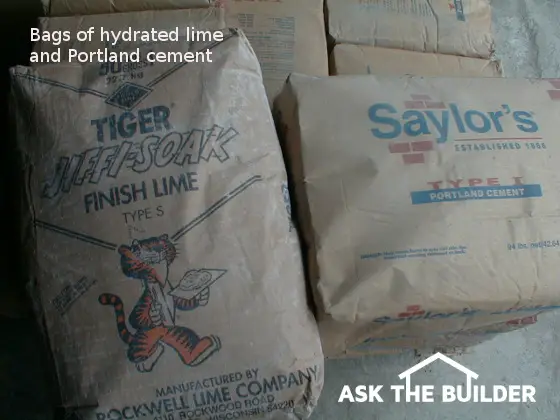
Flagstone mortar mix needs both of these bags. The bag on the left with the tiger is hydrated lime. The bag on the right is Portland cement. While the bags look almost identical, what's inside them are as different as cats and dogs. CLICK THE PHOTO to order hydrated lime. It's the best ingredient you can buy. (C) Copyright 2021 Tim Carter
"Flagstone mortar mix is made by mixing sand, hydrated lime, and Portland cement in precise quantities. The hydrated lime is often left out but it adds long-term strength and durability."
Flagstone Mortar Mix Checklist
- Hydrated lime is a mythical mortar component forgotten by many
- Lime has been around for thousands of years
- Mix lime, Portland cement, and sand in precise amounts
- CLICK HERE to Get Tim's FREE & FUNNY Newsletter!
DEAR TIM: I'm installing flagstone and some paving brick on top of a concrete patio. A book I read suggests mixing sand, cement, and hydrated lime in different proportions to make the mortar mix.
What is hydrated lime and is it necessary to add it?
Lastly, as cold weather is around the corner, when should I stop working so as to prevent freeze damage to fresh mortar? Rick A., Blacksburg, VA
DEAR RICK: Here is a subject near and dear to my own heart.
Flagstone & Brick On Concrete
The first thing to remember is I can't begin to tell you how many paving brick and pieces of flagstone I have set in cement mortar over the years. It's been more than I care to remember. The great news is that each and every one is still solidly set and shows no sign of delaminating from the concrete base below.
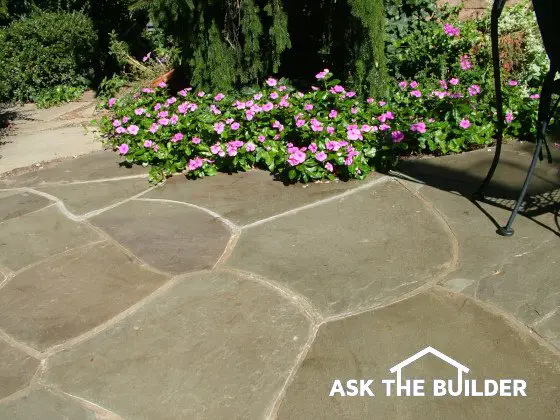
This is a flagstone patio I installed. You can't see the hydrated lime in the mortar, but it's there. Copyright 2018 Tim Carter
It's important to realize that using basic and readily available building materials as you describe above, you can create a decorative patio surface that will last for many years.
What is Hydrated Lime? - Mythical Material
The hydrated lime you read about is a dry fluffy powder. It's an ultra-strong mortar that's been used for thousands of years and still performs well.
Lime is made by first taking limestone, a very durable rock, and heating it up in giant kilns. The rock is then crushed and is now chemically unstable.
Please watch this informative video about hydrated lime mortar.
How is Hydrated Lime Made?
To make the hydrated lime you'll buy in a bag, the manufacturers add a very specific amount of water to the crushed and cooked lime and mix the two in large mechanical mixing machines. The small amount of water activates the calcium oxide in the lime but does not turn it into a paste or putty.
Mortars that contained traditional lime were often subject to popping, pitting or disintegration if they were not carefully proportioned and mixed. Hydrated lime takes the guesswork out of mixing mortar and as such is very user-friendly.
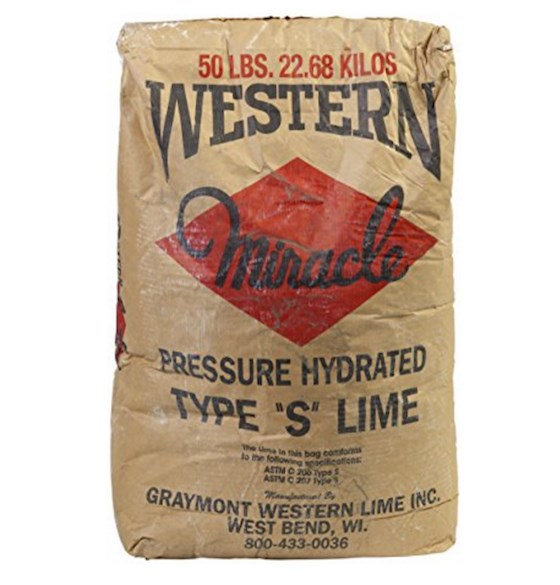
This is excellent hydrated lime. It's a fine white powder and it's going to look great on your home. CLICK THE IMAGE TO ORDER SOME RIGHT NOW.
Is Lime a Necessary Mortar Ingredient?
Hydrated lime is not a necessary mortar ingredient, but mortar made with hydrated lime is perhaps the best mortar you can make. You can make mortar with just Portland cement, sand, and water.
The mortar that I used to permanently attach the brick and stone to my patios did not contain any hydrated lime. But adding hydrated lime to the mortar mix can be very beneficial.
The plasticity or workability of the mix will improve. When hydrated lime is added to the mix, the sand and the cement do not separate. The final mortar is also more waterproof. Shrinkage cracking can often be eliminated or minimized when hydrated lime is added to the mixture.
Flagstone Mortar Mix Secret Recipe
Replacing 10 to 15% of the total volume of cement with hydrated lime usually produces optimum results. Keep in mind that the Portland cement is the glue that holds the flagstone and brick to the concrete patio.
Years ago many recipes I looked at suggested a ratio of three parts sand to one part cement for cement mortars. I altered that recipe and always mixed my ingredients 3 parts sand to 1.5 parts cement.
After surviving twenty-five years of brutal winter freezing temperatures, my patios look like the day they were finished. I'm convinced that my recipe is one that will work for you as well.
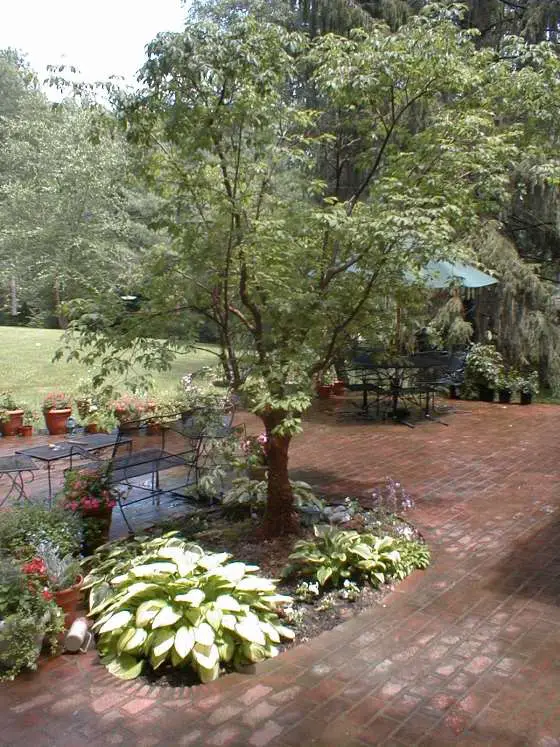
I built this patio using true paver brick. The mortar between each brick is made with a rich recipe of fine sand and Portland cement. I wanted it to flow through a mortar grout bag. Hydrated lime would have been a good thing to add, but I didn't do it on this job. The mortar, after 30 years, looks like the day it was installed. (C) Copyright Tim Carter 2021
Hydrated Lime & Cement Recipe
If you decide to use the hydrated lime, you can use this recipe for the mortar:
- three 5-gallon buckets of dry sand
- 6.38 gallons of Portland cement
- 1.12 gallons of hydrated lime
I'd use medium sand. It's available at local gravel pits or businesses that sell brick and concrete block.
Blend these ingredients together well before adding any water to the mix. Add water slowly until you get a mixture that resembles regular bricklayers mortar.
The consistency should be like a stiff applesauce, not runny applesauce.
IMPORTANT TIP: Only mix as much mortar as you can use in one hour or less. If it's hot, windy and sunny, only mix as much as you can use in 30 minutes. Do not add water to the mortar if it starts to get stiff.
Is Cool Weather Best To Install Flagstone?
Cool weather is your friend but cold weather is indeed your enemy as you attempt to finish this job. If the mortar had its choice of weather conditions, it would undoubtedly tell us to install it on days when the air temperature was in the mid-50sF with overcast skies.
A nighttime low temperature of 40F would be ideal. Believe it or not, sunny hot, dry or breezy weather are not great conditions for working with mortar and concrete.
Should I Avoid Freezing Temperatures?
I would not install any flagstone or brick if the air temperature is forecast to drop below 28F for 48 hours after you install them. You can help yourself immensely by preheating the materials you will be working with.
Should I Keep Flagstone Mortar Mix Materials Warm?
If at all possible, keep the sand, cement, and hydrated lime indoors at room temperature and only bring it outdoors to mix it. Use very warm or hot water to mix the mortar. Try to heat the brick or flagstone as well although this may be far more difficult to accomplish.
Can I Use Insulated Blankets If Freeze Danger?
After you lay the flagstone or brick, cover them as soon as possible with waterproof insulating blankets. These can be rented at tool rental businesses.
The mortar actually creates a small amount of heat as it cures and hardens, and if retained within the masonry instead of released to outer space, it helps the mortar get stronger faster. Keep the masonry covered with the blankets for at least 48 hours if possible.
Do Cold Temperatures SLOW the Chemical Hardening Reaction?
As the air temperature drops so does the temperature of materials stored outdoors and the actual concrete to which the flagstone and brick will be attached. These cold temps radically affect the chemical reaction of hydration that starts the moment water is added to the powdered cement and hydrated lime.
Hydration is the reaction that turns the powdered cement and lime into actual microscopic cement paste crystals that interlock the sand particles together.
Can I Trick The Temperature?
To resist the expansion forces of freezing temperatures, a certain amount of crystals need to form. The way to accomplish this is to fool the mortar into thinking it is 55F or higher. You do just that by preheating all of the ingredients and by storing all of that heat as you do each night when you sleep under blankets or a comforter.
Column 488

I don't have a concrete base for my flagstone, I do have 8 inches of rock base...Can I use the same mixture above?
thanks!
An 8" stone base if compacted properly and contained on outer edges with proper soil base graded properly is as good as concrete. If your flagstone is 1 1/2 inch I would mix at 3 to 1 ratio of stone dust to Portland Cement to set the flagstone at a thickness of 1 to 2". Grouting could be done with same material. Experiment by Polish (scrub with a brush) by brushing few hours later to expose aggregate.
Also wondering about my base.. We were planning on doing a sand base. Would the above plan still work? Or do I need to do something different?
Dear Tim,
I'm considering using a dark grout om my flagstone terrace. The stone is lovingly collected stone that has been taken up from old installations-from the 1930's to1960's. It's weathered and doesn't look like someone that just got a new hair cut. What are your thoughts on most attractive grouting. 1000 square plus job.
I've recently had my cement porch and step covered with flagstone. It looks really good except that there are places where I think the cement mortar is too wide as well as too white looking. Does it darken over time and how long does it take AND is there anything I can put on it to make it appear darker, even more buff colored? Thanks.
Hello
I am looking for the best mortar type of making block and Pavers, bricks.
Please let me know.
Thank you Robert
I have flagstone, adhered with sand & portland, laid over 4" concrete. I need to drill some holes into that...any recommendation for the best drill bit to use?
Connie,
It's not so much the drill bit as having the correct drill. If you use a traditional carbide bit in a typical drill, you may be drilling for 15 minutes or more to make one hole. You must have a "hammer drill".
If you use the drill below equipped with the bits you'll see underneath it in the "Buyers Also Bought" section, the hole may be finished in about 12-15 seconds depending on diameter and depth.
The more expensive drills create larger-diameter holes. I recently sold my original Bosch hammer drill that's about 40 years old. It still worked perfectly after all that time.
http://amzn.to/2EtOidf
I am planning on using some smaller flagstone in my living room of my new cabin. I am thinking of laying cement backer-board down over the plywood sub-floor so I have a base to set the flagstone on. Would this mortar mixture work for such an application or what would you recommend?
It will work great. But you BETTER be sure the cabin floor joists are strong enough and meet the 1:360 deflection rating before doing this.
If the floor joists are weak, the flagstone grout will crack and pop out and some stones may come loose in the middle of the span.
Hello, our home is 20 years old with interior flagstone flooring throughout. A couple of years ago we purchased an old
piano from the early 1900's weighing approx. 400 lbs that had to be moved across the floor and into position. A crack
developed between the joints that are approx. 3/4" wide in a section of flooring.
I removed the original cracked joint filling and have tried to refill on three occasions but after a while the filling pulls
away from the flagstone edges and also the appearance does not seem to match the original as well as it could, the
original having a rough sanded textured look. I've tried to mix my own but without success.
I probably only need a quart mixture to refill the area between the flagstone pieces. Can you provide a mixture for the 3 ingredients for that small amount, also our original finish shows a somewhat rough finish so with different types of sand can you recommend type in the middle that might produce a similar look. TIA, Paul
The ratios are above. I think you can just round them off:
15 parts sand
6 parts Portland cement
1.5 parts hydrated lime
Question: I have a flagstone patio that was originally laid with pavers and, we loose sand almost every time we get a hard rain. The installer did not offer me the mortar option. How can I now put mortar between the joints and what is the best product to use? The only size of lime I can get is a 50 lb bag which is way more than I will ever use. Please help
I purchased a home with a 13 year old wet laid blue stone patio. About 20% of the joints are cracking and need repair.
I had a contractor recommend cutting out the joints and replacing with a polymeric sand?
I am not sure about polymeric sand? It surrounds my pool and I don't want sand dust coming up an in the pool?
It feels better to me to just repair 20% of the joints and use a strong mortar? If so any suggestions what type of mortar?
Hi,
I am planning on laying a 6x8 bluestone sandstone porch and want to use your lime mortar recipe. What type of sand should I use and what type of store sells it.
Thanks,
Al
Hello, I only want to remove broken and missing motor in the joints on an 8 X 14 blue stone porch. The stones are very large, maybe 18 stones all together. The motor is broken out and missing in places. I will clean them all out. Do you have a formula to reduce the amount of motor into smaller quantities? Perhaps one bucket at a time?
I’ve stopped landscaping after 30 years. We’ve carried out work always to a high standard but I wish I’d read this at the start. So well explained and yes, we should have used lime far more. Our work hasn’t failed but I know the addition of lime would have been one more reason to leave a job knowing you’ve done your absolute best for the longevity of that project. I hope many contractors read this and add it to their construction methods. Thanks Tim.
Hi! Is this mortar mix suitable for brushing in dry between the flagstones and then "watering" in?