Bath Exhaust Soffit Vent
DEAR TIM: I'm replacing my bath exhaust fan. The old fan was vented through the soffit. I don't believe I have an attic as there seems to be no access to the space. My roof is sloped but my bath ceiling is flat. What's the best way to exhaust the fan out through the soffit? If I close off some of the continuous vent strip to prevent exhaust from entering the vents, how much should I do? I'm worried about damaging my house and I live in northern New Hampshire where it gets very cold. What would you do if you were me? Bob D., Dixville Notch, NH
DEAR BOB: You should be very concerned about damaging your house. I feel I can speak to your concerns because I also live in New Hampshire and know all about cold weather. Some of your answers go back to your high school physics class, if you can recall some of those memories.
Let's talk about the science of what's going on and allow me to relate to you some of my own observations. Here are three things we know are facts:
- hot air rises
- water vapor will condense on cool or cold surfaces
- water will fuel wood rot by providing wood-eating fungi with much-needed moisture
It's hard to see air as it's invisible. But in cold weather, we get to see the foggy water vapor that turns to miniature clouds when we exhale our breath or we see water vapor escaping from a chimney, dryer vent, soffit vent, auto or truck exhaust pipe, etc.
You never see the white water vapor go down in cold conditions. You may try to force it down, but it always starts to float up much like air bubbles rise up in water. The past few years in the cold winters that you and I experienced, my propane boiler belched out clouds of water vapor through a side wall vent near the ground. Ten feet above this vent is a roof overhang that gets coated with frost as the water vapor condenses on the cold painted wood soffit and fascia boards.
I maintain that much of the water vapor that comes out of your bath exhaust soffit vent will float along the bottom of the soffit until it finds a way to float up through openings in your continuous soffit vents. This water vapor will start to condense on the ice-cold roof framing members and your roof sheathing. You will not see this happening in your attic space that exists above the flat ceiling of your bathroom.
I've been in attics that are coated with frost from humidity that makes its way up into attic spaces. With great ventilation you normally don't have any frost as the cold dry air moving through the attic space picks up this moisture and carries it away into the atmosphere.
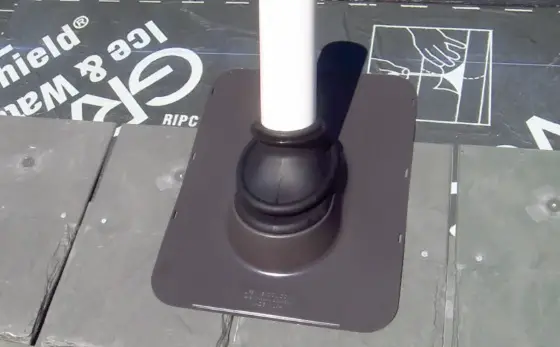
If you decide to vent your bath exhaust through the roof using solid PVC pipe, be sure to use a high-quality flashing like this one to prevent leaks. Photo Credit: Tim Carter
You may luck out and not have a problem, but I would never ever knowingly inject vast amounts of water vapor into my attic or above a vaulted ceiling and then hope all would be well. Hope is the emotion of last resort. You hope for things when you can't control the outcome. You can control where the water vapor from your bath goes.
I would exhaust my bath fans, if given the opportunity, through the roof. We have the technology to do this easily and effectively. Being a master plumber I'd just treat bath exhaust like I do my plumbing vent pipes. I'd connect bath fans to schedule 40 PVC pipe and send the exhaust up through the roof. Once the pipe exits the roof, use a gentle sweep 90-degree angle followed by a 45-degree bend to prevent rain water from entering the exhaust pipe. Be sure the end of the pipe is at least 20 inches above the roof so it's never blocked by deep snow.
It's vital the exhaust pipe be wrapped with at least three inches of foam insulation. If you have just the PVC pipe exposed in the attic, it will get cold and the water vapor in the pipe will condense and run back down the pipe eventually leaking into the bathroom through the exhaust fan.
When you go to put the PVC pipe through your roof, you want to make sure you use a great flashing. The last place you want a leak is in your roof. Not all roof flashings are made the same and some have components that fail in short order. I recently replaced a plumbing vent pipe flashing that had failed after just twelve years or so.
I happen to like using the roof flashings that are made with a high-grade silicone boot that doesn't become brittle like the less-expensive rubber boots found on common vent-pipe flashings. Remember, if you decide to vent your fan out the roof as I propose, it's the same exact procedure that a plumber and roofer use to take care of a plumbing vent pipe.
Some people are terrified to cut a hole in their roof to put in a flashing like this. You'd be stunned at how easy it is to do. I decided to tape a video showing step-by-step how it's done and how to create a leak-proof installation. WATCH MY VIDEO about installing the special high-quality flashing and consider exhausting your bath through your roof:
Column 1096

Tim built custom homes and did ultra-custom remodeling for 20+ years before launching his Ask the Builder media presence. He was selected as one of the Big 50 by Remodeling magazine in 1993. This award gave birth to Ask the Builder in October 1993. Tim also operates https://DrawPlumbingPlans.com. His @askthebuilder YouTube channel was the first home improvement channel on YouTube.
What if you cannot exhaust through the roof? Our master bath is at the front of the home and I don't want anything piercing the roof that is visible from the front. Is it possible to route the exhaust to a specific outlet in the soffit? I would never let it vent to any interior space.
I would place an external hood/flap on the side wall. There are several variations you could use, some even have colors!
The Key is to get the moisture out!!!!
How about the roof caps for a roof vent ? Does the condensed moisture drip onto the exterior of the roof?
The spray paints that are made for plastic actually work quite well, and you could paint the vent to match the color of your roof, reducing its visual impact significantly.
A 6" PVC end cap could be attached to the top of 4" pipe like a chimney cap, held out from the pipe at 120-degree intervals with approxomately-1"-long plastic sleeves and stainless screws. This would eliminate the need for the elbows. Or prior to installation of the top section of the pipe, cut three large squares out of the top edge of the pipe, leaving narrow (3/4"?) three tabs, that can be gently heated and bent so that they will fit snugly against the inside of the 6" end cap and held with screws. The latter attachment would raise the cap above the end of the pipe and enhance breathing.
For a 6" pipe, an 8" cap would be required.
Using larger ducts than the vent-fan exhaust outlet improves performance.
I've had good luck installing a bathroom exhaust vent kit made by Nutone. The hood has a good damper and it is black metal with an integral flashing pan. It comes with flexible aluminum pipe to connect in the attic. As Tim noted it is important in cold climates to insulate the pipe in the attic to stop condensation. The cost of the whole kit is less than the boot to flash the pvc pipe mentioned above!