Hodges Bay Antigua
The two photos below were taken from the property where I'm staying at Hodges Bay, Antigua.
Hodges Bay is at the northern tip of the island of Antigua.
Antigua is is the Lesser Antilles and Antigua is one of the eastern most islands of all Caribbean islands. It's just a few hundred miles north of South America.
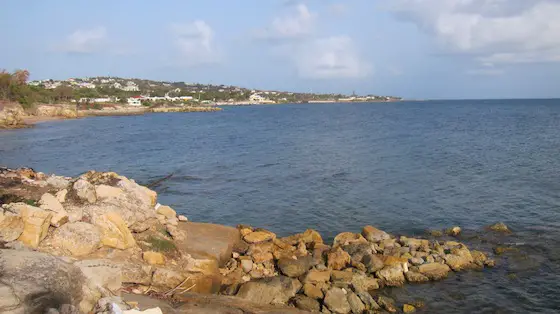
You're looking west from the shore at Hodges Bay, Antigua. This was taken from the property where I'm staying. Photo credit: Tim Carter
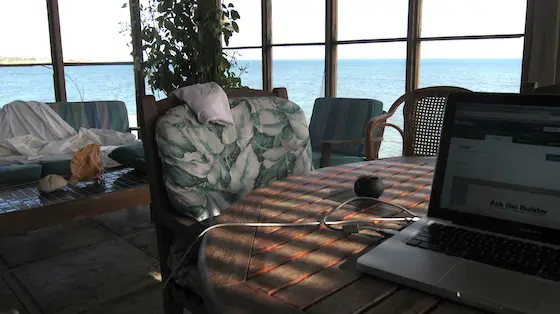
You're looking at Hodges Bay through the screened porch where I spent lots of time working and sleeping! It was so glorious to be right next to the water. Photo credit: relaxed Tim Carter
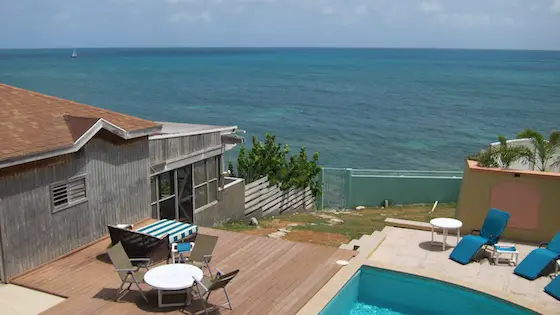
You're looking north out into the Atlantic Ocean. The Caribbean Sea is directly to the west of Antigua. The other photo above was taken just on the other side of the opening in the sea wall at the bottom of the path in the grass. Photo credit: Tim Carter

Tim built custom homes and did ultra-custom remodeling for 20+ years before launching his Ask the Builder media presence. He was selected as one of the Big 50 by Remodeling magazine in 1993. This award gave birth to Ask the Builder in October 1993. Tim also operates https://DrawPlumbingPlans.com. His @askthebuilder YouTube channel was the first home improvement channel on YouTube.
Hey Tim:
I recently read your article on drywalling. I read a tip in "Famlly Handyman" magazine. He suggested wetting the drywall tape before applying it. Don't soak it, just wet it down. It sticks readily to the bed of mud and once you get it in position, you don't have to worry abut it slipping out of position while you are smoothing it. It also won't soak moisture out of the drywall mud. Not sure if it would work in corners, but for regular seams, I'm sold.
I've never heard of this. In all my years watching hundreds of professional finishers do drywall I've never seen it done this way.
What's more, when you open the Bible of drywall finishing, the Gypsum Construction Handbook published by USG, there's no mention of doing it.
It's a waste of time in my book and serves no purpose. I've NEVER had a problem of paper tape sticking to joint compound.
If you're having that problem, perhaps you've not blended it to the right consistency. Have you watched my video showing you how to do this?
The mud from the factory is a little dry by design.
Tim,
While at the recent hardware show in Las Vegas I came upon a product that I had read about many years ago but could never locate - Wet & Stick Joint tape by HYDE Tools. This may be what the Family Handy man article was referring to. It is a drywall tape that has adhesive on one side and after running it quickly in and out of a bucket of water it will stick to drywall seams without applying mud on first. It sounds like it could be a bit faster for the professionals (those who don't use the super taping tools) and certainly easier for the DIYers. I have not tried it myself, but will certainly do so now that I know who makes it. They do say it works in corners as well. You might want to try it too and tell us what you think.
This is a very broad question, and maybe hard to answer, but I think it is good food for thought from a construction viewpoint: Are there any tropical areas where one can build without extensive interior finishing and insulation? I imagine that in the past many homes were built with just framing and an exterior shell. Hey, if the temperature is mild year round why would you need insulation? And yes! I am aware of the hurricane danger--I went on a volunteer trip to Jamaica after Hurricane Gilbert. But I could envision a home with exposed framing and t and g siding, probably painted a light color with an easy to clean enamel and with electrical power in conduits and plumbing in centralized chaises. Sort of an update version of a beach shack, but with modern seismic and hurricane protection. In the States, the barebones "industrial" look is in, or the loft style.
So, can this be done, according to current codes in any tropical countries? Seems like it could be an easy and fun way to have a home without a lot of complicated work.