Penetrating Deck Sealer
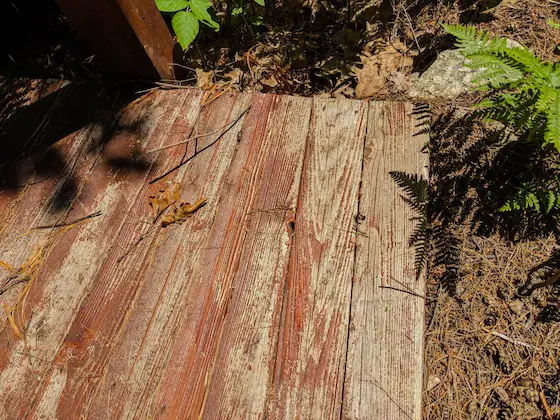
Best Penetrating Deck Sealer | Just three years ago this cedar decking looked like an exquisite piece of fine furniture. It had just been sealed with a top-quality outdoor sealer. Look at how it’s peeled. Copyright 2023 Tim Carter
Where is the Best Penetrating Deck Sealer?
Do you have a wood deck? How much time do you invest in cleaning and sealing it? How many gallons, currently priced around $55.00 per gallon, of high-quality sealer do you use to make your deck look fantastic? I pretty much know all the answers because I’ve dealt with cleaning and sealing outdoor decks. fences, and other wood for decades.
Deep experience is often coupled with cynicism. I’m acutely susceptible to this because it’s my job to think analytically about building products and tools. I feel a deep responsibility to find the best products and then share that information with you. When it comes to deck and outdoor wood sealers, I’m not certain there is a great product currently on the market.
In the three decades I’ve penned this column I’ve written about all sorts of products telling all the truths that the manufacturers conveniently leave out. I’ve been a master plumber since 1981 and when I saw the big push about the wonders of tankless water heaters I shared that in certain cases you’d never save money with them. Your energy bills would go up because you’d have an endless supply of hot water. I shared that you have to amortize the much higher installation cost. This meant it would take years to break even.
If my claims were wrong, I would have heard instantly from the water heater manufacturers. They would have demanded a retraction or correction column. I never heard a word. The exact same thing happened less than ten years ago when I exposed how asphalt shingles were being pre-aged. This means they don’t last as long as they should on your roof. Did the shingle manufacturers reach out crying foul about all the facts in my Roofing Ripoff book? The answer is no. That means my claims were correct.

Now let’s see what the deck sealer manufacturers are going to say. Less than thirty years ago deck sealers used to be true stains. They would soak into the wood and not leave a film on the surface. I distinctly remember testing one that use synthetic resin instead of natural oils. Natural oils like tung, linseed, and others are delicious food for mildew and algae. Not so synthetic resins.
That magic sealer penetrated into the wood and would look great for about three years. All you had to do to reseal the deck was to wash it with soap and water or an oxygen bleach solution. You’d then apply a fresh coat. The product never peeled. Back all those years ago many deck sealers were true penetrating stains.
But things started to change in the last two decades. Just about every deck sealer I’ve tested has peeled. In other words, the sealers are more like paint and varnish rather than like a wood stain that soaks into the wood.
The issue is when the film-forming deck sealer fails, it’s a catastrophic failure. Some of the sealer peels and some doesn’t. If you just clean the deck and reseal it not removing the unpeeled sealer and taking the deck to bare wood, you often get an uneven finish that appears blotchy.
To achieve great results when it’s time to reseal your outdoor wood, you have to strip off the old finish or sand it off. That is mind-numbing work, to put it mildly. This fact begs the question: Why would the manufacturers create film-forming products that cause you and millions of others so much agony? Is it to sell more sealer faster?
Realize that when I start to ask penetrating questions about product failures of any type, I often get the silent treatment from the public relations (PR) people who work for the manufacturers. Having done expert witness work for nearly thirty years I believe I know why. The attorneys working for the manufacturers don’t want information out in the public domain that might hurt the manufacturer in a future private or class-action lawsuit. This just happened to me when I started asking tough questions about lithium-ion batteries. No PR person would return my calls or emails.
You and I both have to battle unethical or misleading information on product labels. The most recent deck sealer I used, Cabot Australian Timber Oil, showed great promise when I applied it three years ago to my new cedar dock panels. The label said it was a penetrating finish. I thought for sure it would be like the sealer of old that was truly a penetrating stain.
It turns out it was a film former. Technically I’m sure an expert on the witness stand would or could say that some of the product did penetrate into the top layer of wood fibers. But I feel half-truths are whole lies. The manufacturer of the product I bought could have also added a phrase, “…and once dry a protective surface film stops water from entering the wood.”
Had that description been on the label, I would have instinctively known it was a film former destined to peel. All of the wood leading to my boat dock I treated with this product is looking horrible and if I want it to look fantastic, it’s going to be a huge project to get rid of the old inferior product.
What are your options? Well, you can bite the bullet if you intend to live in your home for many years. You can get a top-quality composite deck material that requires just a simple cleaning each spring to get off any dirt from winter storms. I did that with all my decks and now I’m contemplating doing it with my boat dock. Wish me luck!
Column 1515

Tim built custom homes and did ultra-custom remodeling for 20+ years before launching his Ask the Builder media presence. He was selected as one of the Big 50 by Remodeling magazine in 1993. This award gave birth to Ask the Builder in October 1993. Tim also operates https://DrawPlumbingPlans.com. His @askthebuilder YouTube channel was the first home improvement channel on YouTube.
I've been using a product called TWP for the last 15 years or so and have been fairly happy with that product. What are your thoughts on TWP?
What are you going to clean your boat dock with?
Will it pass muster with the EPA or NHDEP?
Will you get a lawyers letter demanding payment of $25000 fine?
I was thinking of using dioxin mixed with 100 gallons of Round-Up. Ed, it sounds like you've got a burr under your saddle.
Hello Tim,
It sounds like you are changing your mind about Cabot Australian Timber Oil deck finish. I bought your report which showed your product testing demonstrating how this was the best product to use. I just used this product on a customer's 440sf two level deck after properly preparing the deck for the new finish. What do we do now?
Hi Tim, your reveal was supposed to be in April of last year but I must have missed it. Also, not sure if your testing took into account mahogany-type decking. I've been using Rymar Exotic over the last few years, seems to do a good job but at $122.00/gallon - yikes! Hope all is well with you, rainy day today up here in Downeast!
Hey Tim! I have been reading about your deck sealer tests for the last 12 years or so and am a big fan of your methods and process for cleaning and sealing decks correctly. Are you saying all is lost? The last time I did it, in 2021, I used the Cabot’s Australian Timber Oil, based on your recommendation. Have they become film-formers too? Say it ain't so.
Tim,
This is the type of column I wish you had every week.
Thank you!
Mike
It was very satisfying reading this article about decking finishes. came to the same conclusion earlier this year when I bit the bullet and had plastic boarding installed on my new raised patio over here in the UK.
I am confused, what you are saying is there aren't any
and you need to bite thee bullet. Sorry I don't have the extra cash to invest replacing the existing wood deck.
So thee question is what have you used that is the longer lasting upward of 3 years?
30+ ago we had to take out 2 decks built over downspouts. From the top was still beautiful. That Redwood today is still better than what you can buy. Same with the fence. I replaced a fence section with used boards, and cheap screws as it turned out. The expansion when wet snapped the screws. So when doing another section I decided to paint the new boards and went with BEHR 6013. Same expansion but used better screws and spiral shank nails. The newest boards 'weld' together when it rains, and then split in the middle during dry weather. I did somewhat follow your suggestion with the posts. 6" plastic sewer sleeve set in concrete with the 4X4 post set in pea sized crushed granite. Tested on the mailbox post about 10 yrs ago still good. Shop vac the rock and post comes right out. Open bottom. tim n Solano County CA
Good luck, Tim!
I had a terrible result a from stain & sealant I used on new cedar deck railings after just one year. So what product(s) do you recommend?
Enjoyed your article in paper about deck sealers and confirmed my suspicions. They don't make them like they used to!! First time my "semi-transparent deck stain" started to peel, WTF!!?? In my case Sherwin Williams and 20+ years ago, didn't see this peeling issue but when they got this "DUCK" technology it should have read "yuck" technology (of course I'm being too nice here). I too have been searching for a new product to use (can't use oil base in NW for mildew issues). But now it's just pointing me to Trex decking or other make as the deck requires much more maintenance now. Of course a new set of issues...
Ok what is the name of a good deck sealer ibn your experience?.
I have used Wolman F&P Natural for 30 years.and my deck is holding up well
regarding today's column about your tankless water heater. You should have taken your own advice and not installed one. they cost too much and don't last much if any longer than a regular water heater.
where is it?