Porch Decking
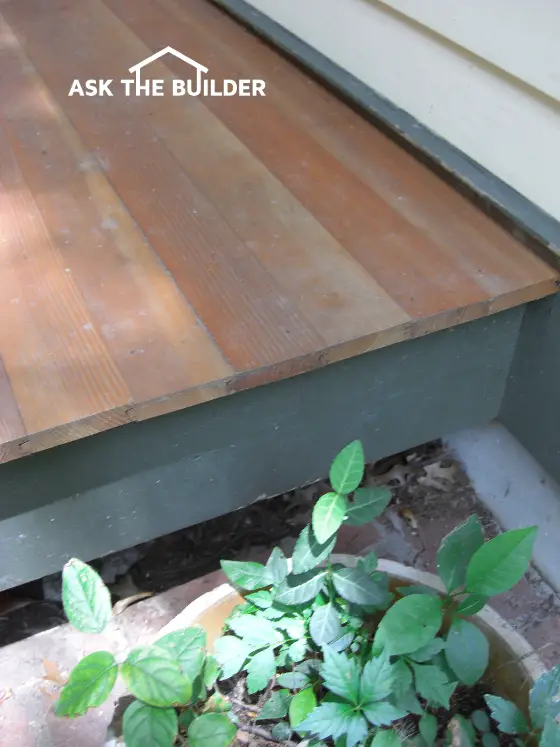
Porch Decking | This is real Douglas Fir porch decking. It’s tongue and groove allowing the nails to be hidden. Copyright 2017 Tim Carter
Porch Decking TIPS
- Traditional wood porches had special wood
- Wood was installed at a slant and shed water
- Use borate chemicals to pre-treat wood before installation
- Stain all wood on all sides and edges BEFORE installation
- CLICK HERE to Get Tim's FREE & FUNNY Newsletter!
DEAR TIM: I’m restoring an older home that has a patio porch deck. It’s covered, so perhaps it’s just a deck porch.
The wood was painted, but is in bad shape due to neglect. What material would you install if you wanted to maintain the character of the house? I’ve seen composite porch decking, but I’m worried that I could have problems with it and that it just won’t look real.
Are there any great trade secrets you can share about decks and porches? Sara G., Mt. Orab, OH
DEAR SARA: I’m really familiar with porch decks, especially ones made from wood.
All My Houses Had Wood Porch Decks
Every house I’ve owned has had one, and some of the wood is over 100-years old and still in very good condition. There are several reasons why the wood has lasted that long, not the least of which is diligent care on the part of the homeowner.
Classic Look
Wood porch decking is absolutely a classic look. You’ll find it on many a covered porch in older homes out in the country as well as houses in the city. I know for a fact that there are thousands of houses in Cincinnati, OH, which is near you, that have original wood porch decks that are still in use. They may be painted, but it’s still wood.
Wood Porch Installation Tricks
If you study your porch, assuming it was installed correctly when your home was built, you’ll discover that it probably is not level front to back and that the wood strips are installed opposite of the way you might think they should be.
Carpenters well over 100 years ago discovered that even though porches like yours were covered, wind-driven rain would saturate the wood in fierce storms. The quicker that water got off the wood, the better. Installing the wood so that it has a fall of 1/8 inch per foot allowed for excellent drainage.
Free & Fast Bids
Tongue & Grooves = Drainage Channels
To ensure no water got trapped between the individual pieces of wood decking, the carpenters ran each individual strip of wood perpendicular to the front wall of the house. That way the seams between the pieces of wood acted as natural conduits for the water to drain to the end of the porch at the overhang.
Installing the wood parallel with the front wall of the house creates a dam between pieces of wood that traps the water.
Douglas Fir - Premium Porch Lumber
The wood that I prefer to use for these porch decks is vertical grain Douglas Fir. It can still be found at many traditional lumberyards. The wood that was installed on many of the old porches, and the ones I built, had a tongue and groove profile.
This unique profile is the same used when milling oak for interior hardwood floors. It allows for blind nailing of the strips of wood and adds significantly to the strength of the wood as each strip interlocks with the one on either side of it.
This minimizes or eliminates sag or bounce when you walk on the wood in between the floor joists that support the porch decking. It’s time-tested technology that works.
Generation One Composite #FAIL
 I tested a composite porch decking that was made to mimic the wood material. It failed miserably.
Composite decking products contain high amounts of plastic. Plastic expands and contracts dramatically when heated. If you don't allow for the decking to move, it can bow, twist or uplift as the material grows in length.
The instructions said to make sure the decking was covered from the sun. That’s pretty impossible to do as the sun can often hit the edges of the decking early and late in the day and as the seasons change with the sun lower in the sky.
In my case, even though the decking was installed per the manufacturer’s specifications, it developed huge humps from the heat expansion of the plastic in the composite product.
Treat With Borate
If you want your new wood material to last for generations, you have to treat it with borate chemicals before it’s installed. Borate powder is easy to get and it dissolves in hot or warm water with ease.
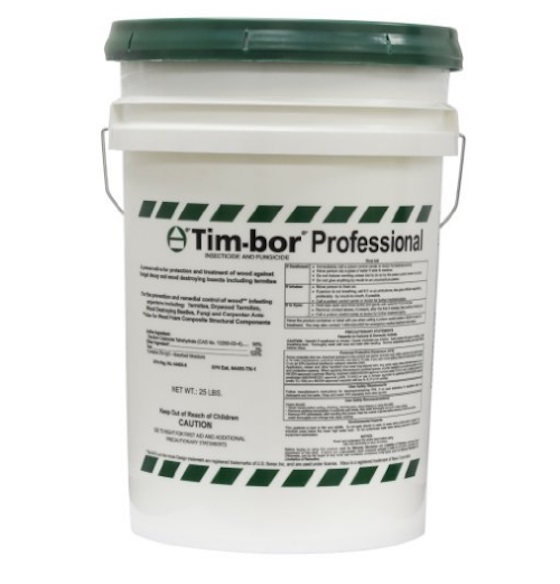
Here's a great borate powder for treating wood. There are many borate suppliers to choose from. CLICK THE PHOTO NOW TO HAVE SOME DELIVERED TO YOUR HOME IN DAYS.
Cut the pieces to the exact length you want and then soak each piece of wood in hot water that contains borate powder.
Let each piece soak under water in a trough for about two minutes. Stack the wood in a shaded area making sure to put wood spacers that resemble paint stirring sticks between layers so the wood can dry.
Wait Two Weeks
Once it’s dried for two weeks, then paint the wood on all edges and surfaces before it’s installed. You can use semi-transparent wood preservatives instead of paint if you want the natural look.
What is the Best Porch Paint?
In case you want to paint the porch, I recommend paints that are specially formulated for outdoor porches. They say so on the label.
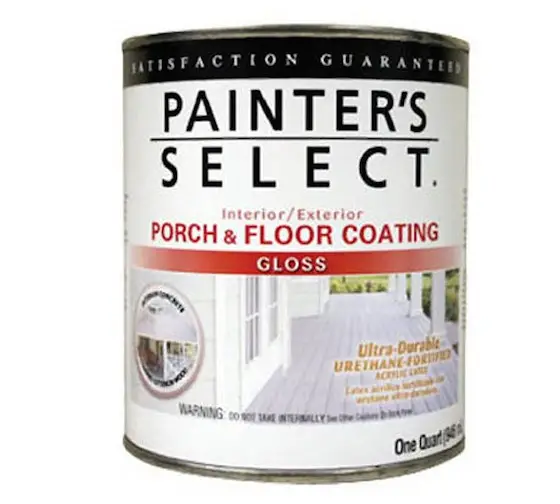
Here's a great urethane-fortified paint. It comes in three different sheens. NOTE on the label it says it's for porches and floors! It's tough enough to walk on. CLICK THE IMAGE NOW TO have this paint delivered to your home.
Be sure to paint all the wood on all sides and edges, including the tongue and groove before you install the wood. Always paint any cut ends to stop water infiltration into the end grain.
What Primer Should I Use on the Wood?
Read the label of the finish paint you intend to use. They almost always tell you the best primer that's compatible with the finish paint. It's best to apply the finish paint as soon as the primer label says it's safe to recoat. You'll get a better bond between the two paints if you do it this way.
Stain All Sides And Edges
The key is to coat all the surfaces of the decking so that water will have a very difficult time entering the wood. If you don’t pretreat the wood before it’s installed, you’ll never be able to coat all the surfaces.
Hot-Dipped Galvanized Nails
Use double-dipped hot galvanized finish nails to install the wood. These will last for generations, especially if the wood is covered with a roof.
IMPORTANT TIP: If you have to cut a piece of wood that’s been treated or painted, be sure to coat the cut end with the borate solution and then the finish sealant or paint.
If you want to minimize any cupping or warping in the wood, consider installing a vapor barrier on the soil under the porch. This will slow water vapor from pouring into the underside of the wood, even though you’ve treated it.
The wood used on many of the old houses had another huge advantage over wood available today. It came from ancient trees whose growth rings were very small.
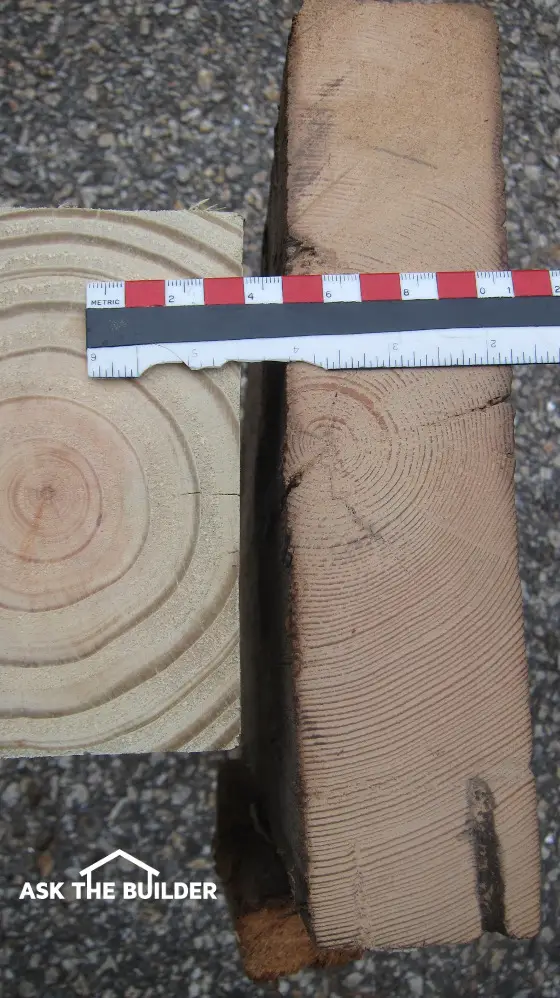
New lumber is nothing like the lumber of old. Look at how wide the lighter-colored spring wood bands are in the timber to the left! (C) Copyright 2017 Tim Carter
As such there was often as much dense summer wood in the lumber as there was the lighter spring wood. Lumber today seems to have a much higher percentage of light spring wood than the dense dark summer wood. Spring wood, because of its open cellular structure, is much more susceptible to rot than the dense summer wood.
This is why it's so very important to treat modern lumber with the borate chemicals. They readily soak into the light-colored spring wood.
Column 839

Tim built custom homes and did ultra-custom remodeling for 20+ years before launching his Ask the Builder media presence. He was selected as one of the Big 50 by Remodeling magazine in 1993. This award gave birth to Ask the Builder in October 1993. Tim also operates https://DrawPlumbingPlans.com. His @askthebuilder YouTube channel was the first home improvement channel on YouTube.
Is there a way to seal the spaces between the tongue & groove boards before sanding and repainting if they have separtated slightly over time?
Yes there is. Use a brush.
Thank you for this article.
So, you suggest hand-nailing the t&g Fir boards?
What are your thoughts on using an air floor nailer?
I am concerned about splitting the tongue, or the possible buckling of boards, with the wood slipping right over the head of a regular finish nail (though unlikely when the wood has been properly treated)...
not to mention missing a nail, denting the wood, bending a nail, etc..
I have a porch job coming up - I bought a box of 2.5" stainless steel ring shank finish nails. The job is about 270 square feet.
There seems to be so many different opinions on this particular point that I cannot find two alike on the internet, and therefore am a little unsure as to the best method.
.75 x 3.50" t&g Douglas Fir - hand nail the SS ring shanks or air nail galvanized 2" L cleats???
I also heard about 'casing' nails with a better head profile for added strength. Since the job is only about 270sq ft I thought I'd take a crack at nailing it myself. I'll be nailing into the original joists (though I may have to put in a couple support 2x8 pieces here and there. But I keep worrying about splitting the tongue, and having to toss boards out.
Any thoughts???
I greatly appreciate any feedback ! ! !
Thank you ! ! !
Nail it whatever way makes you happy and you're comfortable.
I have a small partially covered front porch that needs reflooring and I had to tear out two partially rotted Doug-fir T&G floors. I am curious of your choice of Douglas fir which has relatively poor rot resistance relative to other species. I would think cedar or perhaps a tropical hardwood like T&G Ipe might be longer lasting. Any thoughts or comments?
Use Douglas Fir T&G again. Do not mix woods as they have different expansion and shrinkage characteristics. I am doing the same thing on my 150 year old cape in Maine. Use 1x4 T&G fir, prime wiht oil base primer and try to blind nail as much as possible. Lay the last piece in by cutting off the bottom of the groove side piece, drop it in tight and either epoxy it there or sink a few stainless steel rimshank nails and cover the holes with sawdust from the fir flooring mixed with yellow wood glue. Sand and seal or paint.
What width of board do you recommend and what are my considerations. I have 1x3 tg douglas fir boards (2 1/4" on the face) on my deck currently and because the pitch was not sufficient water pooled and over time rot set in in several placed.
I am not sure that I can successfully source matching lumber to replace individual boards and repair will not solve the pooling problem.
So if I have to replace the whole thing can I/should I use wider boards like 1x4 or 1x6?
Thanks for the great article.
Hi Tim,
I had a guy replace my T& G porch with untreated pine because he said treated wood would have to sit for 2 years before staining so I followed his advice and after 2 years of his wood choice it is all rotting and needs to be replaced, even though I used a colored stain on it. I am now being told to use treated douglas fir and the lumber yard said that it has been dried so I should be fine on staining it. My question is what type of stain should I use? The colored stain I used last time was very expensive and was peeling off in one year. I am now looking at a product called Arborcoat. If I have to apply it every year that is fine as it is a small deck but I don't want to have to scrape the old peeling stuff off. Is there a colored stain that won't peel? I should mention that the deck is on the S. side of the house and it gets quite a bit of Midwestern sun. Any advice would be greatly appreciated.
I am frustrated over treating CVG tongue and groove fir flooring before the contractor installs it. I am going to have a brand new covered three season porch built in New England and I’m wondering if I use CVG fir flooring must I treat each piece with borate before the contractor installs it or if I am going to paint the CVG fir floor, do I just need to prime each piece with oil base paint first? Thank you for your help.
I'd treat all the wood with the borate chemical I suggest above AND after the wood is dry, I'd paint it on ALL sides, edges, etc. to lock in the borate chemical.
All CUT edges during the install must be dipped in some borate solution for ten seconds, allowed to dry for a moment and then coated with paint before being installed for maximum protection.
Thank you Tim. Also, what kind of primer and paint should I use for this 3 season NE porch floor? Sheila
Sheila,
I modified the column and added the information you need. Go up and check it out!
Thanks again Tim - much appreciated! Sheila
Tim- I have untreated T&G porch floor pine. My wife is looking to go with a stain finish. Am I on the right track with the following steps: 1) soak in borate solution; 2) fill and sand knot holes; 3) Stain/Sealer combo (Oil or Water based?) Also, should I consider and epoxy on the end grain? Thanks in advance for your help.
Hi Tim, I am putting a roof over deck and going to screen in 10' of the 16' wide deck. I was going to use tongue and groove on the flooring as to help keep mosquitos from coming up through flooring. I see you are treating your own wood. Is there a disadvantage to just using tongue and groove decking boards that are already treated such as yellawood? this would simplify the process. Thanks, Darrell Phillips
We bought treated pine 1X4, T&G. Already dried. Do you still recommend the borate? Isn’t the treatment essentially the same thing?
Read THIS column to make sure it has the RIGHT treatment: https://www.askthebuilder.com/treated-lumber-ratings/ You shouldn't need the borate.
What can I possibly soak 7 ft. boards in? What kind of trough?
This becomes a three step process then; soak, prime, then paint.
Oh man, I have 3661 linear feet to do!
Hello - using T & G, CVG Doug Fir, but want the dark stained look. Couyld we use a penetrating sealer pretreat right before install vs Borate and having to wait two weeks? Then what recommend to use for a dark strain finish and # coats after install?
thanks!
Will 20 Mule Team Borax purchased in the laundry aisle at the grocer work for pre-treating the wood? I think that is sodium borate.
If using borates, should the fasteners be upgraded from galvanized to stainless steel? And will rainwater leached borates attack fasteners below deck in the framing?