Relocation Checklist

Relocation Checklist - You may dream of living in a home with a view like this. Wait until the July 4th weekend when boats equipped with sound speakers the size of a VW Beetle cruise past your house at wake speed. When this happens at my home as I sit on my deck, it rattles my glass of iced tea. Copyright 2026 Tim Carter
Relocation Checklist - You Need One for a Long-Distance Move
Brian lives with his wife on the East Coast. He’s been a subscriber to my free newsletter for years. Brian is in a select group of virtual friends I’ve made over the years. It’s a delight to have email exchanges with these high-tech pen pals using electrons instead of ink.
You may be like Brian. He’s about to retire. He and his wife plan to do a long-distance relocation. It’s going to be their final big move, from what I understand. His last email exchange with me touched on this as he was asking for a bit of advice, knowing that I had done the same thing moving from Ohio to New Hampshire (NH) in 2008.
Brian shared that he and his wife are attracted to a community in Pennsylvania that has all sorts of amenities. He and his wife would become part of a homeowners' association (HOA). I’ve lived in one of these for the past seventeen years and cautioned him against making that choice.
I understand the lure of an HOA as you get older. Offloading any number of maintenance headaches to someone else is very attractive. But it often comes with a huge price tag that rises each year. I shared how my HOA dues started at $60 a month in 2008, and are now $200 a month. That increase is far greater than the rate of inflation over that same time period. His dues would be close to $5,000 a year. Imagine what they’ll be like fifteen years from now when money in his budget may be tighter than a banjo string.
The other issue, in my opinion, with HOAs is that I feel there’s at least one control freak who is the unpaid self-appointed bylaws enforcement officer. I have one in mine. This woman has a magical built-in radar gun in her head. She can somehow tell when you’re speeding down our private roads. She's not too bright because what she fails to realize is we don't have official speed limit signs on my street. We have the yellow/black recommended speed signs! You seed these signs on public roads below a sign telling you a curve is ahead.
You can view thousands of videos on YouTube of Karens like her who spread angst each day in HOAs like the wind scatters dandelion seeds.
My email exchange with Brian started to touch on other aspects of moving. Soon, I realized that the conversation should be shared with you. Moving within a city or town is stressful enough. That stress has a force multiplier when you move hundreds of miles away to a strange city or state you’ve never set foot in.
Finances should be one of the things you consider. Some states, like NH, have no sales tax or income tax. The state you’re thinking of moving to might have low property taxes. I was a real estate broker in Ohio for over twenty-five years and feel there’s only one way to compare property taxes. All you have to do is divide the annual property tax by the fair-market value of your home.
You’ll be stunned to discover that one city or state might have a tax rate three or four hundred percent higher than another. In my case, my property tax is only 0.6% of my house value. Brian’s current tax is 1.6% of his fair market value. That’s almost 300 percent higher than mine in NH.
Water - Wells vs. Recycled Sewage
Brian and I exchanged thoughts about water. He and his wife were reluctant to drink well water. I remember having the same reservations when I moved to NH. I had consumed the recycled sewage from all the upstream cities on the Ohio River for fifty-five years. Not only was chlorine added to the water, it needed to be filtered through huge activated charcoal to remove chemical pollutants like benzene. You see, there are big chemical plants up in West Virginia and Pennsylvania.
Layer on top of this flouride was added to the Cincinnati, Ohio municipal water supply. It's recently been connected to all sorts of health issues.
Well water, for the most part, can be very pure. It depends upon where you are, of course. You can test well water with ease, and it's very inexpensive. You can make this part of a sales agreement and back away from an offer if the test results come back unsatisfactory.
I feel it’s important to create a list of things you dislike about your current home and city. For me, I had become numb to the horrible traffic, potholes, pollution, background noise, etc. of my fifty-five years in Cincinnati. I thought that most places were like this. I was wrong.
You then have to create a list of things you desire. Perhaps you want to be close to thousands of miles of hiking trails. Maybe you do want the big city life. You may want to be close to the ocean or a large lake as both often offer lots of recreation opportunities.
I casually mentioned to Brian that should he and his wife give NH a serious look, he needed to avoid houses that are located on a Class-five road. A Class-five road is just dirt and gravel. Forty-nine weeks out of the year, you can travel on them with no issue. However, when mud season arrives in the spring, some can be impassable unless you have an Abrams tank. In the summer, everything outside your home is covered with dust created by passing cars and trucks.
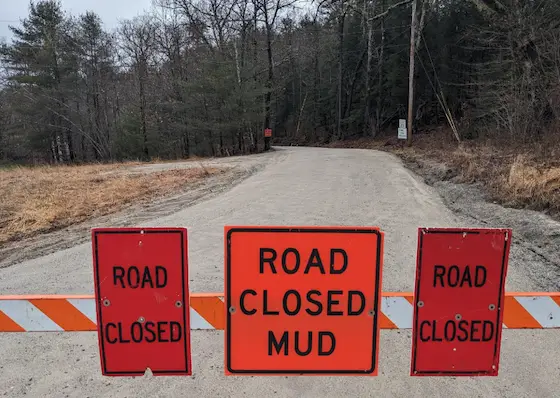
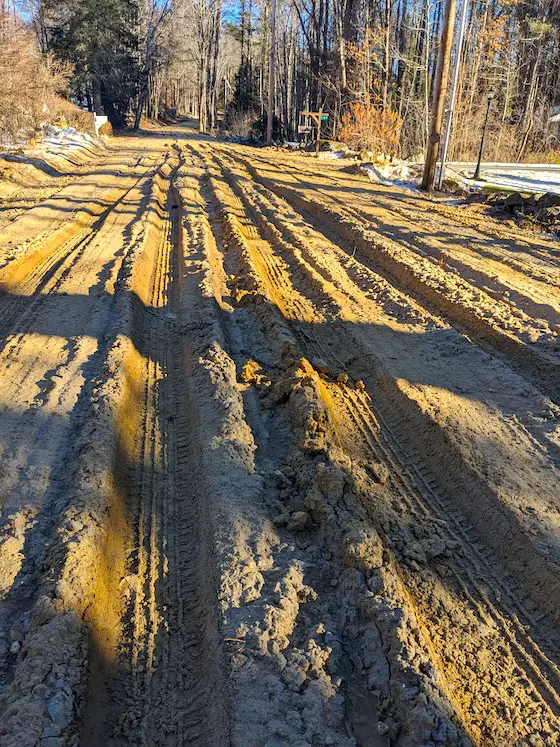
This mud is frozen, but when it warms up you better have great tires on your 4x4. The roads become impassable in the worst cases. Copyright 2026 Tim Carter
You should consider climate, wildlife, and insects. My wife and I wanted to escape the insufferable humidity one suffers through in Cincinnati from June until September. NH has much lower dew points in the summer. That said, it also has wretched black files in the spring. These miserable tiny insects inflict a vicious bite for two or three weeks. The mosquito has been nominated to be the NH state bird many times.
It’s very important to consider crime statistics. There are quite a few websites that track this information. Study these facts to see what crimes happen where you plan to move. Is crime growing or lessening?
My advice to Brian was simple. Narrow down the choices to two or three places. Then, research the times the weather is best and worst. Travel to each town or city and rent a house for a week. Start to scout around to see if you like it. Stay in the city or town to see if you like the weather extremes.
Note the distance to stores and shops. Do you have to travel a great distance to get your car repaired? Do you like to dine out? Are there abundant great restaurants that will satisfy your appetite?
Drive by the worst parts of the city or town. Are there lots of homeless people? Are you a person of faith? If so, visit the places of worship to see if you fit in.
Think about how you buy a new car or truck. You often take it for a test drive. You need to do the same thing when you plan to put down new roots. Rent a house in the town for at least four weeks over a period of a year and see if you really like what you experience.
Column 1647
Insufferable humidity????? Just a good excuse to drink lots of cold sweet tea. Insufferable is cold, snow, ice, high heat bills, scrapping windows, frozen pipes or say car doors and more. Should have been smart and moved south.
Great advice!