Vapor Barrier on Foundation Walls
Quick Column Summary:
- Tar paper or 6 mil plastic vapor barrier
- Leave an air gap to avoid mold
- Video link
Charles Gregoire is perplexed up in Ottawa, the capital of Canada.
"Confusion on whether to use tar paper or 6 mil plastic. In repairing a 64" section of an existing basement interior wood framed dry walled wall I discovered tar paper was glued onto the concrete wall, followed by a 1/2" gap, 2x3 wood framing followed by clear plastic vapor barrier and drywall.
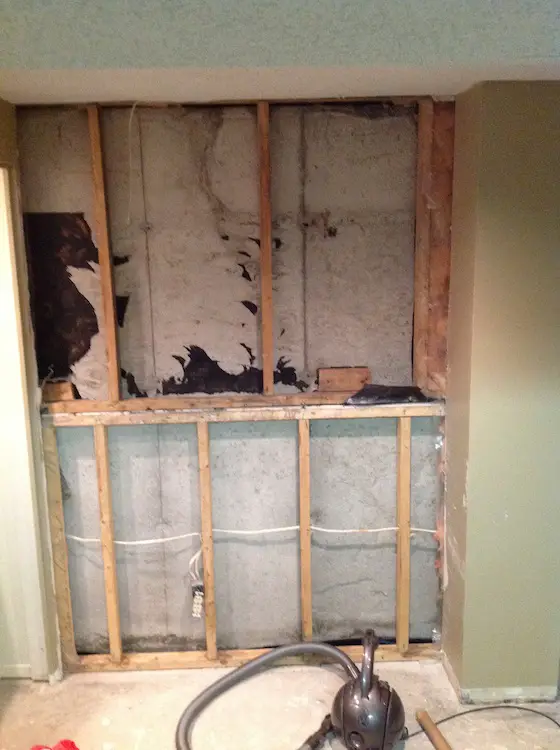
Here's Charles' wall.
After ripping everything out I needed to restore the section of wall. Note that there was concern over damage/mould from a plumbing leak that occurred 3 years prior. After ripping the section out I concluded there really wasn't any issue.
The fiberglass insulation was a slightly damp to the touch. I ran into some confusion when try to decide how to restore the wall section. After watching many videos and talking to people at Home Depot and Lowe's I never gain an in site into what I should do.
The fellow at Lowe's said to cover the concrete with PE instead of tar paper. The fellow at Home Depot said that was a bad ideas because the concrete needs to "breath" and that I should use tar paper although I think he would have preferred I attach the tar paper to the back of the stud wall instead of gluing it to the concrete. I left to conclude that Tar Paper although waterproof still allowed for the passage of air whereas plastic vapor barrier would be water and air proof potentially trapping water allow for eventual mould growth. What is correct here and why?"
Here's my answer to Charles:
Charles, the fellow at Home Depot was on the right track.
Watch this video of mine about basement remodeling. I didn't have time in the video to explain the second reason you need the air gap between the back of the studs and the concrete wall. It's to allow air circulation.
I NEVER put any membrane on the concrete wall because I never wanted to TRAP moisture that would lead to mold growth.
With the 1-inch air gap, there seemed to always be enough air circulation from the top gap to prevent liquid water from forming on the concrete wall.

Tim built custom homes and did ultra-custom remodeling for 20+ years before launching his Ask the Builder media presence. He was selected as one of the Big 50 by Remodeling magazine in 1993. This award gave birth to Ask the Builder in October 1993. Tim also operates https://DrawPlumbingPlans.com. His @askthebuilder YouTube channel was the first home improvement channel on YouTube.
Hi Tim,
Thank-you for your response but unfortunately your answer doesn't seem to address the problem and concern I'm trying to solve. In your video you advocate using no vapour barrier and keeping a 1" gap between the concrete wall and stud wall. That's all great but when it's time to add the insulation there will still be concerns on how to keep the insulation dry. I'm still not completely resolved about what to do but I like the idea of using a dimple based foundation wrap between the concrete and the stud wall. This would allow the foundation wall to breath while protecting the insulation from moisture off the concrete wall. The problem with my idea is the dimpled wrap doesn't come in smaller quantities. I have also considered using tar paper and creating my own way of having an air gap between the concrete and tar paper using some kind of spacer. Maybe 1/4" plywood strips on which to stand the tar paper off of. Of course I'd have to put some kind of coating on the plywood to keep it from rotting etc.. Let me know what you think.
Thanks,
Charles
Charles, I tried to let you know what I think. I told you what's worked for me for decades. If you want to explore other possibilities, that's why I created this product - My 15-Minute Phone Consult.
How about an inch layer of closed cell spray foam insulation on the foundation walls? Will that work as a vapor barrier whether you frame the walls or not?
I'd prefer the closed cell foam be on the COLD side of the wall. This means outside in the ground so the foundation surface stays WARM and above the dew point of the water vapor in the basement area. This will prevent liquid water from forming on the poured concrete.
Good answer Tim.....they should hire you at Lowe's ...you could teach them a few things 🙂 Just keep them in mind when you want to retire and not do hard labor any longer 🙂 all I ever see those guys do is stand around chit chatting to each other, and if you want help you have to run someone down !!!! and then you may or may not get the correct answer !!
Keep up the good work....now only if you could answer some questions for me 🙂 LOL.......
I would worry about air circulating on the concrete wall. I don't think it will dry it at all, I think it would be more prone to deposit condensation, as the concrete wall will be much cooler than the air.
I'm planning a basement remodel / finishing project for some time in the hopefully not-so-distant future. The recommendation from a magazine I subscribe to is to glue 1 inch polystyrene to the concrete wall before putting the stud wall in place (using construction adhesive in vertical patterns only so the condensate can travel down the wall). I think I'd rather attach the insulation to the back side of the stud wall instead. In short, I guess I'm in agreement with keeping the surface of the concrete bare so as to not collect condensate on anything else. Any comments on this?
Did you watch my video referenced on this page??? In my answer? Tell me what you saw on my basement concrete walls. 🙂
Gee Tim, I saw concrete! Would you recommend using a poly barrier on the back side of the wall? A hundred years ago when I worked for a remodeling contractor, we would staple poly film on the back of the studs before we raised the walls in place.
What I understand is that the dew point will be met somewhere, so I just want to know the best place for it. I'd like to keep it out of the stud wall.
The concrete walls were bare.
Yes they were. He had ripped down the tar paper *before* taking the photo......
Hello,
Here in Northern Ontario, if the foundation hasn't been back-filled with clay, good practice is to glue 2" blue styrofoam to the concrete then add a 2x4 frame inside that. If insulation is placed in the frame, it is usually mineral wool as opposed to fiberglass. Absolutely No vapour barrier is placed on the inside surface of the framing so there is no condensation on that surface. In winter the dew point will be somewhere in the styrofoam.
Cheers,
Bryan
Thanks Bryan, that's what I'm going for, and that's what I expect to happen with installing the foam that way, but all of this talk about condensate on the face of the concrete has me worried about mold. I don't want to entrap water between the foam and the concrete and encourage mold growth.
I live in Northern Illinois where it can be quite humid in summer and winter.
Hi Ross,
There's no organic food for the mould on the surface of the concrete. I have forgotten the ratio, but I think the foam should provide more than 1/3 of the R value, so if you have 1" of blue foam, you don't want more than R 10 in the frame.
Bryan
Hmm, interesting. Thanks.
Here in Montreal (Canada), one recommendation is to not leave an air space between the foundation and a basement's insulated stud wall. Our local guru's explanation is here:
http://www.joneakes.com/jons-fixit-database/743-MYTH-LEAVE-AN-AIR-SPACE-BEHIND-THE-INSULATION-IN-THE-BASEMENT-TO-AVOID-CONDENSATION
I've also heard that a water/air barrier (not vapour barrier) can be used against the foundation wall but only from grade level down. Above grade must not be covered.
I have no barrier but do have Roxul ComfortBoard panels on the foundation wall. The stud wall will built in front of that with stone wool insulated stud cavities.
A potentially worse problem, if you put a completely impermeable 'layer' DIRECTLY over the interior basement concrete wall (that is, with no air gap between wall and the impermeable layer), is that the concrete and trapped moisture in it will 'push off' the layer -- including pieces of the concrete (i.e. spalling)! Even IF the exterior of the basement wall has been 'completely' water-proofed, I'm not sure I would trust that there would absolutely be no moisture migrating through the concrete (imperfect installation or products, etc.)... Moreover, once a 'layer' is directly attached, you cannot inspect the concrete surface, to see if there is an issue -- until you renovate...