Your Disaster Plan
Disaster Plan
This column is a departure from my normal question and answer format. You can thank the editor of a large East Coast newspaper for the inspiration. She asked me to write a special column about preparing for storms, but she resisted doing a survey of her readers to see what information would best help them.
“Well, I’ll just do the survey myself. I’ll ask the100,000 subscribers to my free AsktheBuilder.com newsletter to take the survey,” I said to myself a little over 48 hours ago. The results are still pouring in, but so far they’re shocking.
Just over 50 percent of the 1,050 responses said they’re not prepared to take care of themselves for a few days in the event of a major disaster. This is sobering as my survey is a statistically relevant sampling of the homeowner population all across the USA.
When asked why they’re not prepared, 29.8 percent said they don’t know how to do it. That was just below the 32.2 percent who chose “Other” and wrote in a specific reason for not being ready.
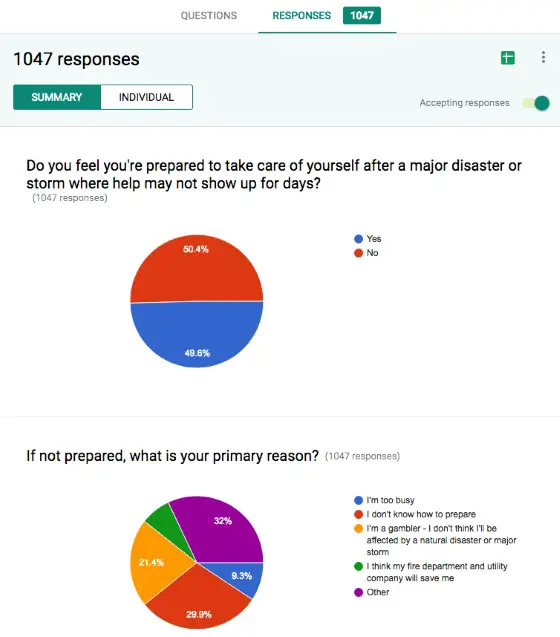
These survey results are not good. Over half the people admit to NOT being prepared. Image credit: Google Inc. (C) 2016
Fast Facts
A big disaster is going to strike where you live. It could be a hurricane, a huge flood, an epic blizzard or a terrorist attack. I don’t know when it will happen. It could be brutally cold or blazing hot when it happens. Think about how many days a year at your home that it’s comfortable to camp in your front yard.
Stop thinking now that the local fire department and police are going to help you in a major disaster. Most people don’t realize they’ll be busy working to get help to larger community assets like hospitals, retirement homes, and any other business that supplies basic needs to the community as a whole. You and your home are at the bottom of their priority list.
Think about how many fire trucks are in your city or town. Then think about how many people or houses are there. That should wake you up like a bucket of ice water to your face. The same is true for utility repair trucks and employees.
What to Do
I feel the best way to get ready to take care of yourself, and your possessions, is to think about going camping. What would you take with you if you were going to do a primitive camping trip where there are no utility hookups?
You’ll need plenty of water. You can get by for days without a shower, but you’d be surprised how much water you need to drink and might need for food preparation and clean up. Some can be stored in bathtubs, but you could need barrels of water to make things comfortable.
Food is easier. Canned foods and dried foods are easy to store. I have a large supply of five-gallon buckets that have gasketed screw-off gamma seal lids. These can be stacked easily and you’d be stunned how much rice, beans, and dried foods can be put into a five-gallon bucket.
Realize that in the event of a huge disaster, our food distribution network is based on just-in-time need. Local grocery stores don’t have enough food in them for all in the neighborhood in case everyone shows up at once.
You’ll probably need a camp stove and fuel to cook. You can buy inflatable solar camp LED light lanterns that will create some light at night. Maybe you’ll be able to have a fire, so do you have access to firewood? You might need a cord or two of dry, split wood. How will you start the fire?
What about shelter? Maybe your home will be habitable and maybe it won’t be. I’ve got a nice shed that could be used as a shelter. If that doesn’t work, I’ve got a small enclosed trailer that could keep me and my family out of the weather. It would be cramped, but we’d stay dry and out of the wind.
Have you thought about your important papers, documents and photos? Much of these can be scanned and put onto hard drives, thumb drives or stored on remote servers. You need to gather all your important papers and digitize them. Wills, insurance policies, treasured secret family recipes, any irreplaceable photos, letters or contracts must be preserved.
Get a small address book and record in writing all important names, phone numbers and email addresses. You have all this now on your computer or cell phone, but what happens if they get destroyed or you can’t power them up?
If you’re thinking of getting a portable generator, you really need to think about fuel. Larger generators can consume lots of gasoline. How can you safely store lots of gasoline? It’s not easy and it may not be legal to do in your city or town. Are you sure your local gas station can dispense gas in a disaster? No one may be there, the in-ground tanks could be empty or there could be no electricity to operate the pumps.
The bottom line is you need to follow the Boy Scout motto and just Be Prepared. There are hundreds of free checklists online for getting ready. Look at many and take from each one what works best in your situation. There’s no spandex list that works for all.
Above all, don’t forget to create a go or bug-out bag. This is a small day pack that has the absolute minimal things you need to survive for even a day or two. There are many go bag checklists online. Get one before you don’t have Internet access!

Tim built custom homes and did ultra-custom remodeling for 20+ years before launching his Ask the Builder media presence. He was selected as one of the Big 50 by Remodeling magazine in 1993. This award gave birth to Ask the Builder in October 1993. Tim also operates https://DrawPlumbingPlans.com. His @askthebuilder YouTube channel was the first home improvement channel on YouTube.
Great article, and reminder. Thank you for sharing this.
Thank you for keeping me on. We have grand children in the Dallas area and we live in Berwick, LA.. .70342
As it is we spend a third of our time in Texas and the rest in Berwick then a few days in Lafayette and another new baby and usually a day or two in Baton Rouge and the New Orleans area when we need to go to doctors in NOLA or Miss Jacki wants to run the roads.
You left out one important disaster that potentially includes the whole west coast. It's commonly referred to as "The Big One"! A massive earthquake that would affect the whole region. Possibly much of the PNW, and on down the Pacific coastline.
Recovery would, like the other disasters mentioned, take not just days to recover, but weeks to bring a slight relief, and months into years to achieve.
My only suggestion to add to this article, and there could be thousands as being prepared could be doing so much, but the basic thing that few have, that I feel safest having in every home, is a wind up powered radio, flash light combination device. There are many of these devices, yet radio transmission will be the available network that can provide information about circumstances, the one thing that eases panic greatest.
Hi Tim. A great article. Long ago I was talking to a manager of a Costco store and he said they turn over the entire contents ( expressed in $$) every 48 hours. As he said 'obviously we don't actually replace everything every 48 hours but the stuff that turns over the most is food.'
If trucks can't get through that's a lot of people going to be disappointed.
Regarding the bug-out bag, I would suggest that if someone can't actually leave one packed, that they at least leave a complete list of what they would need in a suitcase or roll-on. That way they'll just have fetch the stuff if needs be. In an emergency it's easy to forget things!!
One last thing I might suggest is to take a copy of your homeowner's policy with you. The last thing people need is to find themselves dealing with an insurance company with no documentation to refer to.
Jim
Great article with a lot of good advice Tim.
Another good asset is to have a few friends and neighbors that you can count on as a team member, in the event of a disaster. Each one has a unique quality and diverse amount of items. This makes it easier for every individual not having to have all the tools and supplies needed to survive for an extended period of time, plus it's a great moral support system.