Concrete Slabjacking Tips
©2017 Tim Carter
Concrete Slabjacking TIPS
- Soil under slabs can sink
- Compacting soil is a must
- Slabjacking usually a better deal
- Concrete slurry is common filler
- Expanding foams are good fillers
DEAR TIM: The concrete patio on my new home is sinking. It used to tilt away from the house. Now it tilts back towards the house.
A similar thing is happening to the concrete slab inside my neighbor's garage.
What do you think caused this to happen? Could it have been prevented? Is there a way to fix the problem, other than installing new concrete? S.W.
DEAR S. W.: There is a very good possibility that both concrete slabs were installed on poorly compacted fill dirt. Sub-surface erosion and shrinking soils are also possibilities. Fill dirt is almost always placed along side of house and garage foundations after the foundation work is completed.
Compaction A Must
Rarely does a builder take the time to compact this dirt. Mother Nature will do the job, but she sometimes takes years to complete the task.
Void Spaces
Soils consist of solid particles and the spaces (voids) between these particles. The void spaces can be filled with either water and/or air. Void spaces are great for grass, bushes and trees.
However, void spaces in soil can cause big problems for buildings and concrete slabs. Concentrated loads, such as buildings or slabs can literally squeeze air and water from soils. When this happens, the soil sinks and the buildings or slabs follow closely behind.
Self-Compacting Fill
Your problem could have been avoided. Instead of installing fill dirt, your builder could have installed granular fill such as sand or a sand and gravel mix. These materials can be compacted quite easily with a hand held vibratory compactor. This material should also be used to fill trenches that cross sidewalks and driveways.
Pea gravel is a great self-compacting fill material. It's small rounded rocks about the size of green peas. Think about how tight marbles compact if put into a box or are otherwise constrained. The same is true for pea gravel.
If you use a granular fill that's got sand in it, be sure to add water when compacting to really drive the small sand down further into the fill material.
Pinning Slabs
Your builder also could have pinned your slab to your house foundation. This process involves drilling holes into your foundation and inserting steel bars (pins). A network of inexpensive steel reinforcing bars are then fastened to these pins.
The concrete patio or slab is then poured with this steel roughly in the center of the concrete. Should the soil beneath the slab settle or sink, the slab stays in place, supported by the pins. Do not use this method for structural slabs (those that support the weight of a structure or machine).
Haunches
Slabs next to foundations can rest on haunches. These are just like shelf supports that are cast as part of the concrete when the foundation is poured. They're often used to support front and back-porch slabs.
Local Contractors
If you are fortunate enough to have a slabjacker in your area, you should not have to replace the concrete. CLICK HERE to get FREE & FAST BIDS from local contractors that do slabjacking. It could save you lots of money.
Slurry
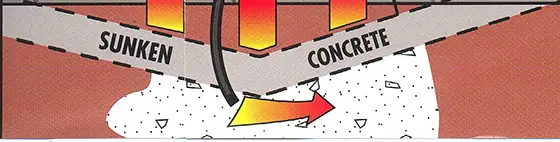
These individuals can float a slab back to its original position by pumping a mixture of sand, cement, fly ash, and other additives beneath your slab. Not all companies use the same product to lift the concrete.
Foam Fillers
You may find a company or two that pump two fast-reacting chemicals that combine and expand under the concrete slab. These chemicals form a structural polyurethane foam that is unaffected by water that may seep under the slab.
Foam is a great material. Just be sure the foam can handle the weight you intend to apply to the slab.
2-Inch Holes
To install the mixtures or chemicals under a tilted or fallen slab, they simply drill strategically placed holes into the slab. Using a portable pump and flexible hoses, they fill these holes with the special mixture.
Lifting a slab using this method can often be accomplished in a few hours. Often the cost to perform this service is less than half that of replacing a new slab.
Benefits
There are numerous benefits to slabjacking. It can be done in virtually any weather. The material injected beneath the slab provides a strong base. There is little or no disruption to landscaping.
Nothing needs to be moved off the slab, as the pump can lift the weight of the slab and anything you have placed on it. This should be great news for your neighbor!
Column 086

Tim built custom homes and did ultra-custom remodeling for 20+ years before launching his Ask the Builder media presence. He was selected as one of the Big 50 by Remodeling magazine in 1993. This award gave birth to Ask the Builder in October 1993. Tim also operates https://DrawPlumbingPlans.com. His @askthebuilder YouTube channel was the first home improvement channel on YouTube.
You wrote that the material injected beneath the slab provides a strong base. My brother has some concerns about the stability of his foundation, and has been considering hiring a slab jacking professional. The stability that it can provide could go a long way in protecting the structure. Thanks for the read.
You're most welcome. TNX for stopping by trying to get a swig of my SEO juice. Sorry to deprive you.
I have a small (2'x5') 6 or 8 inch thick step to my screened-in porch and sidewalk that are tilting toward the house. I have some foundation cracks under the porch there where the bricks holding the porch slab is under the doorway. The are all topped with flagstone. Do you think the step and slab could be jacked without damaging the foundation wall behind it?
Tim
I have a different problem.
I joined my wife at this house 24 years ago. Several years before that she had to have the foundation jacked up, the water line repaired & placed above the footing, and a 2' X 3' patch in the garage floor.
The whole concrete floor is now being pushed up. The patch is pushed up more than the rest of the floor. We thought that the foundation was sinking again, but a contractor told us that was unlikely because the foundation walls were level.
Can you help at all?