Low E Glass Benefits
Low-E Glass Benefits TIPS
- Not new but a must-have on your windows
- Bounces heat back to its source - saves energy
- Soft and hard coat and films too
- Pro installers can get you the best Low-E CLICK HERE
- CLICK HERE to Get Tim's FREE & FUNNY Newsletter!
DEAR TIM: My husband and I will be building a new home soon. Our windows are available with optional low-E glass. Just what is low E glass? Does it really work?
Are there different types? Will it block ultraviolet (UV) light? Is the argon gas necessary? Do you think it is worth the extra money? E. R.
DEAR E. R.: Window glass was revolutionized in the 1970's.
Single Became Double
Insulated glass (two or more pieces of glass with a dead air space between) made its debut in the early 70's. Prior to this almost all window glass was a single pane.
Low-E Glass Next In Line
Low E glass was introduced in 1979. The E stands for emissivity. Low E glass works by reflecting heat back to its source. It does this by utilizing an ultra thin metallic coating on or in the glass.
Among other things, sunlight contains visible light, UV light, and infrared (IR) light. Visible light enables us to see things. Ultraviolet light damages your skin, wood, fabrics, and causes colors to fade.
Free & Fast Bids
IR = Infrared Bouncing Is Good
Infrared light is basically heat. Low E glass has the ability to allow visible light to pass while blocking certain amounts of UV light and IR light.
The infrared light in sunlight is powerful. When it strikes an object it heats it up. These objects can be your tile floors, furniture, sidewalks, patio furniture, etc. As these objects cool off, they emit a low powered form of IR light.
Cooler House In Summer / Warmer In Winter
Low E glass reflects this form of energy. In the summer this helps to keep your house cooler, as the heat from objects outside is kept outside. In the winter, all objects in your home are heated (by either the sun or your furnace). This heat is also bounced back into your house by the low E glass.
Hard & Soft Coat
There are two types of low E glass: hard coat and soft coat. Tin is applied directly to the molten glass to make hard coat low E glass. It is hard to scratch the tin off the glass. The soft coat process commonly involves the application of a thin layer of silver while the glass is in a vacuum.
This coating is delicate. Soft coat low E glass is always sandwiched with another piece of glass. It can also oxidize if exposed to air. Argon gas is sometimes used to prevent this oxidation. This gas also acts as an additional insulator.
Low-E Glass Detector
If you need to test a window to see if it does have low-e glass, you're in luck. There are high-tech low-e glass detector tools that do this. Here's one:
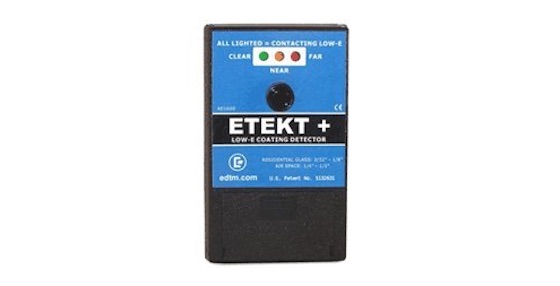
Here's a low-e glass detector. CLICK THE IMAGE TO LEARN MORE OR BUY IT.
Helps Reduce Condensation
Low E glass helps to reduce condensation on glass. The inside surface temperature of the glass is warmer.
The differences can be dramatic. Imagine a cold night with an outside temperature of 0 degrees and a 15 mph wind.
The inside temperature of a single pane window would be approximately 26 degrees. Regular double pane glass might register 35 degrees. Hard coat low E glass would be very near 49 degrees. And weighing in at champ would be soft coat low E glass at 62 degrees.
Low-E Film
Some glass manufacturers have gone even farther. They have suspended thin, low E transparent films in between pieces of glass. This system has excellent performance characteristics. Some of these films can block 99.5 percent of UV light. Some boast an insulating value twice that of soft coat low E glass.
Low E glass is worth the price, especially since houses tend to lose 25 percent of their heat through windows. Purchase the highest quality low-E glass you can afford.
Column 097

Tim built custom homes and did ultra-custom remodeling for 20+ years before launching his Ask the Builder media presence. He was selected as one of the Big 50 by Remodeling magazine in 1993. This award gave birth to Ask the Builder in October 1993. Tim also operates https://DrawPlumbingPlans.com. His @askthebuilder YouTube channel was the first home improvement channel on YouTube.
When washing my Milguard windows with a product that removes hardened water stains, will I damage the low-E finish or is the finish between two pieces of glass? Thank you, Constance
I don't know. Has Milguard APPROVED the cleaner you intend to use?????? I'd make sure!
I am trying to replace some 3mm low e glass damaged in a recent hail storm. The glass is a light blue color, I suspect that it is a ppg product, possibly Azuria 3mm, however I have been unable to find anyone who carries or distributes it, any suggestions?
I am hoping to purchase la z boy leather furniture. The high back sofa will sit 2-3 inches above the windowsill. I have an older double pane window that can't take film without cracking in time. I want to replace the windows, 8 ft. wide x 3 1/2 ft. high (middle window with two sliders on either side) almond trim. What is the best UV window to get? Most seem to be 94% UV.
One that's AAMA approved. CLICK the following URL and read all my columns that talk about AAMA windows. Then get the best 3M film to block UV. Go here first:
http://www.askthebuilder.com/search-results/?q=aama
I own a 4000 sq ft single story stucco on block home, aprox. 25 years old. It currently has single glazed windows, Just replaced ac and heat pump with a seer of 16, and am waiting on my insulating contractor to install R38 blown in fiberglass along with 3 solar attic fans. I assume my next move will be good to excellent double glazed low e argon filled vinyl windows. Your advice on improvements already completed, and will i also save my summer electric enough to make up the cost of the new windows
Is there an Energy Star cirtificate with high quality windows. Any help and advice will be much appreciated,........Thanks again,, and Best Regards, Al.