Wood Deck – Clean / Seal
DEAR TIM: I have asked three different people and received three different answers about cleaning and sealing my new wood deck. Is it necessary to apply a sealer to a brand new wood deck? Do you need to clean new wood before applying the sealer? What is the best method to clean wood decks? I have had bad luck with past sealers. Is there one that resists mildew and algae? What is the best weather to clean and seal decks? Larry C., Apple Valley, CA
DEAR LARRY: I have had the same thing happen to me. Out of curiosity, I frequently ask employees of home centers and paint stores how to approach deck cleaning and sealing jobs. I have yet to get the same recommendation from two different people. What's worse, there is a considerable amount of questionable information being distributed. It turns out that many traditional wood deck cleaning and sealing products and methods might not be best for your new wood deck investment.
Unprotected wood is immediately attacked as soon as it is exposed to the sun's ultraviolet (UV) rays and water from snow, rainfall, and dew. The UV rays actually blast apart the wood cells on a microscopic level. This damage permits water to penetrate deep into the wood. This water can accelerate wood rot in untreated lumbers such as cedar and redwood. In addition, repeated water soakings lead to excessive shrink and swell cycles that result in cracking, cupping, and twisting. For these reasons, it is necessary for you to quickly seal any wood product that is exposed to outdoor elements.
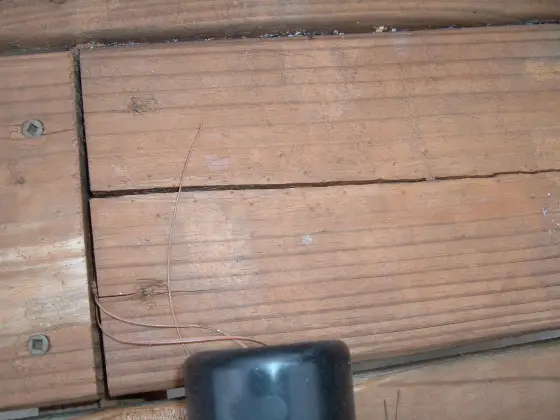
This decking split can get worse if the wood is not sealed on a regular basis. Water soaks deeply into unsealed wood and causes it to expand. As the water leaves the wood, the lumber contracts. This movement causes the split to grow in size and length. PHOTO CREDIT: Suzanne Wieczorek
Independent lab tests have shown that it really pays to clean new wood before it is sealed. The lab results indicate that sealers can penetrate up to 25 percent deeper into new wood that has been cleaned with an oxygen bleach solution. The cleaning action opens the wood pores of the freshly milled lumber. Oxygen bleach is a unique product. It does not remove the natural color from wood. What's more, it is non-toxic to plants that surround your wood deck. It also does not harm wood fibers. It is safe to use oxygen bleach on all woods except redwood. I have successfully used oxygen bleach on redwood, but in certain instances it has been known to darken it. If you want to be completely safe, use oxalic acid to clean redwood. Existing wood decks have to be deep cleaned before they are sealed.
Often I have been told by salespeople to use chlorine bleach to clean wood decks. Chlorine bleach - sodium hypochlorite - is a fantastic sanitizing product if you want to kill germs, however, it creates havoc when used on wood. Chlorine bleach removes natural wood color, destroys wood lignin (the glue that holds wood fibers together), can corrode metal deck fasteners and hardware, and can kill vegetation that surrounds decks.
 Your disappointment with many wood deck sealing products is shared by many consumers and testing labs. Apparently many of the commonly available deck sealants contain wood protecting resins made from natural products such as tung oil, vegetable oil, linseed oil, and animal fat. These oils are gourmet foods for mildew and algae. To slow down mildew and algae growth, the sealers often contain toxic fungicides and mildewcides.
I have had the fantastic luck with synthetic penetrating water repellents. Look for ones that are formulated using synthetic oils and resins. These products contain no food for mildew and algae. If you want maximum performance and protection, be sure to use a pigmented (colored) product not a clear product. The pigment particles absorb and deflect UV rays helping to protect the wood.
I have found that cooler weather with daytime temperatures of 60 - 70 F are best for cleaning and sealing decks. The cleaners do not evaporate quickly and the penetrating water repellents have adequate time to seep deeply into the wood before the sun can evaporate them. Avoid hot, windy summer days for deck cleaning and sealing. Reserve those for fun in the sun, not work!
| Message from Tim:
Years ago while researching a column about cleaning decks, I discovered the wonders of Oxygen Bleach. It is perhaps the 'greenest' cleaner I know of as it uses oxygen ions to break apart stains, dirt and odor molecules. There are no harsh chemicals, and it works on just about anything that is water washable. I decided to create my own special blend using ingredients made in the USA. In fact, the raw materials in the active ingredient are food-grade quality registered with the FDA. I call my product Stain Solver. I urge you to use it to help clean your deck surfaces. You will be amazed at the results! |

Tim built custom homes and did ultra-custom remodeling for 20+ years before launching his Ask the Builder media presence. He was selected as one of the Big 50 by Remodeling magazine in 1993. This award gave birth to Ask the Builder in October 1993. Tim also operates https://DrawPlumbingPlans.com. His @askthebuilder YouTube channel was the first home improvement channel on YouTube.
Have you ever heard of making homemade weather sealant with kerosene, diesel fuel.motor oil, transmission fluid optional for tint,color. Does it work and how long would it last.the smell should go away after awhile.I have a lot of wood to do and was looking for a less expensive way, Thank You.