Different Deck Piers and Wet Basements and Yards
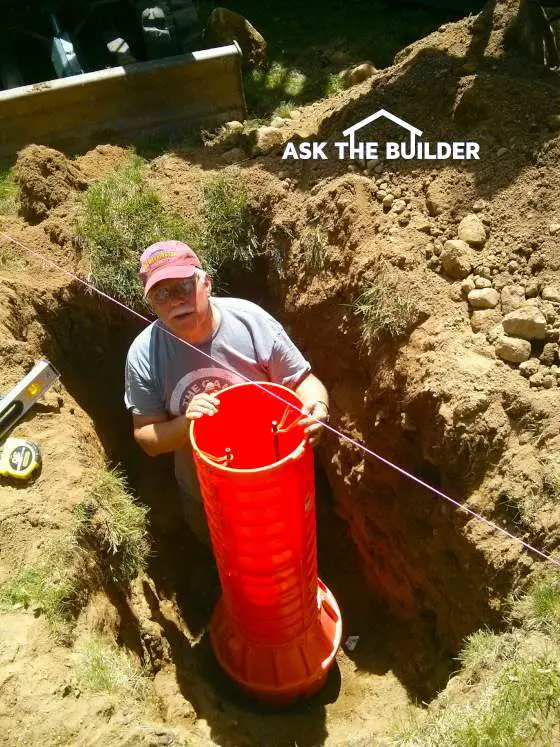
This is me setting a deck pier form. Yeah, they need to be that deep in the ground in New Hampshire to prevent frost heave. (C) Copyright 2018 Tim Carter
Different Deck Piers
QUESTION #1: Tim, can you explain why I need concrete deck piers under the wood support posts that hold up my deck? I saw an older deck where the posts just rested on pre-cast concrete stepping stones. The deck seemed fine to me. Are deck piers overkill and a way for contractors to just rip me off and make more money? - Cynical Sarah, Cincinnati, OH
You might be a distruster like Sarah if you’ve been burned once or twice by unethical and dishonest contractors. The ecosystem deals with these bad people and it’s harder for them to operate now that you can use the Internet to share your horror story.
However, any contractor that says you need deck piers for your new deck or to expand an existing one is giving you great advice. Deck piers are the foundation for a deck just like your home most likely has footings and foundation walls.
There are quite a few reasons why you need piers not the least of which is to spread out the concentrated loads of the deck posts across a larger footprint on stable and strong soil.
Decks are heavy, very heavy. Pick up just one treated-lumber 2x12x16-foot floor joist to get an idea. If your deck is bolted to the side of your home and has two posts that support the structure, usually half the total weight of the deck is bearing on the tiny 4x4 posts.
These wood posts resemble spike high heels some women wear. Several thousand pounds of weight might be pressing down on the two posts. This kind of concentrated load on 2-inch-thick precast concrete paving stones can crack them like you’d snap a fresh saltine cracker.
Another key point is the deck structure must be immune from frost heave damage. Here in central New Hampshire where I live, the soil freezes in the winter and I’ve seen it rise up at least 4 or 5 inches. The bottom of the deck piers must be placed deep enough in the soil so the pier can’t move up and down. This movement can wreak havoc on any structure.
It’s important to realize that the shape of the deck pier is critical. It’s a good idea to make the bottom of the pier larger than the top. The base of the larger bell-shaped pier can then distribute the weight across more soil.
Reinforcing steel should be placed in deck piers to make them as strong as possible. In almost all cases two 1/2-inch steel bars extending vertically in the pier is sufficient. Some DIY deck pier forms come with the reinforcing steel already cut and bent.
I’ve created a page at my website that has illustrations of different deck piers and numerous videos of me showing the deck pier I love to use. Go to: Deck Piers
Wet Basements and Yards
QUESTION #2: Hello Tim! A spate of recent rainstorms has created not only a wet basement at my home but also a backyard that resembles the Okefenokee Swamp. Is there a way to prevent the water from entering my basement as well as drying out my yard? If a method is available, is it DIY friendly? - Wet Walter, Woodstock, VA
Wet basements, crawlspaces, and soggy yards are some of the most frequent problems homeowners like you ask me to solve. The good news is I’ve helped tens of thousands of homeowners stop water from entering their homes. What’s more, I’ve dried out thousands of acres of land at the same time!
My college degree is in geology with a focus on hydrogeology and soils. Water tends to move sideways through most soils that have a medium to high clay content. Almost all land has a slope to it that you can use to your advantage to capture subsurface water before it comes in contact with your foundation.
It’s important to realize you need to capture all roof water from your home and pipe it to the lowest part of your lot. You then need to dig a 6-inch-wide trench around two, or more, sides of your home that resembles a moat around a castle. The trench might be as shallow as one foot or it can be several feet deep. A perforated pipe is placed in the trench and the trench is filled with rounded or angular gravel the size of grapes or walnuts.
The perforated pipe extends to the lowest part of your lot as well. Water flowing through the soil encounters the large gravel, it drops through the gravel and then enters the pipe. The water flows through the pipe, out onto the ground away from your home and continues its journey to the ocean.
I’ve got lots of other trench drain installation tips at my website as well as a video showing you easy DIY methods to install one of these superb trench drains. Go to: Stopwater

Tim built custom homes and did ultra-custom remodeling for 20+ years before launching his Ask the Builder media presence. He was selected as one of the Big 50 by Remodeling magazine in 1993. This award gave birth to Ask the Builder in October 1993. Tim also operates https://DrawPlumbingPlans.com. His @askthebuilder YouTube channel was the first home improvement channel on YouTube.