Vapor Retarders Will Stop Odors and Moisture
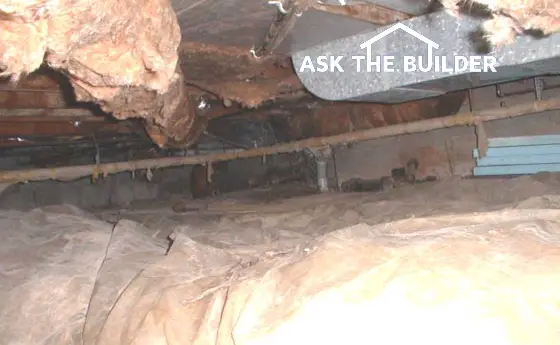
The dirt in this crawl space is covered with traditional clear poly. It can have thousands of pinholes and allow vast amounts of water vapor to escape up into your home.
Vapor Barrier in the Crawl Space
DEAR TIM: Our home is a hodgepodge of construction. We have a medium sized basement, a crawl space, and a part of the home built on a slab. The house always has a musty odor and damp feeling. I am constantly battling mildew on just about every surface. There is no water leaking into my home. Is this mustiness damaging my home? What is causing this to happen? Is there a way to eliminate and/or minimize it? Paula B., Culpeper, VA
DEAR PAULA: Have I got good news for you! Your mildew fighting days are going to be over very soon. Not only that, the air within your home will soon be dry and fresh smelling. Fortunately, much, if not all, of the work required to stop the musty odor can be done by yourself if you are willing to use a pump sprayer and wiggle around in the crawl space for a half a day.
The musty odor is caused by water vapor that is entering your home through the concrete walls, slab, and the dirt beneath your crawl space. The invisible vapor can elevate interior humidity levels that will easily support the growth of mildew and other microorganisms. If you stop the water vapor from entering your home, you can cause these tiny creatures to die of thirst.
It is important to stop water vapor movement in homes. If the water vapor comes into contact with wood surfaces that are cool or cold, the vapor turns into liquid water. This liquid water can accumulate inside of exterior walls and up in roof and attic spaces. If enough water is present, wood rot and decay can cause significant damage.
To stop the water vapor from entering the crawl space, I suggest that you install a high quality vapor barrier. Before you run out and purchase the standard 4 or 6 mil clear as shown in this photo or black polyethylene at the home centers or hardware stores, be aware that some of these products are often a single layer of plastic, are made from recycled plastic resins, and can contain fillers, pin holes and imperfections. Certain alkaline soils can actually degrade these plastic films.
A better choice might be high density cross laminated virgin polyethylene. These vapor barriers are made with two sheets of high strength puncture resistant virgin polyethylene that cross each other at right angles. The sheets are bonded to one another and stop virtually all water vapor movement. Special tape is available that allows you to effectively seal any seams where the plastic needs to overlap or be cut to fit around pipes, posts or other items that project from the soil of the crawl space.
If you want to install the vapor barrier in the crawl space professionally, you simply need to lap the material up the sides of the foundation walls. Apply strips of treated(ACQ) lumber at the top edge of the plastic. Use regular masonry nails to attach the strips to the foundation walls. Trim any excess plastic that projects beyond the wood strips. Apply a bead of standard caulk at the top of the wood strips to complete the job.
The concrete walls and floor in your basement and the remaining floor slabs in the house and garage can be sprayed with some unique water based chemicals. These products are basically a liquid water vapor that penetrate into concrete surfaces and block water vapor movement. Because they are water based, they can be safely sprayed indoors near furnaces or water heaters. Avoid the use of solvent based products indoors. These products produce vapors as they dry that represent a severe explosion hazard around any open flames or spark ignition appliances.
These liquid vapor barriers are often colorless. Once they dry, there is usually little trace of their presence. If you have rooms that are going to be re-carpeted soon, you can tear up the old carpeting, clean the floor and apply these chemicals before the new carpeting is laid. These high quality liquids and sheet vapor barriers can be found at specialty concrete and building supply businesses that sell products to contractors.
Author's Notes:
I received this email from Michael P, Cincinnati, OH. Here's how he helped with his crawl space problem.
"I live in Turpin Hills and wanted to thank you for your advice for sealing a crawl space. This is our third winter in our home and the basement is always much colder than previous basements from other homes. I did as you suggested and put heavy duty, thick plastic on the gravel and put doors on the opening of the crawl space. It's been a few weeks and I can see water droplets forming under the plastic. I may put a second layer of plastic for good measure. The basement is warmer and so is the room above the crawl space. I don't smell the mustiness either. Thanks again for the tip."
Here's another one from Marilyn W. in Troy, MI with a similar issue.
"I read your answer concerning musty smells coming from crawlspace and slab foundations. The musty smell is in our cottage. Part is a slab and part is a modified crawlspace that we can not get under. The space is too small and there is no entry. If we remove the carpet and spray the the floor with the liquid water vapor barrier, would this take care of the smell? It is closed a good part of the year, and when we do open and use it, the smell permeates everything including our clothes, hair etc. Please help us make our cottage usable. Thanks!"
Column 279

Tim built custom homes and did ultra-custom remodeling for 20+ years before launching his Ask the Builder media presence. He was selected as one of the Big 50 by Remodeling magazine in 1993. This award gave birth to Ask the Builder in October 1993. Tim also operates https://DrawPlumbingPlans.com. His @askthebuilder YouTube channel was the first home improvement channel on YouTube.
The previous owners of our house has cats and dogs. They had the litter box in the basement on bare concrete and the cats didn't always go in the litter box. We've scrubbed and sealed the concrete but almost a year later the smell is back (although not nearly as bad). Could I use the Vapour Barrier you recommend in this article as a smell barrier underneath carpet padding on the concrete floor so we don't have the smell issue anymore and can finish our basement?
Suzi,
I'd first flood the area with certified organic Stain Solver oxygen bleach for several DAYS. You need to mix up a new small batch every 6 hours.
Stain Solver is a FANTASTIC de-odorizer and I use it here at my house to get rid of male cat spray. It COMPLETELY eliminates the odor.
https://www.StainSolver.com