Reinforcing Steel in Concrete
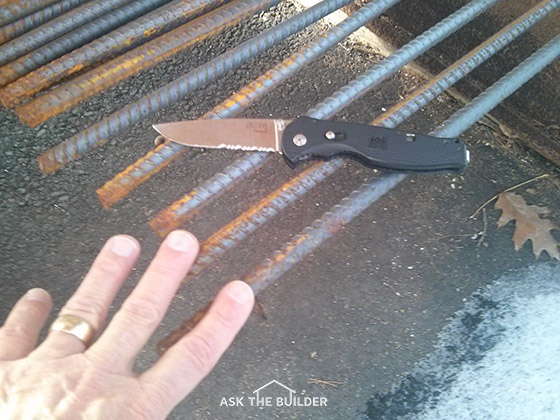
This is 1/2-inch rebar. The rods are almost always 20-feet long. Hand and pocket knife for scale. © 2017 Tim Carter
Reinforcing Steel in Concrete TIPS
- More cement means more strength
- Steel is 100 times stronger than concrete
- Use steel rods or mesh
- WATCH concrete videos below!
- CLICK HERE to get Tim's FREE & FUNNY Newsletter!
DEAR TIM: I am having a large amount of concrete work done at my house. As you know, it can be expensive. I want the concrete to last and last.
What are the secrets to long lasting concrete that does not crack, scale, or fall apart? The concrete walks and driveway in my childhood home are in very good shape and my guess is that these surfaces are nearly 40 to 50 years old!
Is it still possible to install concrete that will last longer than I will? Beverly D., Schaumburg, IL
DEAR BEVERLY: Concrete is one of the most abused building materials that I am aware of. All too often the people who work with it have absolutely no formal training with respect to how the material needs to be specified, placed, finished, and cured.
Basic Components
The components that make up standard concrete are very basic - gravel, sand, water, cement, and certain additives. But the science surrounding concrete is very, very complex. Scientists invest their entire lives studying it and producing professional papers. Perhaps the top organization that is the center of the vortex with respect to concrete science is the Portland Cement Association.
CLICK HERE to get FREE & FAST BIDS from local concrete flatwork contractors.
Cement Glue
Installing concrete that will last a lifetime is absolutely possible. The process begins by ordering concrete correctly.
Always keep in mind that the cement powder in the mixture is the glue that holds the sand and gravel together.
More Cement = Strength
You can order concrete with different amounts of Portland cement in it. The amount of cement is directly related to the overall tensile, bending or stretching, force of the cured concrete. You might order concrete in these strengths, all in pounds per square inch (PSI):
- 2500
- 3000
- 3500
- 4000
- 5000
Some regions of the USA have you order it based on the number of bags of Portland cement there are per cubic yard of finished concrete. A typical bag of Portland cement weighs 94 pounds. A mix that produces 4,000 PSI has six bags, or 564 pounds of cement in each cubic yard of the concrete.
Guidelines
If you have small amounts of glue the concrete will be weak. Concrete suppliers and concrete trade associations have developed tables that tell you and your builder how strong concrete needs to be for different applications.
For example, concrete used in standard residential foundation footings can be lower strength than concrete used for outdoor patios, sidewalks and driveways. The average person might think the opposite is true.
Concrete Videos
Watch these videos. I've got many more at my AsktheBuilder.com YouTube channel.
Ice & Concrete
Concrete exposed to freezing weather must be a minimum of 4,000 PSI strength. Remember, this is a MINIMUM recommendation. You can always order it stronger.
Concrete exposed to the weather can absorb water. This water soaks into the surface of the concrete and then freezes. When water freezes, its volume increases by nine percent.
This crystal growth can tear apart concrete that's not strong enough to resist the forces. Adding air to the concrete helps create spaces where the ice crystals can grow into.
Want perfect concrete work? Find a pro by using my Concrete Work (Sidewalks, Driveways, Patios & Steps) Checklist. I offer a 100% Money Back Guarantee.
It Shrinks
I know you don't want to hear this but concrete is supposed to crack. As concrete hardens it begins to shrink ever so slightly. In fact, concrete shrinks 1/16th of an inch for every ten feet of length that is poured.
Crack Control
Wise concrete finishers know this and install contraction or crack control joints that encourage the concrete to crack at these locations. For the joints to work correctly they need to be a minimum depth. Always make sure that these joints are cut 1/4 or more of the thickness of the slab.
CLICK HERE to get FREE & FAST BIDS from local concrete flatwork contractors.
Steel A Must
Concrete is incredibly strong when you try to squeeze or compress it. But it has only about 10 percent of this strength if you try to stretch or bend it. This bending or stretching happens if the soil is weak under the concrete or say a heavy vehicle drives onto the concrete.
The concrete wants to bend or snap much like you'd snap a toothpick in two. The bending or stretching force is called tension.
You can prevent small hairline cracks from offsetting or widening by installing reinforcing steel.
Wire mesh and one-half inch diameter steel bars are readily available and very inexpensive. This steel needs to be in the middle of the concrete or slightly above the middle of the slab to provide the necessary reinforcement.
Super Strong
Reinforcing steel has enormous tensile strength. The average piece of rebar, or reinforcing steel rod, has a tensile strength of 40,000 pounds.
That means you need to apply 40,000 pounds of pulling or stretching force to rip apart the steel rod.
The average concrete you order from the ready-mix plant only has 4,000 pounds of tensile strength.
Beware Water
Water is needed to mix and cure concrete but if excess water is added to concrete after it leaves the central mix plant or is mixed into the surface of concrete during the pour or finishing activities, it can severely harm the concrete.
IMPORTANT TIP: Water added to already mixed concrete can dilute the amount of cement in the mixture. This added water weakens concrete just as added iced tea to your half empty glass at a restaurant dilutes the sweetness of the remaining tea.
Cure Concrete
Once the concrete is finished, it needs to be cured. The water within the concrete fuels a chemical reaction called hydration that continues to happen within the concrete for weeks and months. If this water evaporates from the concrete too rapidly, then the concrete might never achieve its design strength.
Curing Compounds
Liquid spray curing compounds can be added to the concrete as soon as the concrete finisher completes his/her final trowel stroke. You can also cover concrete with sheets of plastic. Curing is a simple step that is often neglected.
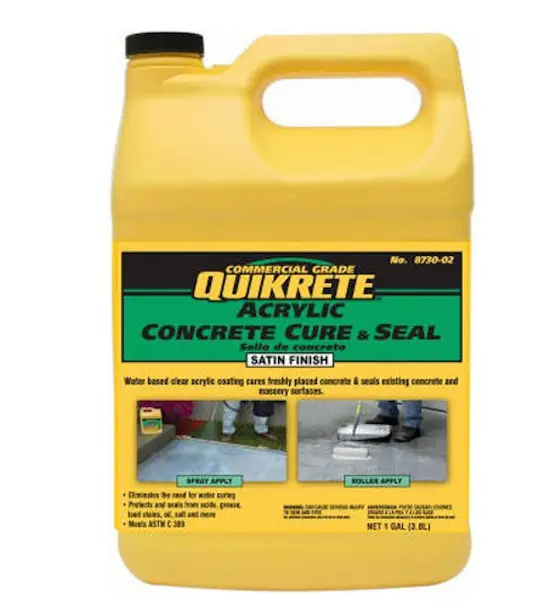
This is a typical concrete curing compound. They're liquid you spray or roll onto stiff concrete. CLICK THE PHOTO TO SEE A VARIETY OF THESE AMAZING LIQUID PLASTIC MATERIALS. THEY DRY CLEAR.
I can assure you that concrete that is specified, mixed, placed, finished, and cured in accordance with industry accepted guidelines will last and last. The biggest problem I feel you are going to have is finding a concrete contractor that is familiar with these guidelines.
Concrete Associations
If you mention Portland Cement Association, American Concrete Institute, or World of Concrete to a contractor and his eyes glaze over, then keep looking!
CLICK HERE to get FREE & FAST BIDS from local concrete flatwork contractors.
Column 322

Tim built custom homes and did ultra-custom remodeling for 20+ years before launching his Ask the Builder media presence. He was selected as one of the Big 50 by Remodeling magazine in 1993. This award gave birth to Ask the Builder in October 1993. Tim also operates https://DrawPlumbingPlans.com. His @askthebuilder YouTube channel was the first home improvement channel on YouTube.
Question . Am going to cross a river with a cable bridge 700 ft .tower needs to be 20ft + tall how much of a footing do I need deep & wide. KEN Thank you.
Ken,
You need a structural engineer.
You mentioned that's it's almost inevitable for the concrete to crack. You mentioned that these joints can make up for that 1/16th that comes from the shrinkage. I think the joint and metal reinforcing it would help it out.