Minimize Cracks while Pouring Concrete
Minimize Cracks while Pouring Concrete
DEAR TIM: Is there a magical trick or an incantation one has to recite to make sure ugly cracks don't appear in new concrete work? There must be something the contractors can do to minimize or eliminate cracks. Tell me it can be done? Marsha B., Fort Pierce, FL
DEAR MARSHA: I'm sorry to say that even the best voodoo princess can't guarantee you crack free concrete. Concrete is indeed a magical material when you think of it. It begins its life as a fluid or plastic material and then within a few hours it becomes solid. This transformation is actually a chemical reaction and the hardness occurs because billions of microscopic crystals grow in between the sand and rock particles to make up a solid matrix.
What causes the cracks while pouring concrete?
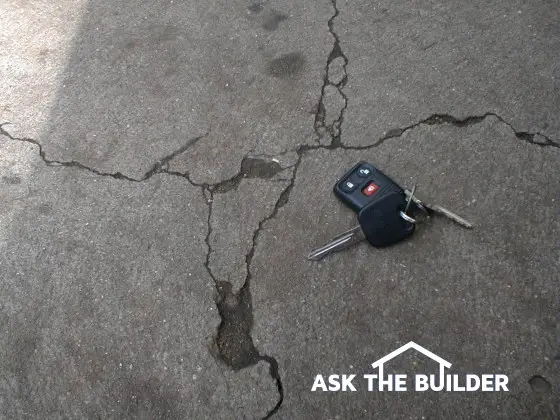
The crack trouble can sometimes be traced to the water used in the concrete mix. As the water is consumed by the chemical reaction that creates the crystals, the concrete actually shrinks. Typical concrete used in residential work tends to shrink about 1/16th inch for every ten lineal feet. This shrinkage produces a tension force within the slab and the concrete can and will tear itself apart just as you can tear a piece of paper.
What are control joints?
The trick is to persuade the concrete to crack where you want it to crack. You can do this by creating weak zones within the slab. Contractors call these control joints. To the average homeowner these joints look like decorative lines. The principal is to make the slab thinner by cutting a line in the slab or by removing actual material so that the concrete doesn't crack randomly. It is no different than creasing a piece of paper several times before you rip it apart. Do this and frequently you get a straight line when pulling the paper apart. Concrete reacts in the same way if you make the cut or the line deep enough.
Want perfect concrete work? Find a pro by using my Concrete Work (Sidewalks, Driveways, Patios & Steps) Checklist. I offer a 100% Money Back Guarantee.
But concrete masons often fail to do this. The control joint depth needs to be a minimum of one fourth the slab thickness. If the slab is four inches thick, the control joint needs to be a minimum of one inch deep. Frequently the tool a mason uses only cuts a line 5/8 inch deep. If the contractor chooses to saw cut the joint, he should frequently check the depth of the saw blade to insure that the saw cut line meets or exceeds the minimum depth.
How can cracks be minimized?
Cracks can also be minimized before the concrete is poured. The ground beneath the slab needs to be solid. Don't pour concrete over trenches that were filled with uncompacted material. If a utility line trench passes under a driveway or sidewalk, be sure the contractor fills this portion of the trench with self-compacting gravel or a special lower cost mixture of concrete, sand and fly ash. Soil should be compacted with machines that eliminate air pockets within the soil. Concrete will crack readily if subjected to tension forces. This is exactly what happens if a car drives over concrete that is bridging a hollow spot in the soil.
Reinforcing steel is also a great preventative crack control measure. This steel holds the concrete together and is often 100 times stronger in tension than the actual concrete itself. If your contractor uses reinforcing steel be sure it is suspended within the concrete and not laying on the soil before the pour. Steel at the bottom of a slab is virtually useless.
You can also order concrete that contains millions of polypropylene fibers. These fibers knit the concrete together and help to prevent random cracking. They are often inexpensive and once the concrete is finished they tend to blend in with the finished surface.

Tim built custom homes and did ultra-custom remodeling for 20+ years before launching his Ask the Builder media presence. He was selected as one of the Big 50 by Remodeling magazine in 1993. This award gave birth to Ask the Builder in October 1993. Tim also operates https://DrawPlumbingPlans.com. His @askthebuilder YouTube channel was the first home improvement channel on YouTube.