DIY House Electrical Wiring
DIY House Electrical Wiring TIPS
- Cable TV shows are not realistic - don't believe them
- National Electric Code is COMPLEX - get a copy to see how to do things
- Electrical fires are real killers - wires arc and overheat
- Don't chance it - hire a pro to do wiring if in doubt
- CLICK HERE to Get Tim's FREE & FUNNY Newsletter!
DEAR TIM: I'm getting ready to tackle some electrical projects around my home. After watching different home improvement television shows, it appears really easy.
What are some of the most common mistakes a homeowner makes when working with 120 and 240-volt wiring around the house?
Am I starting this project with a false sense of security/safety? Kristin N., Ft. Lauderdale, FL
DEAR KRISTIN: Often I have to get up out of my chair and walk out of the room when I watch many of the home improvement shows on television.
Cable TV Shows Are For Entertainment - Not Teaching
I get so aggravated that I simply can't continue to view the program. Important information is often either left out of the broadcast show or it is simplified to the extent that the average person thinks they can successfully complete a project.
If you're a rookie or newbie electrician who is starting an electrical project with little or no experience, I urge you to reconsider. Household electricity can be very dangerous.
Fires Are The Danger - Not So Much Electrocution
Every day in the USA there are over 100 house fires that are caused by electrical malfunctions or mistakes. Many people die in these fires and survivors can be seriously burned.
While people get shocked each day from touching live wires, my guess is there aren't too many deaths caused by this error. A lurking fire that starts in the middle of the night with no warning is the far greater possibility.
In comparison, I rarely have heard of a person drowning in their own home because of a plumbing leak or burst pipe. Electricity must be treated with the utmost respect.
Steve's Dimmer Switch Fire
My close friend Steve and his wife Karin had a fire start in a wall switch. It was a dimmer switch that started to melt because it overheated.
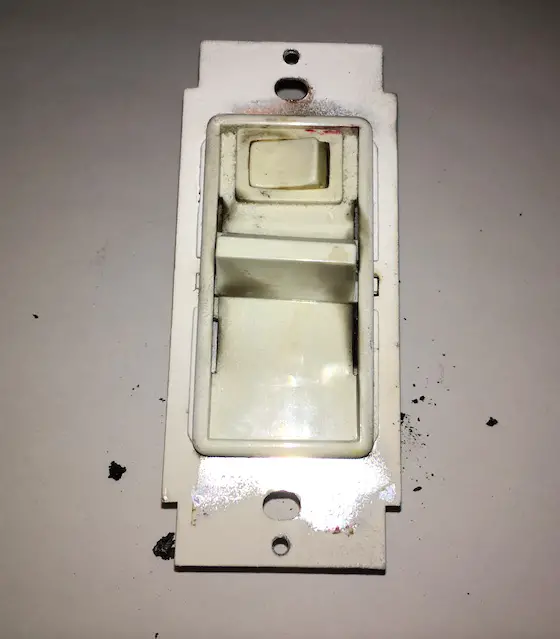
This switch looks somewhat normal, except for the soot around the edges. Wait until you see the back. (C) Copyright 2016 Tim Carter via anonymous friend contribution
CLICK HERE to see more photos of the dimmer switch that caught on fire.
Free & Fast Bids
CLICK HERE to get FREE & FAST BIDS from local electricians who can keep you and your family SAFE.
Learn The Code
Once you know what you are doing and can fulfill all of the requirements in the National Electric Code (NEC) with respect to wiring in your home, electrical projects can be completed with relative ease. The issue is the NEC is complex and it's an extensive list of requirements.
Most of the language and terms used in it would sound like a foreign language to a non-electrician like you.
CLICK HERE to order a copy of the NEC. It's expensive, but worth it.
Simple Mistakes = BIG Trouble
The trouble is, a rookie can create hidden problems that may manifest themselves in the form of a short circuit or shock hazard. Since electricity is invisible, these hazards can't readily be seen.
Here's a simple list of possible mistakes you might make:
- mixing wire gauges in a circuit
- installing too big a circuit breaker for wire size
- nailing cable staples too tight
- installing the wrong-sized electrical boxes
- reversing polarity on outlets
- etc.
I could go on and on and on with other possible mistakes you might make.
Missing Ground Wire
Some older homes do not have ground wires at switch and outlet locations. It is very tempting for a homeowner to install a grounded outlet receptacle in place of the old fashioned two prong outlet. This is a huge mistake.
Keep in mind that it's a code violation to install metal cover plates on ungrounded receptacles or over ungrounded boxes. In the event of a short circuit, the cover plate can become energized and deadly.
Popular Switch Videos
Watch these three videos to get a feel of how to wire a single-pole, a 3-way and a 4-way switch.
CLICK HERE to get FREE & FAST BIDS from local electricians who can keep you and your family SAFE.
Flush Boxes
Electrical boxes that aren't flush with combustible interior wall surfaces can sometimes cause problems. If a homeowner adds wood paneling to a room, the recessed electrical box may be in violation of the code.
Special extension rings can solve this problem but you need to know about it before you get too far into the project.
No Floaters
Switches and regular outlets aren't allowed to float near the surface of the finished wall.
This can happen if the electrical box is not nailed to the wall studs so it's flush with the finished wall material. If the electrical box is slightly recessed, then the finished wall material must be solid and filled in so the small metal tabs of electrical outlets and switches touch the wall when the mounting screws are tightened.
Watch this video to see exactly how to handle this situation.
Often a rookie electrician will not screw them tightly to a recessed box because the cover plate will not look right. This is a very dangerous situation as the wires connected to the switch and outlet can flex and wear each time the device is used.
Secure Cables
The plastic coated wire that runs between outlets, switches and your electrical panel is actually called a cable by those in the electrical trade. These cables need to be securely attached to wall studs or beams.
But a rookie can get into trouble if the staples that attach the cable are driven too tightly or at an angle. The wires within the cable can be damaged or nicked.
Use Right Gauge
One of the biggest dangers is using the wrong sized wire for a circuit. Electrical wire comes in different gauges or thicknesses.
The common gauges of wire used in residential USA wiring is 14, 12 and 10-gauge wire.
I know it doesn't make sense, but the smaller the number the thicker the wire is. Here's the amperage capacity of each of the common sizes:
- 14 gauge = 15 amps
- 12 gauge = 20 amps
- 10 gauge = 30 amps
The thicker the wire, the more electrical current it can safely handle. If you use too small a wire on a given circuit, the wire can overheat and short out before the fuse of circuit breaker trips or activates.
Circuit Breakers Protect Wire - Not You
Keep in mind that circuit breakers and fuses are meant to protect the wires in the circuit, not you. You must match wire sizes with the fuse or the circuit breakers.
Strip Small Amounts
The electrical code is also very specific about the length of the stripped wires that are attached to switches and outlets. Too much stripped wire extending from the inside of an electrical box causes big problems as you push the outlet or switch towards and into the electrical box.
Complex - Hire A Pro
Are you starting to get the picture? Working with electricity requires lots of knowledge and a firm grasp of the National Electrical Code. There are also many good books that explain and illustrate many common household electrical projects. I urge you to read those before you proceed with your projects.
Column 392

Tim built custom homes and did ultra-custom remodeling for 20+ years before launching his Ask the Builder media presence. He was selected as one of the Big 50 by Remodeling magazine in 1993. This award gave birth to Ask the Builder in October 1993. Tim also operates https://DrawPlumbingPlans.com. His @askthebuilder YouTube channel was the first home improvement channel on YouTube.