Foundation Choices Are Many
By
©1993-2012 Tim Carter

        
Summary: The foundation of your home is important. An extra 20 inches of concrete will give you full-height eight foot finished ceilings in your basement. You could also get a slab on grade or crawl space basement.

DEAR TIM: I'll be very brief. My wife and I are building a new home soon and wonder which foundation is the best. Should we do a simple slab on grade, a crawl space or a full foundation with a basement? What are the pros and cons of each? Daniel V., Potsdam, NY

DEAR DANIEL: You are fortunate to have all three choices. Many people, because of local soil and groundwater conditions, often have only one or two options when it comes to house foundations. In certain places, constructing a full basement means blasting through solid rock. In other places, the ground water table may be lurking just a few feet below the surface limiting these folks to a simple slab on grade.

The slab on grade choice is very attractive to builders because of its relatively low cost. Excavation is kept to a minimum and the construction schedule can often be accelerated. The day after the slab is poured, wall framing can often begin.

But slabs come with some baggage. Frequently, plumbing drainage and water supply lines are buried beneath the slab. If something goes wrong or a leak develops, repairs can be costly. Heating or cooling ductwork buried underneath the slab can sometimes fill with water during wet seasons. Should this happen, mold can form and spores might be blasted into the home each time the furnace or air conditioner fires up. Thermal conduction issues are always present. Slabs poured in colder climates can conduct cold back into the house unless special precautions are taken. Homes built on slabs often offer little protection during tornadoes or hurricanes, unless a special masonry or concrete safe room is built within the house. These safe rooms can masquerade as a large walk-in closet.

A foundation system that sports a crawl space is indeed a step or two above a slab foundation. Generally speaking, a footing needs to be poured and short foundation walls are built to support the home. Some crawl spaces are indeed just that offering only 16 to 18 inches of clearance between the bottom of the floor joists and the soil. Other crawl spaces are tall enough to crouch in. Crawl spaces are a slight money saving option. Little time is saved during construction when a crawl space is selected in lieu of a full height foundation.

Crawl space foundations allow you to install plumbing and heating utilities so that they are accessible. The floor system over and the foundation walls inside of the crawl space almost always need to be insulated. A high performance vapor barrier that is sealed to the foundation walls must be placed over the soil in the crawl space. If this vapor barrier is missing, water vapor will readily travel up into the wood floor system and then into the house. This water vapor can cause severe mold problems. Homes built over crawl spaces offer minimal protection in severe weather unless you can install a trapdoor in a closet that allows quick entry into the crawl space.

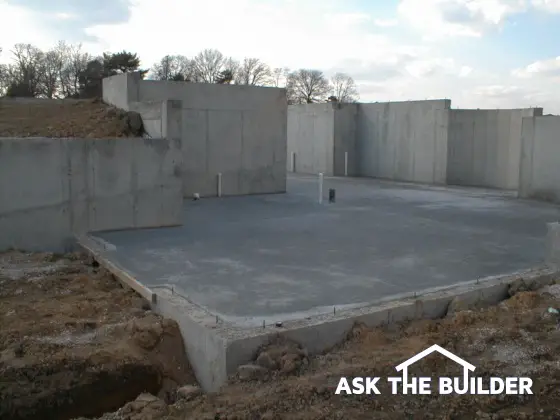
Ask any homeowner who has a dry full height foundation and they will often tell you they would never be without one. The cost per square foot for this bonus space is often a fraction of what you pay for the living space stacked above it. If you do an actual cost analysis of a full height foundation versus a crawl space, you will find it costs very little to upgrade to the full foundation. Talk to experienced Realtors or appraisers in your area. They will often tell you that full basements make a house more attractive to potential buyers.

A full foundation offers superb protection in the event of severe weather. During the wet season it is not a challenge to keep a basement bone dry. The builder simply needs to apply a real waterproofing material such as synthetic rubber or liquid asphalt that has rubber additives. These materials can bridge small hairline cracks that might otherwise leak water. If you intend to finish off the basement space at a later date, be sure to install a true waterproofing material not the traditional hot asphalt dampproofing spray.

Finally, if you can afford the extra cost, ask your builder to consider extra height foundation walls that allow you to have a clear ceiling height of eight feet or more beneath any and all beams that support floor joists. Furthermore, increase the height of the actual steel I beams. If you go from a traditional eight inch beam to a twelve inch high beam, the support columns in the basement can often be placed as far apart as 16 to 18 feet.


Still Need Help? Type Your Keywords Here:
(examples: drywall repair, pilot light goes out, poor lot drainage, crown molding guide, etc.)

Comment on Facebook

Your Facebook friends would love to know how this column helped you solve your problem. Type a quick comment of what you discovered here at AsktheBuilder.com. Thanks!


Comments:

Welcome! I, Tim Carter, don't answer questions here. If you post a question here in the Comments Area, perhaps another visitor will help you. You need to go to the Ask Tim page if you want a question answered. Once there, look closely at how many weeks behind we are. Please be patient as you use this free service. If you have an emergency and need to talk to me, there is an option there for you.
Kathi
02 Apr 2008, 14:27
My husband and I are going to be building an addition. Our existing home is on a slab with a four foot footer. Our addition will have a full height basement. We want to do as much of the work ourselves. We have heard something of a different type of block that when finished has an R rating of 50! I think it's a plastic block that you fill with concrete? Do you know anything about this? Where can I find more info about it?
Thank you for any help.
Kathi
AsktheBuilder
05 Apr 2008, 09:25
Kathi,
I think the R-value you state is in the stratosphere. I have written about these wonderful blocks. Go read all of my past columns where I discuss Insulated Concrete Forms. Use my Search Engine at the top of the page.
Sandra Kelch
06 Jul 2008, 23:11
We have a newer home build on a slab... the grey water is also going into the septic tank, soaps from washing machine, etc. Is there anyway to re-route when plumbing is in the slab? Would like to keep all grey water out of tank. Not sure what we can do to fix our septic system. Any suggestions will be appreciated.
Bob Burns
17 Feb 2009, 17:27
Hi Tim,I'm emailing from Australia.I'm about to re-stump my house foundations.The stumps are 75x75x4mm rolled hollow steel sections,set 1000mm into the ground, with an average height of 1000mm from the ground surface to the bearers under the house.Due to previously poor drainage, water has been able to lie around the stumps at the point they enter the concrete footing for many years.the stumps have rusted through at this point.Because of the obvious working height restrictions it's virtually impossible to remove the old stumps!!Can I therfore simply add the new 36 stumps as close as possible to the old ones,with out too much concern?????Best regards Bob.
Jackie
22 Feb 2009, 12:05
My husband and I are looking to buy a house. In some of the older homes the floors seem to be warped. They hump up. What causes this?
Tim Taylor
18 Mar 2009, 18:15
I am starting a project that will start with a brick fence at the entrance of the property. There will be nee for water to through the fence in one area. I am not sure how to provide proper foundation for the exteriior fence, (entrance to property). Do you have any ideas of how to build the foundation for the fence and provide a culvert aswell. Just thaught I would ask.

The project is on a cattle ranch and the owner wants to creat a new pleasing entrance, stone construction. I want to create afoundation that will last and of course support the stone for many years.

Thanks, Tim
B
07 Apr 2009, 22:13
Who do I call to have the joists fixed. The house has a crawl space.
Someone told me it would be easier to tear the floor up to fix the joists vs. crawling under the crawl space.
sandie
06 May 2009, 05:30
My home has a crawl space underneath with a small concrete area for storage. When it rains a lot of water stands under house(not on concrete area). We plan to add dirt-but should we put down a vapor bearer? If so, what kind and where do we find it. We checked at Home Depot. They were not sure. Thanks Sandie
Trevor Davis
07 May 2009, 11:39
Dear Tim
I am looking for to see how to seal an newly poured basement that has foam forms. I have the understanding that if you use normal basement seal, it will eat the foam? Is this true, if what would some one use. Please reply to sgttdavis@yahoo.com
amanda
01 Oct 2009, 16:39
I have a doublewide home on a slab and we want to add a large addition on a foundation off the end of the home, and connect the slab with the new foundation. how do you waterproof the side of the foundation that will attach to the house, will digging under the slab enough to work to build the foundation cause the house to shift? are there any books you could recomend to do it youselfers to show us step by step instructions on how to do this? also is it ok to have 3 walls of a block foundation that will not be backfilled, meaning the one attached to the home and slab would be underground and the other 3 open as this is being built in a spot were we have to dig out a hill and it is not deep, it goes downhill, and we also want to put windows in the revealed walls? i hope i make sense :) thanks

     View all comments
*Name:
Email:
Notify me about new comments on this page
Hide my email
*Text:
Security Image:

Visual CAPTCHA


Remember, Tim Carter doesn't answer questions here in the comments. You need to go to the Ask Tim page.
 
Have a Suggestion?
Do it right, not over!

Ask the Builder Comment Help

Thanks for stopping by! The Comments Section of my AsktheBuilder.com website is a place for you to share stories about how you've solved a similar problem at your home or carry on a conversation with other visitors. I tried, at the beginning, to be part of the conversation, but there were too many questions being asked and it was impossible for me to keep up and get my regular work finished each day.

If you want to ask me a direct question, you should go to the Ask Tim page of this website.

Helpful Comment Tips: If you need help with a problem, please try these things now before you type in a comment. You could discover your answer in just minutes.
Don't show this alert again.