Ask the BuilderAsk the Builder
Ask the Builder's on:

Subscribe to askthebuilder's videos

Air Conditioning
Asphalt - Blacktop
Brick
Building Tips
Cabinets
Caulk
Ceilings
Ceramic Tile
Checklists
Chimneys
Concrete
Concrete Defects
Concrete Installation
Condensation
Countertops
Deck Construction
Deck Maintenance
Design
DIY
Doors
Drainage
Drywall - Plaster
DVDs
EBooks - EDocs
Electrical
Energy Savings
Engineered Wood
Fences
Fireplaces
Flooring
Foundation
Garage Doors
Glossary
Glue
Hardware
Heating Design
Home Builders
Home Depot Stories
House Plans
Hurricanes
Insects
Inspections
Insulation
Interior Walls
Kitchen
Lighting
Lots
Miscellaneous
Mold
New Construction
Newsletters
Online Courses
Outdoor Projects
Painting - Staining
Patio
Payments
Plumbing Design
Plumbing Supplies
Projects
Radiant Barrier
Remodeling
Retaining Walls
Roofing
Rough Lumber
Screened Porches
Sheds
Siding
Specialty Accessories
Stone
Storage
Structural
Stucco - EIFS
Tools
Trim Lumber
Vapor Barrier
Ventilation
Videos
Walk Throughs
Wallpaper
Windows


Handicap Ramps

By Tim Carter
©1993-2008 Tim Carter
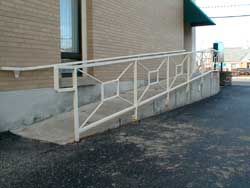
Summary: Handicap accessibility for your loved one with a handicap requires planning. Handicap ramps should meet the needs of the individual. Building handicap ramps requires a little bit of your high school math. To build a proper ramp for people who are physically challenged, you may want to exceed minimum standards for ramps to make the ramp easier to navigate at your home.

DEAR TIM: After years of using a walker, my father's condition has worsened. He is now confined to a wheel chair. I have to have a ramp built so that he can get into and out of our home. I have seen many ramps but what are the necessary specifications to build one? How wide should they be? What is the slope? How do you calculate the slope? What is the best material to use for the ramp? Is this a do-it-yourself project? Becky D., Visalia, CA

DEAR BECKY: Years ago I had a business partner who required a wheelchair. His sons built a circuitous ramp from his driveway up to the living level of his home. Although the ramp worked for him, I doubt it would meet the minimum specifications outlined in the Americans with Disabilities Act(ADA) for handicap ramps. Fortunately, for you and your dad, there is an enormous variety of handicap ramp systems available to you. Some are even factory-built and can be shipped to your home.

There are minimum specifications that have been developed for handicap ramps. These specifications are not mandated for ramps built at private homes, but they do work well for many people who are confined to wheel chairs. Certain aspects of the specifications can be fairly complicated if the ramp has lots of turns and has to climb a significant vertical distance. If your ramp is simply a straight shot from bottom to top, then the job is somewhat straightforward.

The most basic specifications for handicap ramps are as follows:

  • the maximum slope of the ramp is one inch of rise for each linear foot of run
  • the minimum clear inside width of the ramp between guardrails is 36 inches
  • the maximum rise for any given ramp segment is 30 inches. After rising 30 inches in elevation, a flat rest platform must be provided before the ramp continues to climb
  • flat landings must be at the top and bottom of all ramps
  • landings should always be as wide as the ramp itself and a minimum of 60 inches in length
  • handrails/guardrails must be on each side of the ramp. The top of the handrail must be at least 30 inches above the ramp and no more than 38 inches above the ramp measured vertically

Keep in mind that some of these specifications are minimum standards. In other words, if your father is very frail, a slope of one inch rise per one foot of run may be too steep for him. You may be forced to build a ramp that has a slope of one inch of rise for every 18 inches of run. The recommended specifications say a 36 inch width will work. In reality, you may find this to be too tight. You may want a 42 or even 48 inch wide ramp should you have the space.

When calculating total slope for your ramp, you must determine the end point of the ramp. The total vertical rise of the ramp is not equal to the vertical distance or sum total of the stair risers of your current front or back steps. Keep in mind that the sidewalk leading up to a flight of steps might also be sloped. This additional vertical distance must be factored into your total rise. Be aware that there are all sorts of ramp designs that can work in very tight situations. Although a straight ramp is often the most desirable, you may find that your ramp will have several switchbacks with 180 degree turns. Every situation is a little different.

A concrete ramp offers superior slip resistance if the final surface is finished with a wood or magnesium float. This creates a sandy surface that provides fantastic traction even in wet weather. But concrete ramps are a challenge to build. You can purchase factory-built ramps made from steel or aluminum. They meet all ADA standards. But if you live in a cold climate, they may ice up in certain weather conditions. Wood ramps are an affordable alternative, but they can get very slippery. Wood ramps must be kept clean or be covered with a slip resistant material such as rolled roofing, which has a slip resistant ceramic granular surface.

Unless you have significant building experience, ramp construction is not a do-it-yourself project. A project of this nature requires several skill sets. The best thing to do first is to have the ramp designed by a professional architect or other individual who can visit your home and make an assessment of what can and can't be done. Once you see the final plans of exactly how the ramp needs to be built, you will most certainly have a grasp of what it takes to do such a project. It is also a good idea to contact your local building and zoning department. You must make certain that your ramp will not be in violation of any ordinances or code requirements.


Comments

Carolyn
07 Dec 2007, 10:21
need how to build a wheelchair ramp for a business. Carolyn
David
17 Dec 2007, 08:24
Tim,
I am having an addition constructed to accomodate a child confined to a wheelchair. Included in this addition is an interior ramp. The issue is what to use as a final "floor" covering for the ramp. At the top and bottom of the ramp is tile, but there are concerns that the tile will be too slippery. We also looked into cork, but have been told it wouldn't be durable enough. Any suggestions for a material which would provide the safety we need and the aesthetics we desire? Thank you in advance for your suggestions
AsktheBuilder
17 Dec 2007, 09:05
David,
Cork will absolutely be durable enough. I would apply satin urethane to it for this purpose. A fantastic surface that is very slip resistant is rubber. You can get attractive rubber tiles at a specialty flooring store or a online suppliers.
Lesia Young
18 Dec 2007, 10:02
We are having to install a ramp,
it has to go up to a 5 foot landing,
How long should it be not to have a steep slope?
michelle
24 Jan 2008, 12:50
I just purchased a new building for my restaurant and need a 38 ft ramp because of the height of current stairs. I would like to only bring it out when needed as that size will take a great deal of current space...any suggestions?
Thanks a ton..
AsktheBuilder
24 Jan 2008, 16:15
Michele,
I can't solve that one! Hiding a ramp that big is a challenge. How would you ever know in advance when to deploy it????? You must have awesome mystic powers! :->
Karen
23 Feb 2008, 15:57
We had a ramp put in for me as I have a hard time with steps and there were some to get up to my side walk and then also into the house but they made it out of wood so it has been very slippery this winter any time it rained or snowed so I did read about the roofing materials to put on there but have heard there is some kind of paint to put on there also. What is the best recommendations for this as it is quite a long of ramp that I am dealing with. We did purchase some rubber strips from a hardware store but was not sure if they are successful. I know we can not do anything until spring when it warms up and dries out so in the meantime I am basically a prisoner in my own house on days that the weather is bad.
Thanks for any advice
Karen
AsktheBuilder
01 Mar 2008, 08:33
Karen,
What about rock salt? It will not harm the wood.
Frank
23 Mar 2008, 17:23
Karen,

I am a professional contractor as to your comment about the rock salt. It will help with snow but you will still have wet wood that will; be slipery. When it comes to wood ramps you need to coner the wood with some type of rolled roofing material there are several options, if it is a do it yourself kind of deal I would recomend trying an ice and water shield. Comes in a 50 foot roll and it is pretty easy to work with. The backing has a sticky feel and is covered by a peel away plastic and it can be cut with a utlity knife. I forget the exact but it is aroud 3 feet wide. It also has a granular surface, which is slip resistant when wet.
Frank
23 Mar 2008, 17:29
Michele,

Check into E-Z access ramps. They go together with minimal tools and a typical ramp the size you need 38 ft. can be assembled in about an hour. Storage is also minimal.

     View all comments
*Name:
Email:
Notify me about new comments on this page
Hide my email
*Text:
Security Image:

Visual CAPTCHA


Ask the Builder Comment Help

Helpful Comment Tips: If you need help with a problem, please try these things now before you type in a comment. You could discover your answer in just minutes.
  • Read ALL Comments Before Submitting One: If there are lots of comments that are already part of this column, there is a very good chance your question has already been answered by me or someone else.
  • Read Similar-Titled Columns First: The column above is almost always part of a two-or-three-part series. The answer to a question you may have is probably in a related column or in comments that are part of that column.
  • Read Columns in a Category: Take the time to read many columns in a category. The amount of information you will discover will amaze you.
  • SHARE a Story: Please share any tips or amusing tales of glory! Tell others what has worked for you. Maybe you have a disaster you want to discuss. Let's collaborate so we all learn together.
Don't show this alert again.