Connecting a New Foundation to an Old One
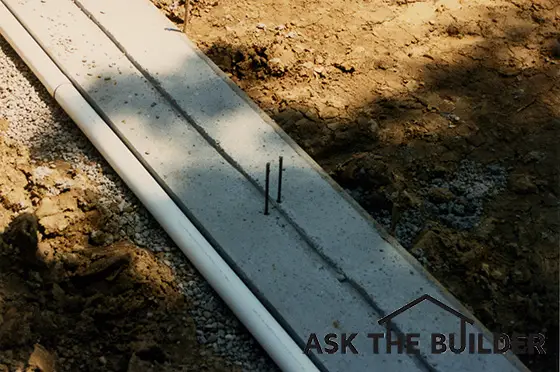
Connect new foundation to existing: Those two pieces of vertical rebar help lock two different pours of concrete together. You start the foundation with a footer or footing. This footing will soon have a foundation wall on it directly over the keyway groove in the concrete. The clay soil beneath it is extremely stable. © 2017 Tim Carter
"You have numerous options with respect to making a physical connection between the two foundations. I've successfully installed steel pins that are epoxied into the old foundation."
Connect New Foundation to Existing Checklist
- Soil strength is paramount
- Footing/foundation connected with steel pins
- Consult with a structural/soil engineer
- Piers are last resort
- CLICK HERE to Get Tim's FREE & FUNNY Newsletter!
DEAR TIM: I'm building an addition on my home and realize I must connect the new foundation with the existing one. What's the best way to do this? Is there a way to waterproof the connection?
Will this connection become a hinge point in the future causing cracks in the walls? I am very concerned about how to make a connection between the structures that will stand the test of time. Paul M., Orono, MN
DEAR PAUL: I can remember many years ago having these same thoughts when I was building my first room addition. I couldn't figure out how the shallow crawlspace foundation would stay connected to the full basement foundation since they were at different elevations.
My geology professors would have frowned at me had they been at the job site. I was not thinking through how to connect the new foundation to the existing one.
Is a Foundation Wall a Beam?
Many people fail to realize that a typical foundation wall is, among other things, a beam. You begin to see this if you look at the vertical web in a steel I beam or even a simple wooden floor joist.
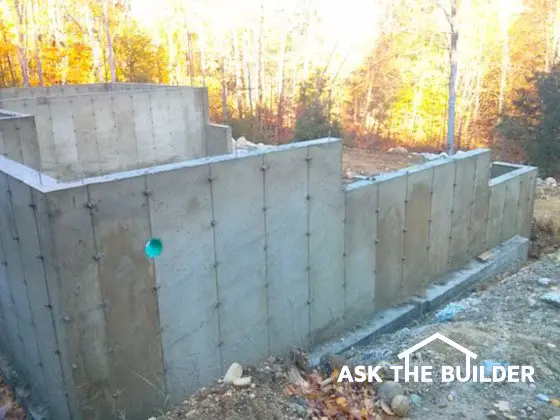
Note how the tall poured walls look just like the center web of an I-beam. Copyright 2018 Tim Carter
Understanding this is essential. Steel I beams derive much of their strength by the thickness and height of the vertical web section of the I beam. It's important to realize steel I-beams gain a great amount of strength from the top and bottom flanges. The top flange is the flat part that ironworkers walk on as they erect the steel.
Can Taller Beams Span Farther?
Generally speaking the taller the vertical web, the farther the beam can span between supports. You can see this clearly if you pay attention to bridges that cross many of the interstate highways you might travel here in the USA.
Some of the bridges span 100, or more, feet between the poured concrete supports at each end of the bridge. The steel I-beams are often 3, 4 or 5 feet tall whereas the typical I-beam in a house basement might only be 8 inches tall.
A foundation wall is no different other than the fact its vertical height is ten or fifteen times greater than a typical residential I beam.
How Important is Soil Strength?
The soil strength is the most important thing of all. Strong soil will not allow the new foundation to drop below the existing one you're connecting to.
If you accept this principal, then it stands to reason the foundation will not flex up or down if the soil beneath this beam is solid.
This is perhaps the most important aspect of connecting the two foundations. The soil under a foundation of the existing house and the foundation must be strong.
If it is, then there's no reason the room addition foundation will sink or pivot next to the existing house.
CLICK HERE to get FREE & FAST BIDS from local SOIL engineers to ensure your foundation is fine.
What are Foundation Steps?
Foundation steps are parts of a continuous wall that are different heights. When you face the wall the top of the foundation appears to be a giant staircase. The photo above shows a side wall with two steps to the right of the highest part of the foundation.
Foundation steps are used when a house is built on a steep or shallow hillside.
When new homes are built, it's often a common practice to pour different parts of the foundation at different times and at different heights within the soil profile. The fact that you are installing the foundations years apart instead of days will make no difference.
I was able to tape three videos of a new foundation going in for a detached garage being constructed here in central New Hampshire just two houses away from my own home. This was NOT my job. I was just a spectator.
Can Footings Be Stepped?
Yes, a footing can be stepped. These are necessary to keep the footing below the frost level when a house is built on a hillside.
But the garage had a stepped footer. Meaning the footer was at different levels just like your addition will be with respect to your home.
WATCH THESE THREE VIDEOS TO SEE FOUNDATION / FOOTING STEPS:
Should the Foundation Contain Reinforcing Steel?
The masonry foundation or the slab should also contain structural steel. Dual horizontal steel bars 12 to 16 inches from the top and bottom of poured concrete foundations help to create a stiff concrete beam.
Concrete block foundations can incorporate steel truss fabric that is installed in every other row of the concrete block units. Filling the hollow cores of concrete block foundations with a pea-gravel concrete slurry also adds strength.
Concrete slabs can contain 1/2-inch diameter steel bars on two-foot centers in both directions to stiffen the slab substantially. A residential structural engineer can easily specify the best solution for your particular situation.
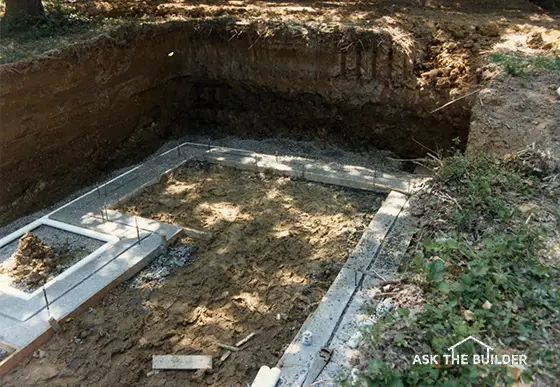
This is the footer under the laundry room portion of my home. Note the distinct soil profiles. My house is built on glacial till. In fact, both visible soil profiles may represent two separate glacial episodes! © 2017 Tim Carter
How Do You Connect a New Footing to an Existing One?
Use steel rods to connect a new footing to an existing one. Drill a hole into the existing footing the same diameter as the steel bar. The depth should be at least 4 inches. Hammer a 10-inch length of steel bar into the hole leaving at least 6 inches to extend into the new footing.
You have numerous options with respect to making a physical connection between the two foundations. I've successfully installed steel pins that are epoxied into the old foundation.
On other jobs, I've bolted a steel angle iron to the existing foundation. The concrete of the footing is poured on the flat part of the angle iron. You can see how it would help hold the footing to the existing foundation just as a shelf cleat hold a shelf in a closet or pantry
Is it Okay to Encapsulate the Steel in the Concrete?
These building components then become encapsulated by the masonry materials that are used to create the new room addition foundation. It's always best to hire a structural engineer to create a design for this connection.
This is especially true if you live in an area with expansive clay soils or an area that is subject to seismic movement.
CLICK HERE to get FREE & FAST BIDS from local STRUCTURAL engineers who'll help you.
Can the New Connection be Waterproof?
There are special waterproof connection materials that work well when connecting a poured concrete foundation to an existing one. These flexible waterproofing materials look like weatherstripping on steroids as they have small fins that project from the center of the main strip.
The base is epoxied and sealed to the existing foundation and the strip projects into the center of the foundation form. When the wet concrete surrounds the strip, you have a waterproof joint so long as the foundations do not pull apart from one another.
How do You Waterproof the New Foundation Connection?
I feel the best way to waterproof new foundations is to apply special waterproofing compounds to the exterior of the finished foundation. There are many different products and systems but all rely on excellent drainage around the foundation.
You need to make sure your drainage system can collect the subsurface water and transport it to a low spot on your property or into a sump pit where it can be pumped to a stormwater collection system.
Do Deep Piers Help in Weak Soil?
Yes, piers help hold up a foundation in weak soil.
Soil stability is everything when it comes to foundations. If the soil quality is suspect, you can ensure a stable foundation by installing piers under the foundation footer.
Piers can be made from concrete, steel or wood, but a common one is a simple vertical hole that extends into the soil until it finds bedrock or stable soil. This hole is then filled with concrete
Piers can be spaced at eight or ten-foot intervals and resemble table legs. The foundation, which is a beam, simply transfers its load down and through the individual piers instead of the unstable soil in between the piers.
CLICK HERE to get FREE & FAST BIDS from local STRUCTURAL engineers who'll help you.
Column 500

Tim built custom homes and did ultra-custom remodeling for 20+ years before launching his Ask the Builder media presence. He was selected as one of the Big 50 by Remodeling magazine in 1993. This award gave birth to Ask the Builder in October 1993. Tim also operates https://DrawPlumbingPlans.com. His @askthebuilder YouTube channel was the first home improvement channel on YouTube.
I am remodeling my house that is 25 years old. It has a basement except not under the garage. I wanted to remove the vinyl siding and brick the entire house from top to bottom however, I have been told it could be difficult to add brick since I have a basement. Do I have to go down to the basement footer to add a footer for the brick ? Or, could I dig a new footer along side my house? Or, attach something like metal to the house just below the soil line to support the brick? What options do I have and what would work best?
Hi there I'm having a water coming thru the basment due to cracks in fondation
I dig around fondation about 6 ft down and 2 ft wide if I fill that with new Cement will that stop the water coming in
Thank you for your help
Tony
An I-beam does not derive its strength from the web, it actually derives all strength from the thick flanges on the top and bottom. If a force acts on the top the top flange is compressed and the bottom becomes tensioned. This is why rebar is put in the footer to mediate the tension forces since concrete is not strong under tension. Just thought someone should correct this in the article.
Nick,
I hate to tell you this in public, but you're about as wrong as wrong can be. The taller the I-beam web, the stronger it is.
The flanges on top and bottom help to keep the beam somewhat straight so it's not like a wet noodle.
If you've ever handled a piece of flat steel like I used to do when using it as a flitch plate in between wood 2x12s, you'd know what I mean.
A piece of 3/8-inch flat steel gets quite a bow in it when you pick it up. But put flanges on it, and it stays damn straight for about the first 16 feet.
Hello Tim,
I am a Mechanical Design Engineer in Raleigh, NC and stumbled across this column while looking up concrete pier info. I must say I am shocked to read what you have written regarding the strength of an I-beam, and your contradiction of the previous poster, Nick. I can definitively tell you from years of studying engineering, specifically statics (physics of stationary structures) that the strength of an I-beam is derived from the flanges and how far the flanges are spaced apart from each other by the web. The web is basically just there to keep the flanges aligned and offset. This is why a floor joist can be drilled close to its center (but not along the edges), and why the web of an I-beam can be drilled without significant weakening. This is why trusses are strong but have open webbing, but must have continuous top and bottom plates. Without the flanges, an I-beam is simply a flitch plate (without carrier joists) which is nowhere near as strong as an I-beam. With only one flange, an I-beam is angle iron or rib, which is also not as strong as I-beam. When you add top and bottom flanges and load the beam, the top flange will go into compression and the bottom into tension and about 2/5 of the way down in between (in the web) feels no force. For more explanation, look up static forces on I-beams or beam stress diagrams. There is a wealth of info out there. Good luck.
The strength of an I-beam differs based on both the web and the flanges (and radius at which the flanges and web meet). An I-beam with a short web is much stronger than the same I-beam with a tall web (all other aspects being equal) - when the pressure applied is not vertical, but at any type of angle.
For vertical-only pressure, the web impacts the strength of the I-beam more than the flange and to some degree the radius of the web to flange "mating" point. Of course, as the web increases in height, it would typically also increase in thickness to provide the additional support to withstand/support greater vertical only pressure.
Don't discount the radius of the connection point between web and flanges - simply changing (increasing) the radius on an I-beam increases the non-vertical pressure it can support/withstand. A hard 90 angle radius (zero radius) is much weaker than web-to-flange radius of even 1/4".
Let us suspend this exchange of you say I say.
for all you nonprofessionals I would suggest you invest in a book, "Statics & Strengths of Materials", Bassin, Brodsky, Wplkoof, McGraw-Hill. This is a text directed at technical institutes and intended for Draftsmen, Engineering Assistants and the like. Read ( better yet)
study pages 230-318 it is all non-calculus! It was published in the 1980's and I expect that is still or a newer version may be available. Centroids, Moments of inertia, Beams, Shear Forces, Bending Moments, Loadings, Diagrams, Horizontal and Vertical Stresses, Max. and Min.,Radius of Curv--ature, deflection, Lateral Buckling. Who knows you may love it! ALL of you others. Take off the cloak and join the living... it may be fun.
My new house had wrong layout for the trench footer, garage wrong side. If new footer is made, how should these footers tie together? House is in FL, with cmu walls on footer.
What type of epoxy is used to fasten rebar pins to an existing wall?
Need a contractor to add approximately 40 square feet to an existing slab in a residential home in Bryan, Texas 77807. This area is an indentation of the slab when the house was built; I want to fill-in the indentation and add this area to the house dining area.