Concrete Block
DEAR TIM: I know this sounds crazy but I am thinking of building a home from concrete blocks. Are there any advantages? What about disadvantages? I am concerned about safety and cold temperatures. Will the block crack if it gets extremely cold? Melissa L., Braxton County, WV
DEAR MELISSA: Surely you are acquainted with fairy tales. Believe it or not, there is much wisdom in those great stories. Read the fairy tale about the three little pigs and you will quickly learn that a house built using masonry materials resists not only the big bad wolf but also wood destroying insects, fire and much more. Open any world history book or visit Europe and you will also discover things that built with stone and masonry materials can last for thousands of years.
A home built using concrete block is nothing new. Travel to the South today and you will see many homes built using concrete block. It is an excellent choice as termites can infest and start to destroy a wood framed home that does not have adequate protection. Concrete block homes that include easy-to-install steel reinforcing can stand up to vicious hurricane winds. Fire typically does not cause a well-built masonry home to collapse. These houses can often be restored with much less effort than a wood frame home destroyed by fire.
Concrete block homes also work well in areas that suffer from earthquakes. Once again the architect or engineer simply has to specify inexpensive steel reinforcing rods that are inserted into any number of hollow voids in the concrete block. A wet concrete mixture of sand, cement and sometimes small rounded gravel is then poured into these voids. This wet mixture surrounds the reinforcing steel and once it cures and hardens imparts incredible strength to the structure.
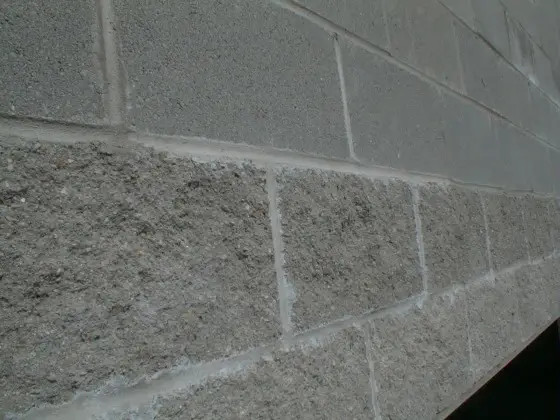
Here are two different styles of concrete block. The first two courses are split-faced block made to resemble stone. The block above it is traditional smooth-faced block.
It is vitally important that a registered engineer develop the specification for this reinforcing steel. It might also be in your best interest to have the engineer stop by the construction site as the home is being built to make sure the steel is being installed correctly. This may require more than one visit.
The thermal mass created in a concrete block home has numerous advantages. There is far less air infiltration if the home is built well. Concrete block homes are virtually soundproof if you purchase high-quality windows and doors that have excellent weatherstripping. The void space between the window and block must also be sealed well to stop air that acts as a sound-transmission conduit between outdoor noise and your ears inside the home. The thick masonry walls also help to maintain comfort within the home, especially if they are well insulated. Keep in mind that Native Americans used mud and masonry homes to stay cool in the extreme temperatures of the desert Southwest.
The disadvantages of building with concrete block are few in my opinion. There is a slight aesthetic issue. If your builder uses regular concrete block with no facing, your home will possibly look like a warehouse. You can purchase concrete block that has very interesting texture and shapes. Concrete block can be stuccoed readily and this extra masonry can be tinted to nearly any color so you will never have to paint the home.
You need not worry about concrete block and cold temperatures. If the block is well made and the builder installs it according to all industry standards, the block will withstand any cold weather Mother Nature can muster. The block and mortar will also resist repeated assaults of cold rainy weather for many years.
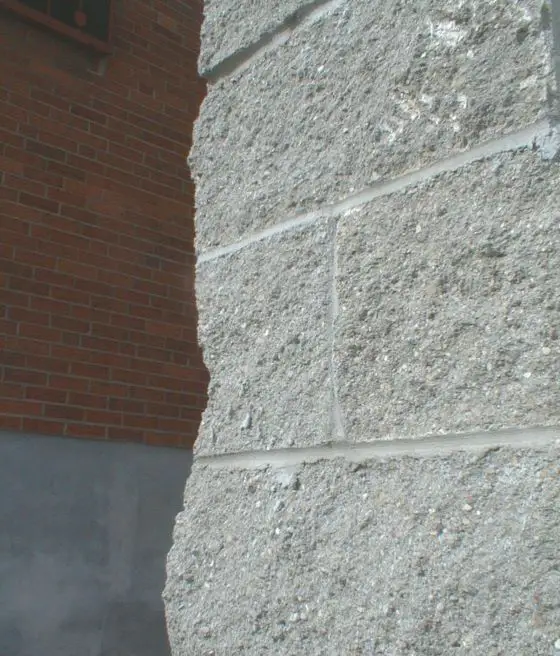
Split-faced block when mixed with brick can add depth, color and character all at once.
You should proceed with your plans to build with concrete block. There are several associations that represent the manufacturers of this material and they probably can show you any number of photographs of homes built with concrete block. My guess is you will be amazed as the block is hidden by other common building materials both inside and out. I strongly recommend that you also hire an architect and engineer who can prove to you they have designed numerous concrete block residential homes. The experience they bring to the table will be invaluable as the plans progress.
Concrete block has been used for years to build residential homes. During the 1950's in many parts of the nation, four-inch hollow block was used as the back-up masonry material for brick homes. The outside of the home was brick, but the inside rough surface was concrete block. Furring strips were nailed to the concrete block and plaster or drywall was then applied as the interior finish surface.
The positive attributes of concrete block far outweigh any negatives aspects. The biggest hurdle will be finding a builder that is familiar with concrete block. All too often certain building methods and techniques get kicked to the curb in favor of newer methods. New does not always mean better, not by a long shot. What's more, there have been many innovations with concrete block over the years. Any decent concrete block supplier can astound you with all of the possibilities and advancements in simple concrete block.

Tim built custom homes and did ultra-custom remodeling for 20+ years before launching his Ask the Builder media presence. He was selected as one of the Big 50 by Remodeling magazine in 1993. This award gave birth to Ask the Builder in October 1993. Tim also operates https://DrawPlumbingPlans.com. His @askthebuilder YouTube channel was the first home improvement channel on YouTube.
I moved to Republic of Panama. Almost all houses and other buildings are constructed with concrete blocks such as these. We have had 631 earthquakes in 2013 and very little damage. I was looking for the material they use here to surface the inside and outside of these blocks. I assume it is quickcrete as well. They smooth out both sides here and then seal them with some kind paint primer and then paint them. It makes it difficult to do things like add electrical outlets or put in any extra plumbing after the fact. Prior planning is necessary but I love these houses and they are tight indeed.
Hi. I am in the middle of buying a manufacturer home
( 28x48 double wide) that is being put on block an stucco. There are telling me that the only way it goes up is 4 inch block bottom to top. I requested in the beginning that it be done
8,6,4 . 8 inch bottom 6 inch middle and 4 inch top block.
So that it will be sturdy an also not wavey. As the 4 inch only even with stucco would be wave an after years of settling be weaker an potential fall. My question is why other then price.will they not recognize that type of wall . Instead of saying 4inch is all we have ever seen. Never heard or seen 8,6,4..
Thanks
Asheville NC