Crawl Space Vents
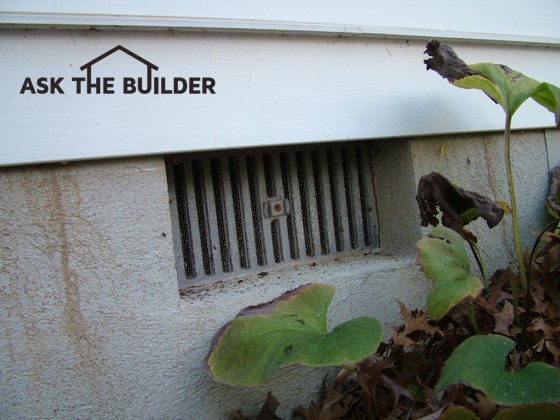
Crawl space vents like this one are supposed to allow air into and out of a crawl space. You need many to get great air flow. © 2018 Tim Carter
"The better idea, in my opinion, is to install a high-performance cross-laminated vapor retarder over the soil in the crawl space..."
Crawl Space Vents Tips
- Water vapor escapes from soil
- Vents can be poor performers
- Encapsulation is better
- Use special plastic barrier
- CLICK HERE to Get Tim's FREE & FUNNY Newsletter!
DEAR TIM: Should I keep my crawl space vents open year round? Are they really necessary? I live in Maryland and get all four seasons and temperature conditions. What's the latest crawl space ventilation technology? Stephen King, Lexington Park , MD
DEAR STEPHEN: There are thousands of people who wonder what to do with crawl space vents. Years ago when I installed them in room addition projects I often thought about the science behind these smallish vents. The actual net free space that allowed air to pass didn't see that big.
How Much Air Flows Through a Crawl Space?
Not much air flows through a crawl space that has just a few small vents.
I'd actually be in the crawl spaces on windy days and could barely feel a puff of air come through the vents. That led me to believe to this day that there was very little science backing up the minimum building code requirements that forced homeowners to install the vents.
Related Links
Crawl space Encapsulation Holds Promise
Crawl space Ventilation Tips - More is Better
Why Do Crawl Spaces Need Ventilation?
Here is the reasoning behind crawl space ventilation. Take a clear piece of plastic and place it over what appears to be very dry ground in your yard. Put some boards around the edges to weight down the plastic so no air gets under the large plastic sheet. If you can do this on a sunny day you will get almost instantaneous results.
I'll bet within minutes you start to see a slight fog develop on the underside of the plastic. Wait longer and the fog will turn to water droplets. The soil around your house and inside of crawl spaces is constantly liberating water vapor. Sunlight, wind and natural evaporation pull this moisture from the ground.
CLICK HERE to get FREE & FAST BIDS from local contractors who deal with crawlspaces.
Where Does The Water Vapor Come From?
The moisture content comes out of the soil. Tremendous amounts of water in the soil drive this water vapor engine.
People who live in the extreme arid parts of the Southwest USA have little water vapor escaping from the soil for much of the year. But even they have a monsoon season and the soil does get wet at certain times of the year.
People who live in the Northwest, Northeast, Midwest, and Southeast have water vapor streaming from the soil year round.
Where Does The Water From My Lawn Go?
The water vapor in the soil out in your yard readily escapes to the atmosphere. But under a crawl space, this water vapor can collect and begin to condense on the foundation walls and the subfloor structure.
If the subfloor is wood, the water can create mildew in short order and eventually the wood will develop wood rot.
What Was the Theory Behind Vents?
The theory for many years was to install the crawl space vents so that outside air could get into the crawl space and lower the relative humidity.
But I'm here to tell you that I have been in many crawl spaces with plenty of open vents and I felt as if I was in a damp cave. I just feel the vents do little good to circulate enough outside air into the confined crawl space.
What's the Best Way to Treat a Crawl Space?
The better idea, in my opinion, is to install a high-performance cross-laminated vapor retarder over the soil in the crawl space in addition to the building code-required foundation vents.
This vapor retarder needs to lap up onto the sides of the foundation and be secured to the wall with treated lumber or rot-resistant wood strips. Tu-Tuf is a great vapor barrier that's been around for years and works well.
CLICK HERE to order Tu-Tuf vapor barrier now.
The best vapor retarders come with a special tape that allows you to permanently seal any seams where the vapor retarder laps over itself or is cut around objects that stick up through the ground in the crawl space.
Do You Still Need Crawl Space Vents?
These vapor retarders block the water vapor and effectively cancel out the need for the crawl space vents. But be careful: My theory may not be synchronized with your local building code if you decide to build another room addition.
CLICK HERE to get FREE & FAST BIDS from local contractors who deal with crawlspaces.
Watch the Encapsulate Video
Watch this video to see what a crawlspace looks like that's covered with the amazing plastic sheeting.
Are Crawl Space Vents a Code Requirement?
Building inspectors may make you install vents. The issue is there are local customs and beliefs that may not be grounded in science.
Each city, town, or county is it's own little building kingdom and the building inspectors are the rulers. No matter what you do, always be sure to check with your local building department and obey the building code in your area.
What About Conditioned Air in a Crawl Space?
Pumping conditioned air into an encapsulated crawl space may be a good idea.
Some local building departments have adopted code modifications that allow a variation of my theory. They permit installation of the vapor retarders as I describe and do not require any foundation vents.
But if you do not install vents, you must insulate the side walls of the crawl space and the heating contractor must pipe in a small amount of conditioned air into the space.
Furthermore, the foundation insulation must be fireproof or if it is not, it must be covered with a fireproof material.
Do I Need Vents With Encapsulation?
No, you do not need vents if you encapsulate your crawl space.
The bottom line is if you install the high-performance vapor retarders correctly, you can forget about your vents. I don't care if you keep them open or closed, it will make little difference.
The proof of concept of this method of encapsulation is widespread. Any home that's got a full basement and has had waterproofing applied to the outer foundation walls and a great vapor barrier under the concrete slab is going to have a delightfully dry basement that's not damp.
The last home I built for my family had this. My basement was as dry as the Atacama Desert. It was never damp, no water got in and there was no mold.
The high-performance plastic used in encapsulation does the same job.
Is the Code a Minimum Requirement?
Yes, the building code is a set of minimum requirements. You can always build things better than what the code says.
Crawl space ventilation is another prime example of how the building code can be argued to be a set of minimum specifications. The building code is indeed a wonderful set of regulations, but it by no means offers a builder or a homeowner the best possible way to do a task.
There are countless examples of where builders can go beyond the code and do extra work or use better materials that will produce a home that will last hundreds of years instead of perhaps 40 to 70 years.
Is Water a Serious Problem?
Water is a serious menace when it comes to residential construction. It can create havoc and misery when leaks develop or even simple water vapor condenses on crawl space floor joists, attic framing or even exterior walls.
The best defense against water vapor problems in crawl spaces is to keep the water in the soil and don't let it enter the crawl space at all. The same is true for concrete slabs poured on grade.
Always install a high-performance vapor retarder under slabs to stop water vapor from seeping through the concrete.
How Do you Stop Water Flowing into a Crawl Space?
Install one of my linear french drains around the crawlspace if you really want to keep your crawlspace dry. This is just a gutter in the ground that collects and redirects the water in the soil.
The water moving through the soil is trying to get into your crawlspace. The narrow trench with the drain tile and gravel intercepts the water and redirects it to a low spot on your land.
Get my Linear French Drain Streaming Video to see how to install this wonderful system.
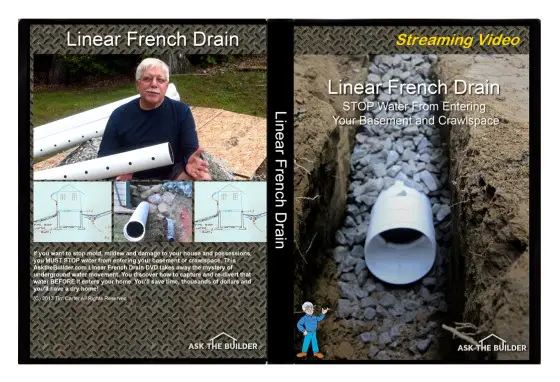
Do your own DIY install of a Linear French Drain with Tim Carter's time-tested methods and materials! CLICK IMAGE TO ORDER NOW!
CLICK HERE to get FREE & FAST BIDS from local contractors who deal with crawlspaces.
Column 543

Tim built custom homes and did ultra-custom remodeling for 20+ years before launching his Ask the Builder media presence. He was selected as one of the Big 50 by Remodeling magazine in 1993. This award gave birth to Ask the Builder in October 1993. Tim also operates https://DrawPlumbingPlans.com. His @askthebuilder YouTube channel was the first home improvement channel on YouTube.

During the rainy season we have a lake under our home in the crawlspace. My home has musty smells and high humidity year round. We are thinking of encapsulating the entire crawlspace, after first installing french drains and a sump pump. The people proposing to do the job (we consulted 3) all say we can then close off all but two of our 22 vents. This makes me so nervous...what if the pump fails when we are out of town...what kind of a moldy mess will we be creating down there with the vents closed? If we encapsulated but left more vents open...would that be a better safer idea?
we have installed many systems like yours; to be on the safe side have your contractor install a battery back up..
I am curious of the logic of the foundation vents. Especially here in the South East. In the Summer the vents are open allowing very high humidity air to enter the crawlspace. If the humidity outside it nearing 80% it would seem that the air in the crawlspace would also become 80% or more. To check this theory I installed a wireless humidity gauge. During the summer with the vents open I would see wild humidity swings in the crawlspace. Anywhere from 80% to 90% humidity. I tried closing them all and the humidity levels were still in the low 80'& range, but stable.
Can you explain?
I've heard about closing off crawl space for air condition reasoning but I never learned about the benefits. I liked how you explained why HVAC contractors do this with the imaging of the plastic on the dry ground analogy. I understand that my crawl space probably needs this.
I have humidity issues in my home. I have recently installed a new heating and air system that is supposed to dehumidify my home but it doesn't work very well. The duct work in the crawl space condensates a lot and so I'm wandering can I encapsulate my crawl space over the damp ground that is in the crawl space or will I have to dry it out first? Will encapsulating eliminate this condensation from the duct work?
Thanks for the article. I’m in a historical old house with only 14 inch clearance. Is there a way to get to the minimum 18 inches?