Remove Clog From Bathroom Sink – Very Easy
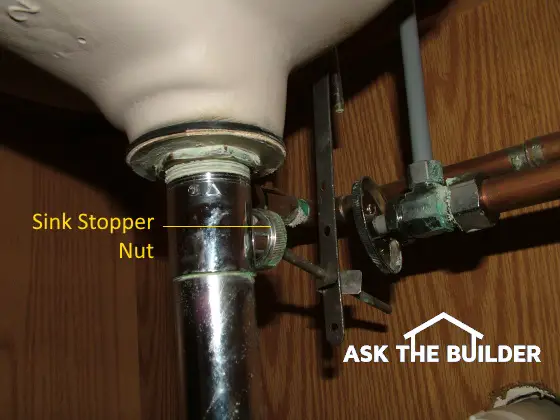
Remove Clog from bathroom sink | The sink stopper nut is just to the right of the yellow text. You can see the sink stopper control rod angling down from the nut. The tips below are SO GOOD that I shared this column with the 31,000 subscribers who read my November 25, 2020 newsletter. Keep reading to see why!
DEAR TIM: My drain in the bathroom is stopped up. My husband took the trap off under the sink, but the drain is clogged up above that. He cannot figure out how to get the stopper out of the sink, that metal button that you can push down and pull up. Can you tell us how to do this? Christie G., Canton, GA
DEAR CHRISTIE: You're suffering as many people do. What appears to be a somewhat large pipe, the 1 and 1/4 inch diameter tailpiece leaving the bottom of the sink, is actually clogged with parts the day it is installed. The sink stopper and the control rod that allows it to move up and down are all inside this pipe before the first drop of water and any debris starts its journey to your sewer or septic tank.
How do you remove the sink stopper?
To remove the stopper and its control rod, you must remove a round nut that is on the backside of the drain tailpiece pipe. If you get on your side or your back and look under and behind your sink, you will see this round nut. It is often shiny chrome and has small knurls in the nut instead of large hexagonal edges like a nut that goes on a bolt.
CLICK or TAP HERE to get FREE BIDS from local handymen that can fix the clog CHEAPER than a plumber!
Nut Loose - Pull the Control Rod Out
Once the nut is completely loose, pull the stopper control rod out of the back of the tailpiece drain pipe. There will be a round plastic ball attached to the end of this rod.
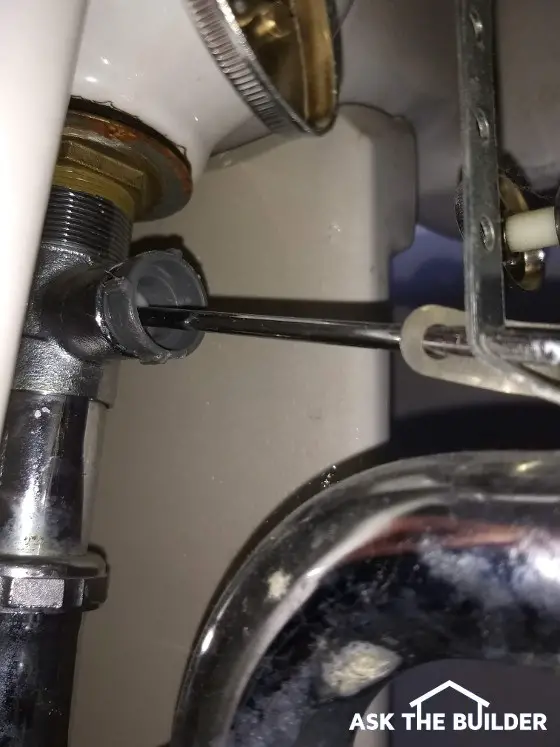
Put your head under your bathroom sink and this is what you’ll see. That horizontal chrome rod lifts the sink stopper up. (C) Copyright 2020 Tim Carter
Pull the Stopper Up and Out
Once the control rod is out of the tailpiece, the stopper will pull up from the sink. It will probably have all sorts of bio-organic goo, hair and crud on it, so be prepared to get disgusted. I would wear rubber gloves if you have any open cuts on your hands. This organic mess is loaded with millions of bad bacteria that can cause serious infections.
Remove the biomass from the stopper and clean it. Do the same with the end of the control rod ball and the metal tip sticking out of the end of the plastic ball. All parts need to be clean before you reassemble them.
Clean Sides of Drain Pipe
But before you put everything back together, you should clean the inner walls of the tailpiece that leads from the sink down to the P-trap piping. You can do this quickly with a 1 and 1/2 inch bottle brush and an empty bucket.
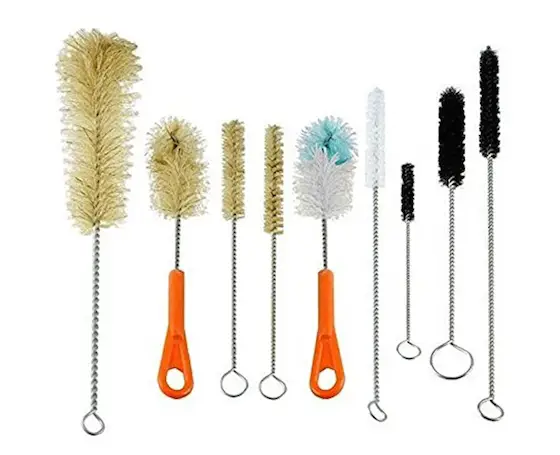
These are typical bottle brushes. You want one that has a diameter of at least 1 and 1/4 inches. A 2-inch diameter one is great for shower drains. CLICK or TAP HERE or THE IMAGE TO BUY THESE NOW.
Use a Bucket to Capture Splash Water
Simply place an empty bucket under the tailpiece and turn on the water in the sink while you move the bottle brush up and down in the drain outlet hole. Be sure to push the bottle brush down as far as you can. You may have to insert the brush from below as well as the top to clean the entire length of the tailpiece.
Cleaning the inside of the tailpiece helps control odors in bathroom sinks. The biofilm buildup that grows on the pipe walls can release odors each time water is run in a sink.
Column 550

Tim built custom homes and did ultra-custom remodeling for 20+ years before launching his Ask the Builder media presence. He was selected as one of the Big 50 by Remodeling magazine in 1993. This award gave birth to Ask the Builder in October 1993. Tim also operates https://DrawPlumbingPlans.com. His @askthebuilder YouTube channel was the first home improvement channel on YouTube.
kitchen drain clooged, double sink,all pipes to trap r clean pipe goes into wall then to riser also in wall.there r 4 elbows past trap all other drains in house r good, cant get snake past 2 elbows, tried drain cleaners,no good,water goes down very slowly,hrs.
Hi Tim: My wife has very long hair that is always getting caught on the stopper rod and clogging the sink. I went to Harbor Freight and purchased long surgical forcipes. Every time she starts complaining, I remove the stopper and with a flashlight to see, pull out the clump of hair. Problem solved until next week.