Composite Decking

Here's a multi-level deck covered with generation-three Trex Transcend composite decking. I built the one with the table and umbrella on it in the summer of 2016 with my own hands. The upper deck was original to the house, but I stripped it and installed all new decking, railing and low-voltage lights. Copyright 2017 Tim Carter ALL RIGHTS RESERVED
Composite Decking TIPS
- Modern composite decking materials are a blend of wood and plastic
- Water can penetrate some composite decking materials causing the wood to rot
- Watch the composite decking video below
- Composite decking capped with solid vinyl offer the best protection against deterioration
- CLICK HERE to Get Tim's FREE & FUNNY Newsletter!
DEAR TIM: I'm thinking of building a deck and am leaning towards composite decking material for the decking, railings, and other accessories. I'm wondering about positive and negative feedback you may have heard on these products.
Are there any other things I should be concerned about regarding the construction and long-term maintenance of the materials? Joe R., Jefferson County, CO
DEAR JOE: Outdoor deck components including decking, railings, spindles, post wraps and caps, etc. that are made using a mixture of plastic and wood or other cellulose material are a rapidly growing building products category.
Composite Decking Industry Growth
You were possibly wooed by the extensive amount of advertising this industry is spewing out to consumers and contractors alike. Some of this advertising states that the composite decking materials will not rot. These particular claims made by some of the manufacturers, though, may come back to haunt them. Read my August 14, 2008 Newsletter for an interesting update.
Additional Composite Decking Articles
Composite Deck Rot and Maintenance
Free & Fast Bids
Generation One Composite Decking Materials
These composite decking materials first started to appear in the early 1990's. Trex was the one of the first manufacturers intended for its products to be very environmentally friendly. They made their composite decking material by combining recycled plastic milk cartons and discarded shipping pallets.
Many of the other competing products are now made using virgin plastic and cellulose fibers or flour and/or a blend of virgin products with recycled materials. Some are still made with 100 percent recycled materials.
Pros and Cons of Composite Decking
Depending upon whom you talk to, you will get both positive and negative comments about composite decking. Some homeowners on the East Coast were so unhappy with one of the brands of composite decking, they filed a law suit in a state court.
Somehow this case was certified as a class action in that one state. Rather than fight expensive future legal battles in a number of different states, the decking manufacturer decided to agree to a national settlement.
By doing this, any evidence or lack thereof concerning the plaintiff's claims was never disclosed in a public courtroom. Many people refer to this legal action the Trex class action lawsuit.
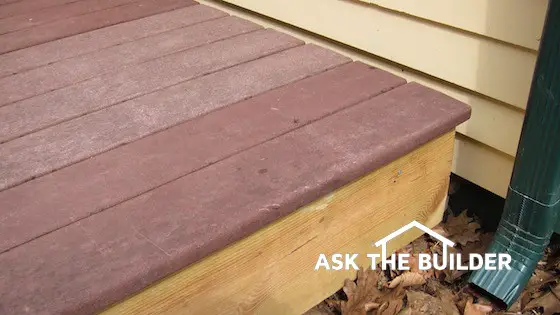
This is generation one Trex composite decking. It was on my front porch when I bought my current home. You can see that the new generation three Trex Transcend is a vast improvement. Copyright 2017 Tim Carter ALL RIGHTS RESERVED
Scientists Study Composite Decking
Several renowned scientists have also discussed composite decking materials in three separate professional white papers published between September 2001 and December 2002 in the Forest Products Journal.
The findings in these three papers indicated that the wood fibers and other cellulose products used in the composite decking products they tested can and does rot if they're not treated with a preservative.
High Wood Content
At first blush, this may not seem like a big issue; the average person might think that the wood or cellulose content of composite materials is low. But it appears many of the products have a cellulose and/or wood fiber content of nearly 50% of the volume of the product and in some it can climb to nearly 70%.
Laboratory tests have shown that some of the composite decking materials can lose between 10 - 20% of their overall weight over time, which translates to a possible 40% or more loss of wood content due to rot.
In an effort to get to the bottom of the issue, I decided to interview fifteen of the most prominent composite decking manufacturers. I sent them a series of written questions asking about their products, whether their raw ingredients are virgin or recycled, whether they were aware of the Forest Products Journal white papers, whether they use a preservative in their products and a few other generic questions. Only one company of the fifteen responded, and they provided concise written answers to my questions. I found the silence of the other 14 manufacturers to be very disturbing.
IMPORTANT Author's Note (October 2017): This column was originally written on or about June 2004. Since that time several of the fifteen companies have gone out of business or have merged with the stronger composite decking brands.
What's more, when this column was authored, there were only generation-one composite decking products available for the most part. The industry has since matured and fixed many of the issues that were brought up in this column.
See below about the Latest Technology for what you should be looking for in a composite decking material.
Composite Decking Video
Here's a fascinating video that shows you just a little something you can do with composite decking.
Treat Wood With Borate
Further investigation revealed there is at least one preservative that can and is incorporated into at least one of the composite decking materials. This simple chemical - zinc borate - can be blended with the wood or cellulose component as the decking is manufactured.
The borate in the preservative acts as a poison to many fungi that typically would consume the wood fiber and produce wood rot. The zinc borate preservative is also long-lasting. It can remain active in the composite decking materials for 20 or more years.
Wood Fibers Must Be Protected
Most untreated lumber exposed to the elements rots over time. Don't think for a moment that the wood or cellulose fibers in the composite decking materials are totally surround and protected by the plastic component.
That is not the case. The wood and/or cellulose fibers not only can be readily seen at the surface of the products and at all cut edges, they are randomly interconnected throughout the entire length, width and depth of each board. Water can and does soak into many of the original composite decking materials and this water fuels the wood rot process in those materials that do not contain a preservative.
Latest Composite Decking Technology
If you are going to use composite decking material, you should consider buying one that contains preservatives. If you can't locate one that has that, then take a serious look at the latest composite decking materials that have a solid vinyl cap that prevents water from getting into the core of the product.
I put this capped composite decking material on my own decks and so far it's holding up great. What's more, the graining and coloration technology has advanced to a point where many of the latest composite decking materials look extremely realistic
Follow Composite Decking Installation Instructions
More importantly, be sure to follow the written installation instructions to the letter. Creating gaps between decking boards, spacing of other components and support joist placement are critical. If you fail to install the materials correctly, you or your builder may void the warranty.
Important News:
August 19, 2005 -
The U.S. Product Safety Commission has issued a Recall for certain Geo-Deck™ Decking and Railing Materials.
As of this date, they have received 370 reports of accelerated degradation. The composite material can fail and create a fall hazard to consumers.
This is a very serious matter.
Click here to read the full text of the recall notice.

Tim built custom homes and did ultra-custom remodeling for 20+ years before launching his Ask the Builder media presence. He was selected as one of the Big 50 by Remodeling magazine in 1993. This award gave birth to Ask the Builder in October 1993. Tim also operates https://DrawPlumbingPlans.com. His @askthebuilder YouTube channel was the first home improvement channel on YouTube.
Just read this article, unfortunately 10 years late. I'm very interested in the list of fifteen manufacturers contacted, and which one responded.
Larry,
Go back up and read the added IMPORTANT Author's Note in red.