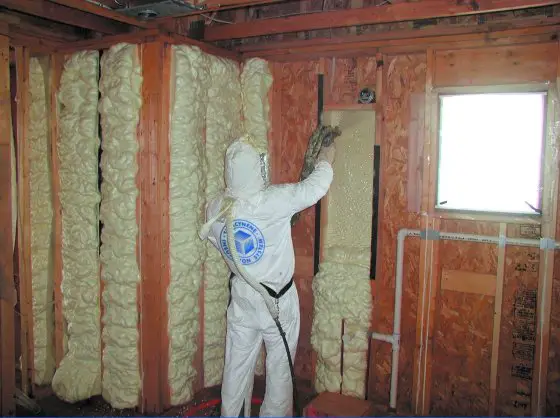
Foam Insulation


To add a comment visit the Article Page.

Comments

Adem
15 Feb 2008, 09:51
Is icynene still regarded as the foam insulation of choice? From what I understand, it's of the open cell variety which allows for the escape of water vapor. I'm about to have this applied to my addition; and pour formula to retrofit the 100 year old walls. The addition was framed using 2x6 lumber which I assume should allow for more material in the stud bays... Also, is advisable to apply the icynene to the attic floor? Thanks in advance for all insight.
AsktheBuilder
15 Feb 2008, 17:37
Adem,
I can't endorse any product for obvious reasons. But I can tell you that I am giving it *serious* consideration for my new home up in New Hampshire.
Adem
16 Feb 2008, 07:42
OK... but would you install open cell spray foam in the floor of an unfinished attic. The attic has a furnace living up there... Thanks!
AsktheBuilder
16 Feb 2008, 10:29
Adem,
Possibly yes...... depends on the con of loosing access to buried cables....... and what about roof leaks? How long does it take for that foam to dry?
Dean
17 Feb 2008, 15:23
I build in upstate New York and have used both the open cell and closed cell foam insulations. The closed cell, in my opinion, is a much better product, with higher r-values per inch and inherent vapor barrier properties it possesses. Technically, a vapor barrier is required over Icynene foam, due to its ability to transmit moisture (open cell).

In comparison to Fiberglass insulation the closed cell foam outperforms by a factor of 2:1 in real heat loss. Here's why: Fiberglass insulation will absorb moisture in the wall cavity due to normal water vapor transmission unless the vapor barriers are caulked and sealed and NO penetrations exist. Typically, an R-19 or R-21 wall is reduced to an effective R-value of 10 or 11 once moisture has penetrated the wall cavity. Add the air infiltration resistance of foam insulation (air infiltration accounts for 35 to 40% of your heat loss) and the spray foams are a hands down winner over fiberglass products.

For cost reasons, I am insulating exterior walls, basement walls and all rim joist cavities with closed cell foams and insulating horizontal attic cavities with a 6 mil poly vapor barrier and R-49 blown in fiberglass. Cathedral or vaulted rafter framed areas get spray foamed as well.

The only additional consideration is an HRV, an air exchanger that maintains fresh air quality within the home.
Adem
17 Feb 2008, 17:39
Dean,

By spraying the rafters, aren't you concerned about the attic and shingles getting extremely hot during the summer months? Couldn't this possibly shorten the life of the shingles? How will the attic air be vented?
Dean
18 Feb 2008, 12:23

Adem-

In the cathedral/sprayed rafter areas, there are two methods that can be used.
One, is to spray foam directly to the back of the roof sheathing, with out the ventilation from the soffit to the ridge vent. This sprayed in place foam application is no different than using pre-insulated stress skin foam panels that are commonly used in timber frame construction (3 or 4" foam with an outer skin of osb and an inner skin of either osb or drywall). I have done this on projects and after 10 years, the shingles are fine. You can verify the suitability with the shingle manufacturer.
The other method is to install the normal proper vents in the bays and spray foam over them. I personally prefer the "hot roof" application of spraying the foam directly to the back of the plywood roof decking. The primary reason for the proper vents is to vent moisture laden air from the rafter bays (as would occur with fiberglass). Since the closed cell foam insulation totally precludes the moisture situation, the ventilation is not really a necessity.

Dean
18 Feb 2008, 12:51
Adem--

by the way, the attic space does not get hot.
Dan
19 Feb 2008, 09:44
I used insoylate (open cell) spray foam in my 3 year old tinmber frame home. In the past 3 years I have had water vapor leaks running down the side of my wall(it is not in the same spot); usually in a corner.
I am almost sure that the fault of this is poor appliation leaving several voids in the product, no vapor barrier (which was not reccomended by the contractor), and no proper venting.
I think the moisture seeps through the tongue & grove pine celings, freezes in the voids next to the blandex roof, and when it gets warm out, the moisture runs down the wall.
What do you think? I am very concerned about mold, rot, and the integrity of the home.
Please help!
Dan
Dean
20 Feb 2008, 14:12
Dan-

It's definitely a vapor barrier issue. The dew point (the point at which moisture condenses into water) is 1/3 of the way into the R-value of any wall or ceiling assembly. With open cell foams, they can wick moisture into the insulation. As it (the moisture vapor) migrates through the insulation and hits the dew point area it condenses into water. This can be ugly, as it is a constantly occurring cycle, year after year. Unfortunately, there isn't an easy fix your your situation now that all interior finishes are applied. I would call the insulation contractor back and press him on the issue. Hopefully you have a certificate of insurance from him that has completed operations coverage. Voids in the insulation would contribute to the problem, but the lack of an impervious vapor barrier (either sprayed on [a product like Supergreen Lam]or a 6 mil poly vapor barrier with joints taped with tyvek tape or equal)is definitely the main issue.
Adem
20 Feb 2008, 14:42
Dean,

So, you think I should apply a vapor barrier over the open cell spray foam, then drywall? Would you recommend a 10mil vapor retarder? I have some remaining after using it under the slab in my crawl-space.
Adem
23 Feb 2008, 08:19
So, you would put a vapor barrier/retarder over the open cell foam insulation? I've got some 10 mil left-over vapor retarder from my concrete slab that I might use behind the drywall. Is that a good idea?
AsktheBuilder
26 Feb 2008, 19:57
Dan,
I would pretty much agree with you.
Adem
28 Feb 2008, 11:43
I have drywall going over my open cell spray insulation on Saturday. I'd like to know if it's recommended to place a vapor barrier over the spray foam before the drywall gets put on. Thanks in advance.
AsktheBuilder
02 Mar 2008, 17:34
Adem,
Yes.
Dean
16 Mar 2008, 20:20
Adem-

Sorry I didn't get back to you earlier, I've been quite busy with some projects... but by the sound of it, you're on the right track with the vapor barrier over the open cell foam insulation.
Ted Wells
07 Apr 2008, 14:28
Greetings,
I remodeled my kitchen and because the skylight required a total ceiling tearout and new micro beams to hold up the roof, I am considering using closed cell foam to insulate.
I want to use 7" around the skylight tunnel which will give me R49. However I feel I may as well continue the insulation over the kitchen ceiling which will be plaster (13'4' X 13'6") The electrician has said that electrical boxes to ceiling fixtures cannot be covered and must have something like a foam box put over it (like they do with roses in the winter) to allow access to the wire connections. Also, I will have recessed lights which are I.C rated. However with closed cell foam around it, would it still present a fire hazard? He says the I.C. is only rated for fiberglass or blown-in insulation

Thank you,
Ted
AsktheBuilder
12 Apr 2008, 06:26
Ted,
You need to get an okay from your local building inspector. I would also call your local fire department and have the fire-prevention officer stop by for an opinion. You do not want to gamble with this situation.
Anne
12 Apr 2008, 15:09
Hello there,
I have attempted to type this 3 times. Each time my questions get shorter, so here goes.

I have a 70+yr old slate roofed cape style home in upstate NY. I am thinking of pulling out the fiberglass and getting blown in foam. I have spoken to both open and closed cell reps and neither brought up the moisture issue. The roof has no ventilation fan or vent. Am I getting myself into trouble with this project? Part of the upstairs is unfinished. If the roof leaked with open cell I understand I would readily see it. Closed cell I understand can divert a leak to another location, requiring one to go in search of the damage.

My other concern is with the basement. Both reps advise foaming the box sills to prevent the airflow into the house. As I have a moist basement wouldn't I make that damp smell worse if I seal off the air movement?

I need all the advise I can get.

Thanks
cyndy
18 May 2008, 00:40
I have a cement block building that I am converting into a home. It is 120 ft by 30 ft with 12 ft ceilings. Do you think it is economically feasible to look into framing out the exterior walls and using spray foam or would regular insulation be enough to keep me out of the poor house with my utility bills?
www.roofcrafterswest.com
27 May 2008, 00:15
If you are going to put foam in your house, talk with your architect/contractor about down-engineering your home. You may be able to get away with 2X4 where 2X6 lumber is needed to give enough space for conventional insulation. Also look at a smaller HVAC system.

Kindly,

Brian Hunt
www.roofcrafterswest.com
Melissa
04 Jun 2008, 12:11
I have an old pier and beam house. Is it ok to spray foam insulation under the house? I have lots of air seeping thru the floor. Would I need to put some type of moisture barrier between the faom and subfloor?
Peter
05 Jun 2008, 13:06
Greetings: I have been researching foam and after reader the comments here, I am sold on the closed cell product. I recently bought a 15 year old home that was very well built. It was a foreclosure and I suspect sat empty for about a year. There was some water damage on the wall of the back of the house from snow build up on the deck so I tore out the sheet rock and found a fare amount of water damage and mold, etc, as I suspected. Going further, I decided to pull down the rest of outside walls in the living room, and the back of the vapor berrier was full of mold. Worse than the water damaged area? THe house is 2x6 construction, Built Rite Sheithing, 6" unfaced glass, 6 Mil Poly and 5/8 rock in Northern MN. I would not have suspected mold elsewhere in the walls, but now I am going to take it the studs everywhere. The wall cavities themselves and the studs are clean as the day they were put in. Just the Clear Poly -- now Black from Mold - and the fiberglass appears to be bad.

Can anyone tell me about what the upcharge over fiberglass is for a spray in for the whole house. I am planning on a complete renovation for the house with radiant floor heat, ground source heat pump, etc, etc, etc.

Regards;

Peter
Rich Pace
09 Jun 2008, 20:00
I have heard that open cell will hold water if the "skin" is not removed. This could possibly explain the issues with water running down the wall cavity in the post above. Open cell in the ceiling is not usually "skinned" but ironically the open cell in a wall cavity is (to fit inside the studs). This is also bad since you are basically now placing a sponge in the wall cavity to absorb any vapor that might enter from inside or outside. I am in the mold business and have seen this a few times. My opinion is closed cell is the way to go. Look at www.buildingscience.com.
Dean
10 Jun 2008, 13:47
Referring to the previous two comments, I just finished closed cell spray foam on a project in Saratoga, NY. We sprayed 3 inches in the exterior walls of the 2 x 6 wall framing. The cost per square foot at that thickness was $3.90 per square foot. As a rule of thumb, figure about 1.33 per board foot (one square foot x 1" thick)

The open cell foam will wick moisture regardless of "skinning". The idea is to keep the moisture from penetrating the insulation from the heated side (which will have the moisture laden air) a spray applied membrane or 6 mil poly vapor barrier (with sealed joints) is the best way to accomplish this.

As a side note, when using closed cell foam for a whole house application, an HRV is recommended for fresh air supply, as the overall envelope will be sealed vitually air tight. This is great, as long as you combine systems to give you an energy efficiency, comfortable and healthy house. I'm using a company out of Utica call Standard Insulating Company of Utica. They are experienced professionals. I'm interviewed numerous insulation contractors, but there are many that buy the equipment and don't have the knowledge or equipment to do the project correctly.
Dave Wesely
28 Jul 2008, 16:22
I just purchased a house to discover the short (5 ft.) cathedral ceiling above a 6 ft knee wall has fiberglass batting insulation packed in it between the drywall and roof sheathing. The roof vents are in the peak above the cathedral ceiling. So the insulation acts as an air filter between the two attic spaces. I could push down the insulation with wood slats, but I would rather do a better job with closed cell polyurethane slow rise insulation under ventilation baffles. This requires removing the roofing sheathing, but I want to install a bathroom fan vent through the roof and that access is only through the roof sheathing. My question is twofold. Am I making too much work for myself? I have yet to find any info on insulation a the foot of knee walls where the ceiling/floor joists come out from the "conditioned" air space. Could I use the same closed cell insulation on top of some fiberglass packing at the opening to create a vapor/infiltration barrier there? (The space between the ceiling and floor is not insulated.)
Richard Michaels
04 Aug 2008, 17:14
I am extensively remodeling my condo. I can hear people walking on the floor above me. What kind of insulation (or whatever) will best deaden or eliminate the sound?
mike
02 Sep 2008, 09:54
I live in pensacola fl. and I would like to know if the foam insulation could act as an adhesive to help bond the roof permantly to the shell of the house and to the other rafters? I'm thinking that it could help prevent the roof from going bye-bye in a hurricane.
Kim
07 Sep 2008, 18:14
I noticed the video for spray foam insulation. Are there any special techniques for existing homes with window framing in place? Would this require us to completely remove window framing?
Thanks,
K
robin
13 Sep 2008, 10:26
Dan;
I am about to use closed cell spray insulation under the floor of my raised 25 yo house in Southern MS. I have concerns about unseen plumbing leaks etc. but feel closed cell far outperforms fiberglass or open cell in this application. Do you agree and what are the differences among the different manufacturers of closed cell foam insulation??
Robin
Chris
27 Sep 2008, 14:25
Dean and Dan - I am a complete novice in terms of building and have read your helpful posts. Just wondering if I could clarify and get your take on my situation.

I have a 1948 brick colonial in Virginia and recently installed a UNICO system for HVAC in my attic. The attic currently has very old loose cellulose insulation in the attic floor. The roof was recently replaced, and we found that the original wood plank decking was sound (a few planks were replaced). I would like to go with a closed-cell foam insulation installed in the 'hot-roof' manner you described. But will this trap our hot humid summer air inside the attic and overload the UNICO handler? Any thoughts/suggestions?
Thanks.
Kelly
09 Oct 2008, 12:44
This is actually for DEAN:

Hi! I know this post is from quite a few months ago.... I am hoping notification goes out on new posts!!

I noticed you said you do work in upstate New York, where I live :-) I have been searching for a foam insulation contractor in the Westchester area for weeks and am unable to find anyone that does closed cell or anyone that something other than Icynene. Our house was built in the early 1900s and is 2x6 stud balloon frame, parts of some walls have fiberglass insulation. The house is stucco with wood sheathing and tar paper underneath. We are going to be replacing the stucco one side at a time and figured that would be a great time to insulate- the house is extremely humid and damp over the summer and extremely energy ineffecient (oil heat I might add), an in a very wet location. If you know of anyone in our area that does this type of work it would be great!!! if you post back I can reply with contact details :-)

Thanks!
Gavin
09 Oct 2008, 18:52
One note on the article about the R-value determinig your energy savings. Because you have the same R-value insulation does NOT mean your energy bills will be the same. R-Value is currently a hotly debated topic in the insulation market. The issue is over the effective R-value of foam over the effective R-value of fiberglass or cellulose. There are numerous case studies proving the energy savings of foam. In Dallas/Fort Worth, TX, two indentical houses were built side by side. Everything was the same, except the insulation. One was fiberglass, one was foam. After completion the houses were heated and cooled throughout 1 year to observe the difference in energy consumption. The foam houses consistently proved to be over 40% more efficient than the fiberglass house. On a more personal note, a friend of my wife's has owned two rather large houses, around 4,000 sq. ft. One was fiberglass insulated, one was foam insulated. The fiberglass house utilities ranged from $300 to $900 per month, her foam home bill never touched $300 year round.

For qualifictions let me just say that I worked for the largest foam insulation chemical manufacturer. I've also installed and sold the product. I haven't been privilaged to build a home yet, but when I do it'll be foam all the way.
Tamara Upham
13 Oct 2008, 18:44
If you apply the closed cell insulation pray foam between wall studs and then cover with sheet rock, does that preclude ever running new electrical wire behind the walls? Should conduits be put in place for future possible electric needs.

Also is it possible to spray foam into the space between the interior and exterior walls of a (1920s) house that currently has no insulation? Can the closed cell foam be applied evenly in vertical spaces if the walls are not open (through holes in the exterior shingles?) Thanks. -Tam
Gavin
14 Oct 2008, 12:10
Tamara,

When you spray closed cell foam insulation it only takes a little over 2 inches to meet the standard R-13 requirement. Since foam is sprayed on the backside of the exterior sheathing, this leaves over an inch of space between the foam and the sheetrock. So adding new electrical wiring down the road should not be a problem.

Regarding the existing house situation, there are several companies that have with is called a pour foam, which is just a slow reacting open cell foam. However, there is a lot of risk involved with this method so be sure any contractor you hire has experience using this technique.
Scott Waste
20 Oct 2008, 22:09
Tim. my name is Scott Waste I own a spray foam and coating company and have a master contractor status with Apex Foam industries. I just read your artical about useing open cell foam in a attic so as it can leak water through itself if you have a roof leak so you know you have a leak. The reason i am writing this is to say that when open cell foam gets wet it holds mosture like a sponge and takes over 20 times longer to dry than if fiberglass was used, with that statement i propose useing closed cell foam for the fact that it is a vapor barrier by itself and will not absorb water and the exaporating time of water if the roof would leak would be much quicker at the decking underside there for not doing the damage that if you had a sponge against your roof boards.It wont let water through itself and why it is also a roofing surface approve system.Would love to talk at anytime about foam and coatings if you ever would like to , Thank you Scott waste 763-238-6310
Rhonda
21 Oct 2008, 07:07
Dean,

In what sort of climate does this "hot roof" application exist? I live in a very snowy part of the Midwest. After your comment, I am doubting the "cold roof" application in which my contractor would install furring strips then decking and new roof over the old roof. My roof joists are old-style 4X's and we'd like to finish the attic, so we need as thin an insulation as possible.

Gary Burchfield
24 Oct 2008, 23:06
I'm building my first home and I want to do things right. My ceiling height is vaulted to the eve and my rafters are 2x10's with an 18" LVL which supports the whole roof which is metal. do I need to worry about moisture forming on the exterior of my ceiling if this is air tight?
Rick Franco
05 Nov 2008, 13:13
Icynene is a good insulation, but I have found that BioBased soy based insulation is better and carries a higher R value and is made in the USA using american soy oil in part instead of imported petroleum. Both are open cell foams.

Makes sense to me.


To add a comment visit the Article Page.

Have a Suggestion?